

Is IB harder than university?
Most students ask this question in the same moment: late at night, surrounded by half-finished problem sets, a TOK outline that still doesn't feel like a thought, and an IA draft that has been "almost done" for two weeks.
It's not really a comparison question. It's a fatigue question. A meaning question. It's your brain trying to locate the edge of the map: If I can survive IB, will the next stage finally be easier?
The honest answer is nuanced: IB can feel harder than university because it compresses many different kinds of difficulty into the same two years. But university can surpass IB in depth, pace, and independence once you hit advanced courses.
This guide breaks down what's truly hard about IB, what university does differently, and how to prepare for IB exams with a calmer, more strategic system.
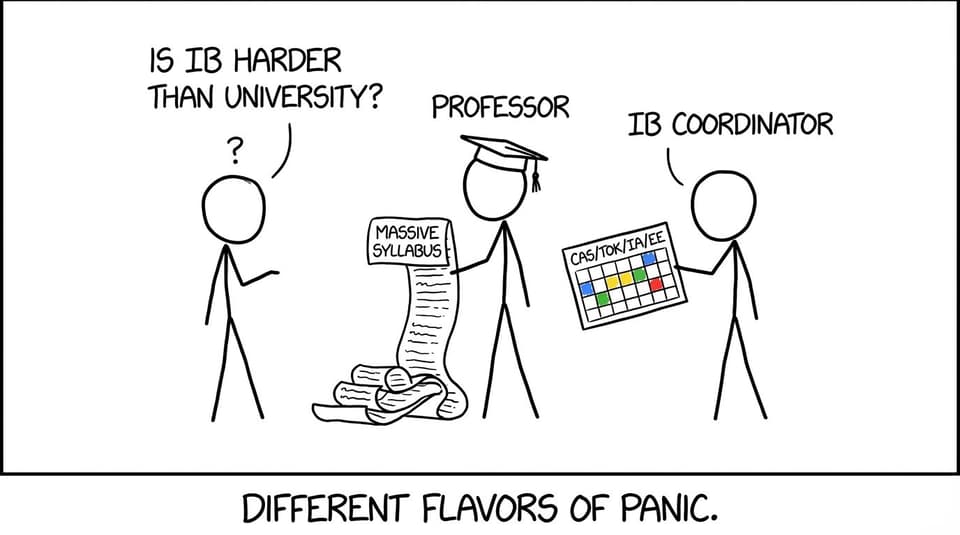
The quick checklist: why IB can feel harder than university
If you're trying to decide whether IB is harder than university, start with a practical checklist. IB tends to feel harder when it has:
- More simultaneous subjects (six at once, every week)
- More overlapping deadlines (IAs, EE, TOK, CAS alongside tests)
- Less control over pacing (your calendar is not fully yours)
- Constant assessment pressure (internal and external, all year)
- Tighter markscheme expectations (precision over vibes)
University tends to feel harder when it has:
- Faster content coverage (especially in STEM)
- Fewer checkpoints (you can drift for weeks, then crash)
- Higher independence (no one chases you)
- Bigger stakes per assessment (one exam can define the course)
The key is this: IB often feels like juggling. University often feels like climbing.
What "hard" actually means in IB
When students say IB is hard, they usually mean one of three things.
The workload is wide, not just deep
You're not only learning content. You're switching contexts constantly: from HL calculations to English commentary to TOK claims to CAS reflections. The cognitive cost isn't just "study time." It's the mental gear-shifting.
That's why students who are brilliant in one subject can still feel overwhelmed in IB. The program rewards range and consistency, not just intelligence.
If you want a structured way to manage that range, use the system described in How to Study for IB Exams: Step-by-Step Guide and anchor your week to small repeatable loops.
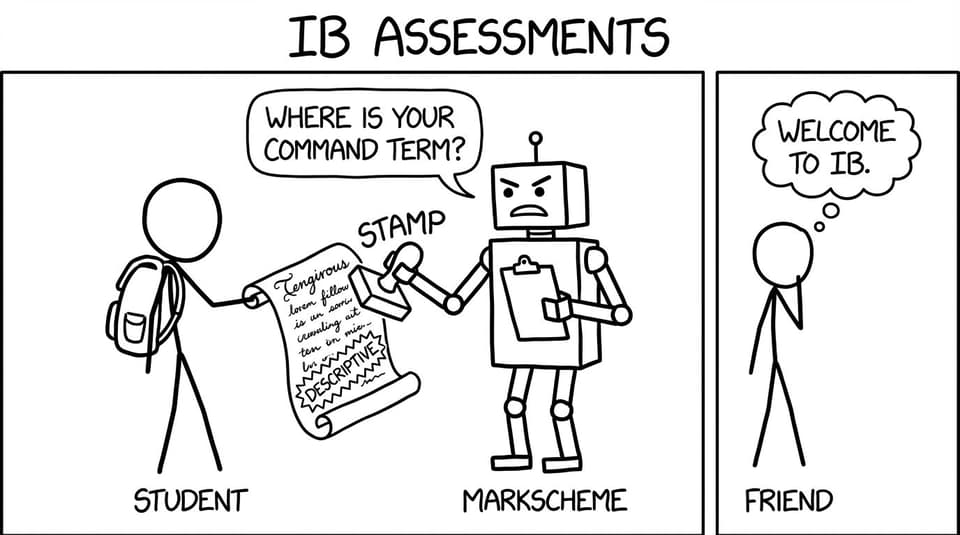
The markscheme is a second curriculum
In IB, the difference between a 6 and a 7 is often not "knowing more." It's knowing what counts.
That means command terms, structure, units, method marks, evaluation criteria, and paper-specific habits. This is why targeted practice matters so much: you're learning the language of scoring.
A good starting point is drilling in a true exam-style bank like Questionbank, where practice is designed to behave like your IB papers.
The difficulty is emotional as well as academic
IB is a two-year project with public outcomes. Your calendar becomes a mirror. You can feel behind even on good days, because there is always something else you could be doing.
That's also why good tools matter: not to make you study more, but to make studying less ambiguous. When the next step is clear, the stress drops.
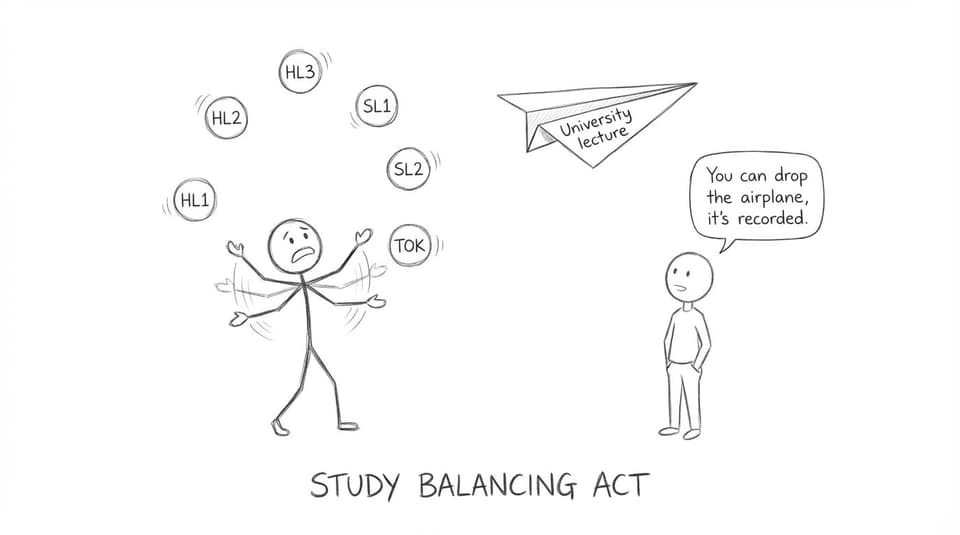
How university is different (and why it sometimes feels easier at first)
Some IB graduates arrive at university and feel a strange relief. It's not that the material is always easier. It's that the structure is different.
University often gives you fewer moving parts
Instead of six subjects plus core, you might take three or four modules. That narrower focus can feel lighter, even if each module is deeper.
University often gives you more flexibility (and more risk)
Lectures may be recorded. Tutorials may be optional. Deadlines may be less frequent.
For an IB student, that can feel like freedom. But freedom is a skill. University difficulty often shows up later, when no one is checking whether you understood Week 3 before Week 9 arrives.
University depth can exceed IB quickly in the right subjects
In many STEM degrees, pace and abstraction increase fast. In humanities, the reading load and expectation for original argument can surpass what you practiced in IB.
So if you're asking "Is IB harder than university?" the real question becomes: Harder in what way, and when?
So, is IB harder than university? A clearer verdict
Here's the most accurate framing for most students:
- IB is harder in breadth and structure. You're doing many subjects, many deadlines, and many formats at once.
- University is harder in depth and independence. You are expected to self-manage and go deeper with less guidance.
In other words, IB is often the harder schedule. University can become the harder intellectual environment.
If you want to feel more confident right now, the win is not debating difficulty. The win is building an exam system that makes IB predictable.
How to make IB feel easier than it is (without lowering standards)
You don't beat IB with motivation. You beat it with a loop.
Use the "learn -> test -> retain -> repeat" loop
A high-return IB study block looks like this:
- Learn quickly with IB Notes (aim for clarity, not perfection)
- Test immediately with the Comprehensive IB Question Bank
- Retain with Flashcards (daily, short, consistent)
- Get unstuck with AI Chat inside RevisionDojo (ask why marks were lost, then retry)
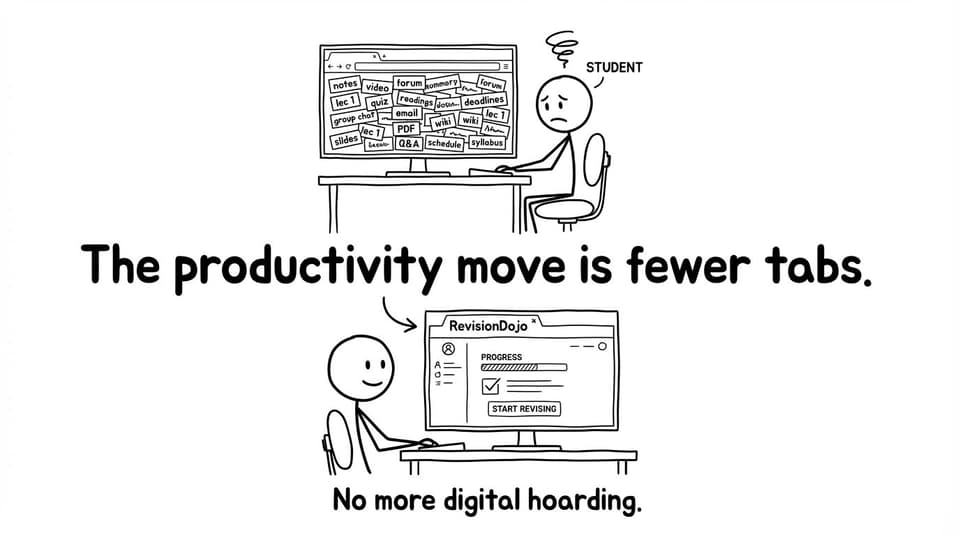
This is where RevisionDojo becomes more than "resources." It becomes the control panel: Questionbank, Study Notes, Flashcards, AI Chat, plus Mock Exams and Predicted Papers when you need timing realism.
Train the exam, not just the topic
University often rewards understanding. IB rewards performance under constraints.
That's why timed practice matters. Use the workflow in How to Run Timed IB Mock Exams in RevisionDojo (Exam Mode + Test Builder) to build pacing early, not in the final week.
If your subject offers it, add realism with IB Math AI Predicted Papers (or your subject's predicted sets) to reduce exam-day surprise.
Don't let coursework leak into exam panic
Coursework is part of IB difficulty because it's always "open." It can silently steal your revision time.
RevisionDojo helps you create boundaries using Grading tools and the Coursework Library: you draft, you get rubric-aligned feedback, you apply the top fixes, you stop. That containment protects exam season.
If you need an overall strategy reset, What's the Best Way to Revise for IB Exams? gives a clean blueprint.
A simple 7-day IB plan that mimics university-level independence
If the fear underneath your question is "Will I cope later?", try this: run your next 7 days like a university student, but with IB precision.
Daily (30-60 minutes)
- 10 minutes of IB Flashcards
- 20-40 minutes of IB Questionbank practice on one subtopic
- 3-minute error log: "What mistake did I make, and what rule prevents it?"
Twice this week
- One timed block (30-60 minutes) using Mock Exams or Exam Mode
- Review longer than you practiced
Once this week
- One "office hours" moment: ask AI Chat or a tutor one targeted question you've been avoiding
This routine builds the independence university will demand, while still training what IB exams actually reward: accuracy, method, structure, and calm under time.
Closing: the point isn't whether IB is harder than university
Whether IB is harder than university depends on what you measure: breadth, depth, independence, or pressure.
But if you're an IB student preparing for exams, the more useful question is: How do I make the next 8 weeks feel predictable?
Build the loop. Use Study Notes to get clear, Questionbank to get accurate, Flashcards to stay sharp, AI Chat to get unstuck, and weekly Mock Exams or Predicted Papers to make pressure familiar.
If you want one place to run all of that, RevisionDojo is designed to carry the full IB load: Questionbank, Study Notes, Flashcards, AI Chat, Grading tools, Predicted Papers, Mock Exams, Coursework Library, and Tutors.
Start by choosing one paper you're sitting next and doing one targeted set today. In IB, consistency beats intensity almost every time.