

You're staring at your document at 11:47 p.m., and the cursor is doing that quiet thing that feels like judgement.
Your IA is open. Your brain is tired. And the temptation is simple: What if I just ask AI to do a first draft?
If you're an IB student preparing for exams, you already know the IB rewards process, not just polish. The real question isn't "Is AI allowed in IB?" so much as: Can you use AI in a way that still leaves a clear trail of your own thinking in your IA?
This post will help you do exactly that. We'll map what's generally safe, what's risky, and how to use AI as a tool without letting it become the author. Along the way, we'll show how RevisionDojo can speed up your IA progress and still keep you on the right side of academic honesty.
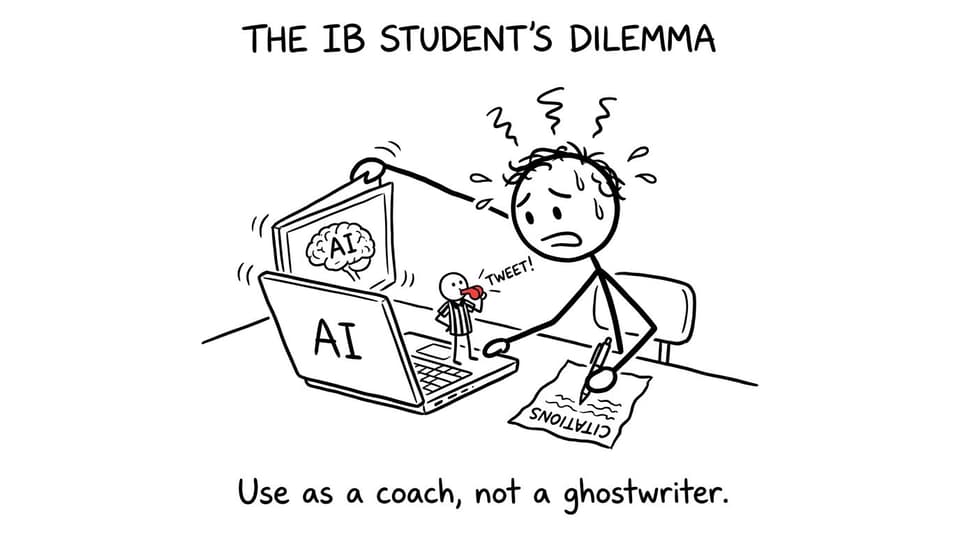
The quick answer: Is AI allowed in IB for your IA?
AI can be allowed in IB, but only when it supports your work rather than replacing it. For an IA, that usually means you can use AI like you'd use a tutor, a spelling checker, or a brainstorming partner.
What the IB ultimately cares about (and what schools enforce) is:
- Authenticity: the IA must be your own work.
- Academic honesty: no misrepresentation of authorship.
- Evidence of process: you can explain and defend what you wrote, calculated, argued, or concluded.
So the safest mental model is:
- AI can help you think.
- AI should not be you.
If you want an IA-focused roadmap by subject, start with RevisionDojo's IB Internal Assessment Guides and compare your plan against the criteria early.
IA-safe AI checklist
Before using AI for any IA task, run this checklist:
- Can I explain the output in my own words, under questioning?
- Did I generate the key ideas, decisions, and structure myself?
- Am I using AI to improve clarity, not to invent content I don't understand?
- If AI suggested sources, did I verify them independently?
- Can I show drafts, notes, calculations, or intermediate steps that prove my process?
- If my school requires it, did I disclose my AI use?
If the answer to any of those is "no," pause. Your IA isn't just a product. It's a trail of decisions.
Where AI helps your IA (and usually stays ethical)
The most effective AI use in an IA looks boring from the outside. That's a good thing. "Boring" usually means "defensible."
Brainstorming IA research questions without letting AI pick for you
AI is genuinely useful when you have a topic area but can't find a sharp, researchable question.
You can ask AI to:
- generate possible variables
- suggest ways to narrow scope
- propose alternative angles
- identify common pitfalls (too broad, too subjective, not measurable)
But you should still make the final choice using the assessment criteria and feasibility.
RevisionDojo makes this easier because many subject-specific IA hubs include criteria breakdowns and structure guidance, such as the IB Environmental Systems and Societies (ESS) IA Guide and the detailed section Essentials of the Internal Assessment.
Clarifying concepts you'll need to write your IA analysis
A common IA failure isn't cheating. It's confusion that never gets fixed.
AI can be great for:
- explaining a method you're using
- translating textbook language into plain English
- creating a short "teach-back" explanation you can practice
On RevisionDojo, this becomes a tighter loop: read the relevant Study Notes, then ask Jojo AI Chat to explain what still feels unclear, then test yourself with the Questionbank.
If you want to see how Jojo can be used as a study partner, try IB Study: Text to Your AI Tutor.
Improving academic writing quality without changing authorship
If your IA draft is yours, AI can help you:
- tighten wording
- improve transitions
- fix grammar
- reduce repetition
The key is that you supply the meaning.
A good rule: if the AI output contains ideas you didn't already have, or claims you can't defend, it's not editing anymore. It's authorship.
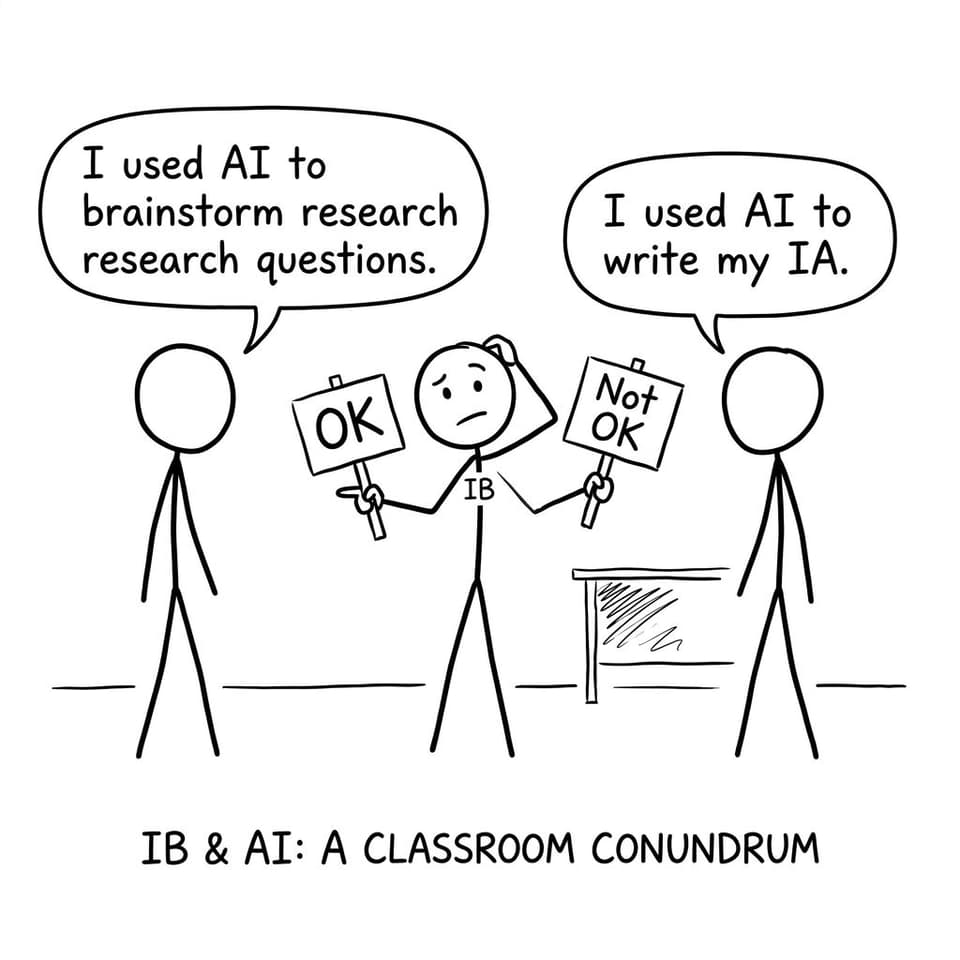
Where AI puts your IA at risk (even if you "didn't mean to cheat")
Most IA problems with AI aren't dramatic. They're quiet.
Letting AI write paragraphs you don't fully understand
If you can't explain the reasoning in a paragraph, it's not safe in an IA.
This matters because:
- teachers often ask follow-up questions
- your writing style becomes inconsistent
- your "voice" disappears
- your evaluation becomes generic
Generic evaluation is especially common: AI loves to write confident-sounding, criteria-flavored sentences that say almost nothing.
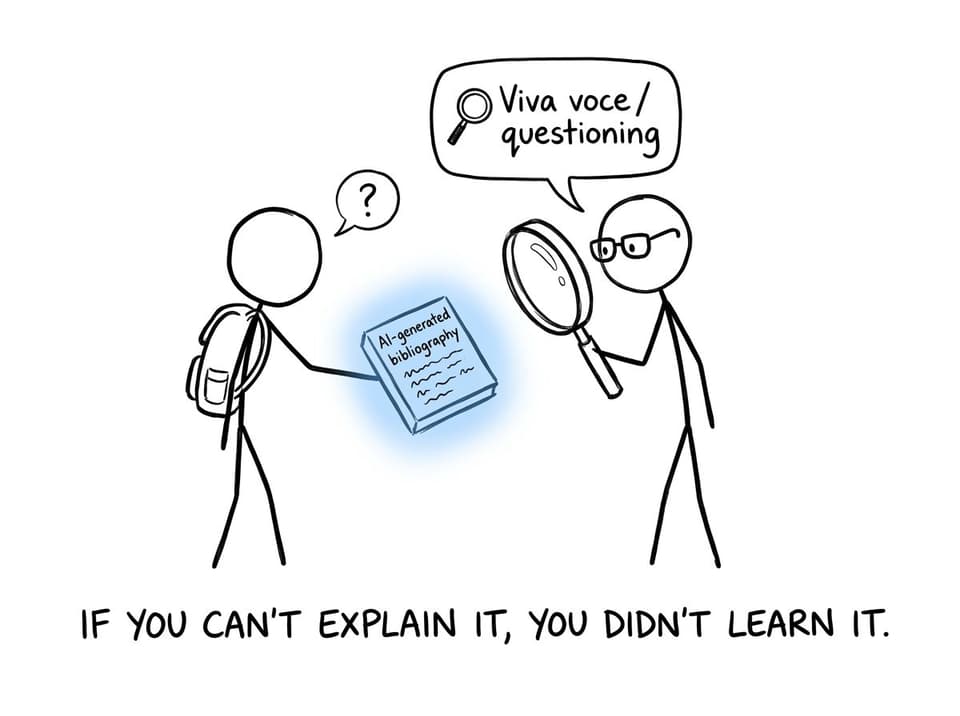
Using AI-generated citations or sources without verification
AI can invent sources, misquote details, or blur what's primary vs secondary evidence.
In an IA, that's dangerous because it collapses trust. If one source is wrong, the examiner (or teacher) starts questioning everything.
Use AI to find search terms, not to "create a bibliography." Always verify.
Using AI to fabricate data, results, or reflections
This is the fastest way to fail the authenticity standard.
Even if you think, "I'll just make the numbers realistic," the IB expects a coherent method trail. Fabricated data usually breaks somewhere:
- impossible precision
- inconsistent uncertainties
- graphs that don't match procedures
- conclusions that don't follow the evidence
If you're working on a science IA and want criterion-aligned guidance, RevisionDojo's subject IA sections like Chemistry IA Data Analysis show what examiners look for in real marking terms.
The safest way to use AI in your IA: "Coach, not ghostwriter"
Here's a process that keeps your IA yours.
Use AI at the start, not the end
AI is best when it helps you choose and plan:
- narrowing the research question
- designing a method
- identifying variables
- building a structure aligned to criteria
Once you're drafting the final write-up, AI temptation increases and the risk climbs.
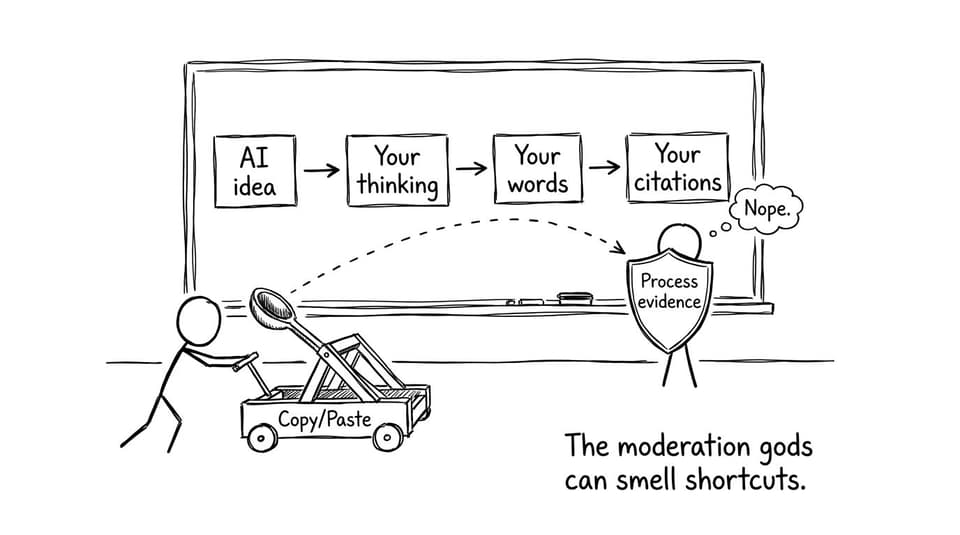
Keep proof of process
Your IA should leave breadcrumbs:
- early outlines
- data tables and intermediate calculations
- drafts with tracked changes
- reflections written in your own style
This isn't paranoia. It's professionalism.
Convert AI help into your own materials
A strong trick: after using AI, create your own flashcards and answer questions on the topic.
If you can't recall and apply the idea under exam-style pressure, it doesn't belong in your IA.
RevisionDojo is built for this exact workflow: Study Notes to understand, Flashcards to retain, Questionbank to apply, then AI Chat to debug misunderstandings.
To build the wider exam routine around this, use How to Study for IB Exams: Step-by-Step Guide and How to Study for IB Exams Without Burning Out.
Practical examples: AI use that's usually fine vs not fine for an IA
Usually fine
- "Give me 10 ways to narrow this IA topic into measurable variables."
- "List common weaknesses in IA evaluation and how to improve them."
- "Rewrite this paragraph to be clearer, keeping all meaning the same."
- "Explain this concept in simpler terms so I can teach it back."
Usually not fine
- "Write my IA introduction with citations."
- "Generate results for my experiment."
- "Write my evaluation and limitations section."
- "Make my analysis sound more sophisticated" (when the analysis itself is thin).
If you want a subject-specific structure template, see an example like IB Business IA HL: Complete Student Guide and compare the criteria language to what you're drafting.
How RevisionDojo helps you use AI ethically (and actually score higher)
A lot of students use AI because they want speed. The tragedy is that speed without feedback creates confident mistakes.
RevisionDojo is designed to keep you fast and accurate:
- Jojo AI Chat helps you clarify concepts and improve explanations without taking over your authorship. Pair it with RevisionDojo App: The Smarter Way to Prep for IB Exams to build a repeatable routine.
- The Coursework Grader gives criterion-by-criterion feedback so you know what to fix in your IA draft next, not just "make it better." See IB Coursework Grader.
- For IA-specific feedback workflows, explore IB IA Grader.
- Study Notes and Flashcards reduce the need to "ask AI for everything," because you have curriculum-aligned explanations and recall tools.
- The Questionbank, Mock Exams, and Predicted Papers make sure your exam prep continues even when your IA is taking mental space.
- When you hit a wall, Tutors can step in for human guidance that protects your authenticity.
In other words: AI doesn't have to be your shortcut. It can be your feedback loop.
Closing: Use AI to protect your IA, not replace it
The IA is one of the strangest parts of the IB. It's personal, long, and often done in the same months you're trying to become sharp for exams. That's why AI feels so tempting: it offers speed when you feel behind.
But the IB doesn't reward speed. It rewards ownership.
So yes, AI can be allowed in IB. And yes, AI can help your IA. But only if the IA still contains the most important thing the examiner is looking for: evidence that a real student made real choices, understood real trade-offs, and learned something real.
If you want the fastest ethical path, build a tight loop with RevisionDojo: use Study Notes and Flashcards to reduce confusion, drill skills in the Questionbank, use Jojo AI Chat when you're stuck, and run your draft through the Grading tools so your IA aligns to the criteria before submission. That way, AI becomes the guardrail, not the getaway car.