


If you have ever redrawn a diagram five times because the labels looked “too similar” to a classmate’s, you already understand something important about IB Economics.
The subject is built on models, evidence, and judgment. But the grades are built on something quieter: whether your analysis is truly yours. In IB Economics, integrity is not a poster on the classroom wall. It’s the daily decision to let the data speak, to admit uncertainty, and to evaluate policies without turning your essay into propaganda.
This guide shows how to practice integrity in IB Economics while still being strategic for exams: clean sourcing, honest diagrams, fair evaluation, and ethical use of AI.
A quick integrity checklist for IB Economics
Use this before any timed response, IA draft, or revision essay in IB Economics:
-
Track sources while researching (not afterwards).
-
Use credible data sets and keep units/timeframes consistent.
-
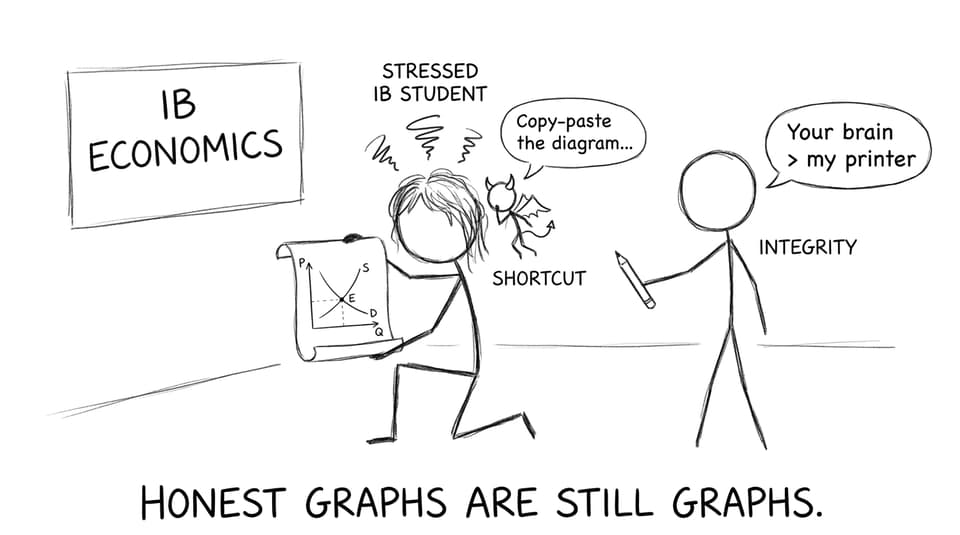
Draw your own diagrams and be able to explain every shift.
-
Paraphrase ideas in your own words and cite where the idea came from.
-
Evaluate policies from multiple stakeholder perspectives.
-
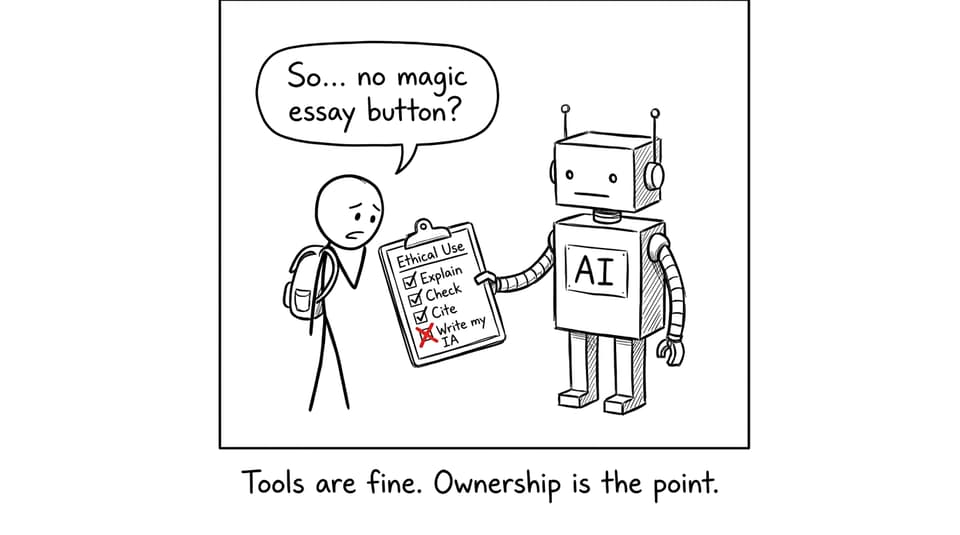
Use AI as a coach (explain, quiz, check) not as an author.
-
Keep your process evidence: outlines, drafts, and notes.
If you want a central place to revise the syllabus properly, start with the IB Economics Resources hub.
What integrity actually means in IB Economics
In IB Economics, integrity is not just “don’t plagiarize.” It’s closer to intellectual accountability: you can explain how you got every conclusion.
That shows up in three places:
Academic honesty (ownership of words and structure)
Examiners reward clarity and personal control. The moment you paste a paragraph you do not fully understand, your writing starts sounding confident but empty. Integrity means you can defend every sentence under questioning.
Data transparency (no hiding the inconvenient bits)
Data is tempting because it looks objective. But it can be chosen, cropped, and framed. Integrity in IB Economics means you do not cherry-pick one quarter of data to “prove” a policy worked if the longer trend disagrees.
Ethical evaluation (fairness, not ideology)
A strong evaluation sounds calm: it acknowledges trade-offs, opportunity costs, and unintended consequences. Integrity means you do not pretend there is a costless policy.
For exam training that strengthens this kind of thinking, practice with the IB Economics Questionbank and force yourself to justify each step.
Using data honestly (without losing marks)
Good IB Economics answers feel evidence-based. But “evidence-based” is not the same as “data-heavy.” It means the evidence you use is appropriate, reliable, and interpreted correctly.
Pick sources that an examiner will trust
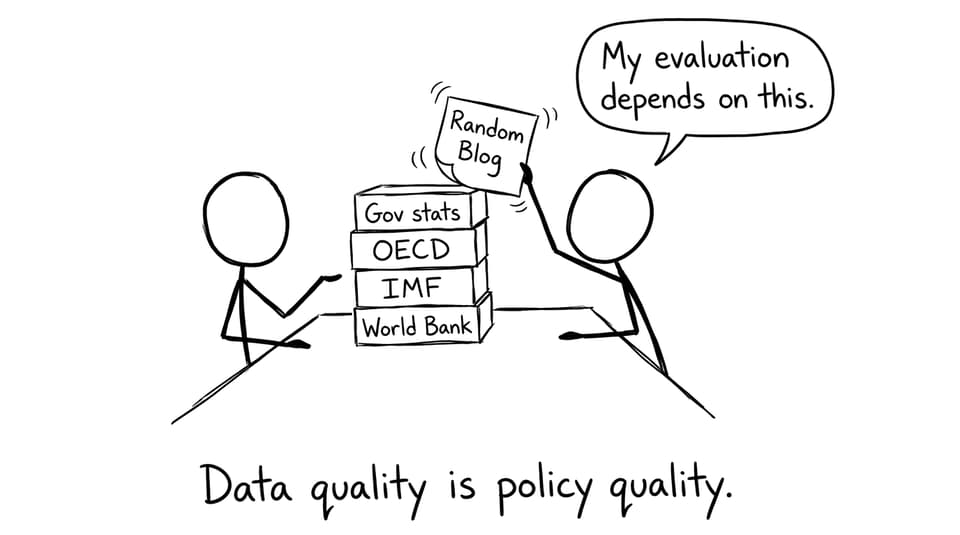
Aim for institutions and official statistics agencies. In your IA or practice commentary, it is usually safer to rely on a few strong sources than ten questionable ones.
Keep your data consistent
Integrity problems often come from sloppiness, not cheating:
-
Mixing nominal and real values without saying so
-
Switching timeframes mid-argument
-
Comparing different definitions of unemployment
A simple habit: write the unit and year range next to every statistic while drafting. It keeps your IB Economics analysis grounded.
Show your working, not just your result
Especially for quantitative sections, integrity is communicated through method. If you revise Paper 3 skills, try timed practice using RevisionDojo’s topic sets like IB Economics 3: Macroeconomics Questionbank.
Honest diagrams and original explanation (the examiner can tell)
In IB Economics, diagrams are not decoration. They are your argument in picture form.
Draw your own diagrams every time
You can use digital tools, but the diagram must be your construction. More importantly: you should be able to recreate it from memory and narrate it.
If you want diagram practice that matches exam style, drill a single micro concept repeatedly (rather than “doing a bit of everything”). For example, use Competitive Market Equilibrium Questionbank practice until the shifts feel automatic.
Explain the mechanism in your own voice
A reliable test for IB Economics integrity: can you explain the diagram in 30 seconds without using the textbook’s exact phrasing?
Instead of memorizing, build your own “cause-to-consequence” script:
-
What changed?
-
Which curve shifts?
-
What happens to equilibrium?
-
Who is affected?
-
What does that imply for efficiency/equity?
This is the same skill that separates analysis from description.
Plagiarism, collusion, and the subtle traps in IB Economics
IB Economics uses shared terminology, so it’s easy to accidentally sound like everyone else. Integrity is about avoiding the traps that look harmless in the moment.
Common plagiarism traps
-
Copying a definition because “it’s just a definition”
-
Rewriting a model essay by swapping synonyms
-
Using an online commentary structure and keeping its logic
Instead, use RevisionDojo’s learning tools to understand, then produce. The methods for effective IB Economics revision are especially useful here because they emphasize active recall and timed output.
Collusion risk: shared drafts, shared wording
Discussing ideas is fine. Sharing assessed wording is where it breaks. A good rule: collaborate at the concept level, separate at the sentence level.
If you want a wider integrity framework beyond IB Economics, keep this guide bookmarked: How to Uphold Academic Integrity in IB Assessments.
Ethical application: evaluation without bias
The most persuasive IB Economics essays feel fair. They do not hide costs. They do not villainize stakeholders. They do not pretend one model explains everything.
Train yourself to evaluate like an economist
When you evaluate a policy, force your paragraph to include:
-
short run vs long run effects
-
stakeholders (households, firms, government, environment)
-
assumptions and limitations of the model
-
a realistic condition for success
This is integrity in IB Economics: a willingness to be precise instead of dramatic.
If you need exemplars to calibrate what “balanced evaluation” looks like, use the IB Economics coursework examples library as a benchmark (study it, don’t copy it).
Using AI ethically in IB Economics revision
Most integrity issues with AI start because students use it at the wrong point in the process. If AI writes the final paragraph, you lose ownership. If AI helps you practice, you gain skills.
Ethical uses that strengthen IB Economics performance
-
Ask RevisionDojo’s AI Chat to explain a concept, then rewrite the explanation from memory.
-
Generate self-quizzes and do them under time pressure.
-
Use feedback tools to find weak evaluation habits.
Non-ethical uses that weaken your learning
-
Submitting AI-written analysis as if it were yours
-
Copying AI-generated diagrams or evaluations verbatim
-
“Polishing” a paragraph you do not understand (it becomes fluent nonsense)
For rubric-aligned feedback that still keeps you as the author, use tools like the IB Economics IA Grader and the IB Economics 10-mark Essay Grader.
How RevisionDojo helps you build integrity and score higher
Integrity gets easier when your system is clear.
RevisionDojo supports IB Economics students with a workflow that rewards real understanding:
-
Study Notes to learn concepts cleanly and consistently.
-
Flashcards for active recall (so you don’t depend on memorized paragraphs).
-
Questionbank for targeted, exam-style practice.
-
AI Chat for explanation and questioning (not outsourcing writing).
-
Grading tools for rubric-aligned feedback and honest improvement.
-
Predicted Papers to practise likely themes without guessing blindly.
-
Mock Exams to build stamina under pressure.
-
Coursework Library to benchmark quality and structure.
-
Tutors to strengthen reasoning while keeping your voice intact.
If you are revising HL, pair integrity with technique and avoid common mark leaks using IB Economics HL: Top 7 Mistakes to Avoid.
FAQ: Integrity in IB Economics
What counts as academic misconduct in IB Economics?
Academic misconduct in IB Economics is any situation where the work you submit is not honestly your own, or where your evidence is manipulated. That includes direct plagiarism (copying text) and indirect plagiarism (paraphrasing too closely without citation). It also includes collusion, such as sharing drafts and ending up with near-identical analysis or evaluation paragraphs. Fabricating data, altering figures to fit your conclusion, or inventing sources is also misconduct, even if the theory is correct. Using AI to generate final assessed prose and submitting it as your own falls into the same category because authorship is misrepresented. The safest standard is simple: if asked, you should be able to explain how you produced each part and where each non-original idea came from.
How should I cite sources in IB Economics without overloading my writing?
In IB Economics, citation should be light enough to keep the analysis readable, but clear enough that an examiner can trace the evidence. Focus on citing the key items: the article you are responding to, any major statistics, and any adapted visuals or data sets. Use consistent details (author/organization, year, title, and link) and keep a running sources log while researching so you are not guessing at the end. If you redraw a chart using official data, state that you recreated it and cite the data provider. Avoid dropping multiple citations in one sentence just to look “academic” because it often replaces explanation with clutter. Integrity is not about quantity of citations; it is about traceability and honesty.
Can I use AI tools while revising IB Economics for exams?
Yes, AI can be used ethically in IB Economics revision when it supports learning rather than replacing it. A good use is asking for a concept explanation, then closing the chat and writing your own explanation from memory. Another good use is generating practice questions, marking checklists, or alternative evaluation angles you then verify with your own reasoning and evidence. AI is also useful for feedback when you keep control of the final wording and can justify every claim you make. The problem begins when AI becomes the author of your final answer, because then you cannot show ownership of structure, examples, or evaluation. Used correctly, AI makes you faster and clearer; used incorrectly, it makes your work fluent but fragile.
Conclusion: the quiet advantage of integrity in IB Economics
Integrity in IB Economics is not a moral extra. It’s a performance advantage.
When your diagrams are yours, you can redraw them under pressure. When your data is clean, your evaluation sounds credible. When your arguments are genuinely yours, your writing stays consistent across papers, mocks, and coursework.
If you want to revise IB Economics with honesty and precision, build your routine around RevisionDojo: start with the IB Economics Resources page, practise daily in the IB Economics Questionbank, and use graders, predicted papers, mock exams, and tutors to improve without shortcuts. Integrity is the one study habit that never stops paying interest.