
TOK has a special talent: it can make an IB student feel brilliant and lost in the same sentence.
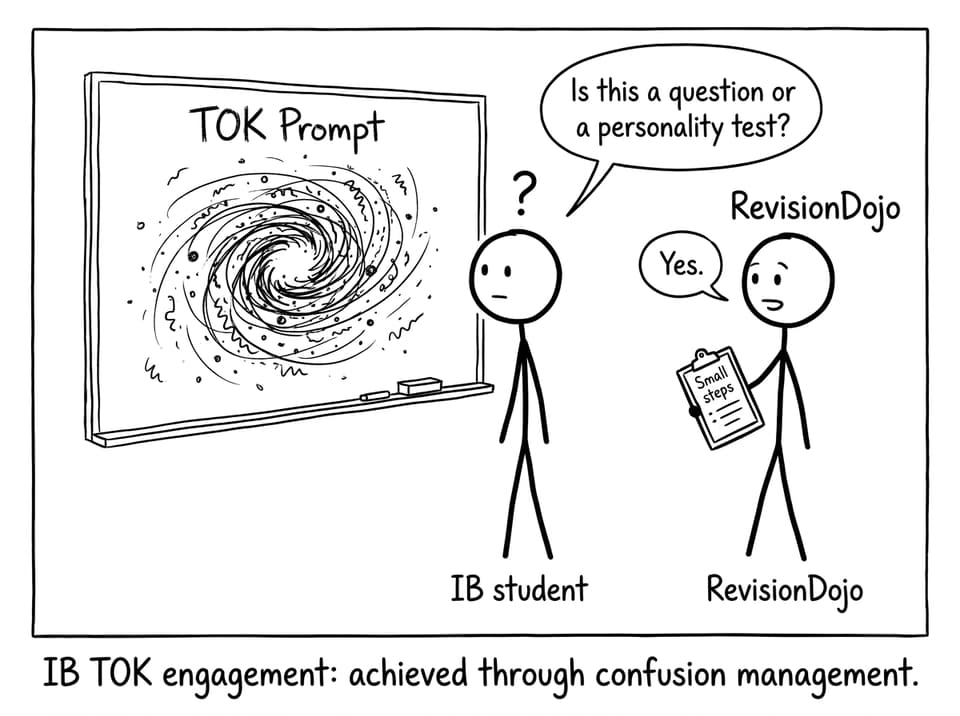
One minute you are confidently discussing evidence and perspective. The next, you are staring at a prompt and wondering if you are meant to answer it… or become it.
That tension is normal. TOK is designed to be abstract. But IB exams are not graded on how abstract you can feel. They are graded on how clearly you can think, structure, and communicate.
This is where engagement stops being a vibe and becomes a system. RevisionDojo helps you turn TOK from occasional philosophical panic into repeatable practice: guided reflection, rubric-aligned feedback, and tools that make your progress visible.
A quick IB TOK engagement checklist
If you want your TOK engagement to actually show up in your writing and speaking, use this simple loop:
-
Pick one TOK idea (bias, evidence, certainty, ethics, perspective).
-
Write a 3-sentence reflection tied to a real situation from your IB subjects or life.
-
Turn that into one knowledge question (KQ) you could debate.
-
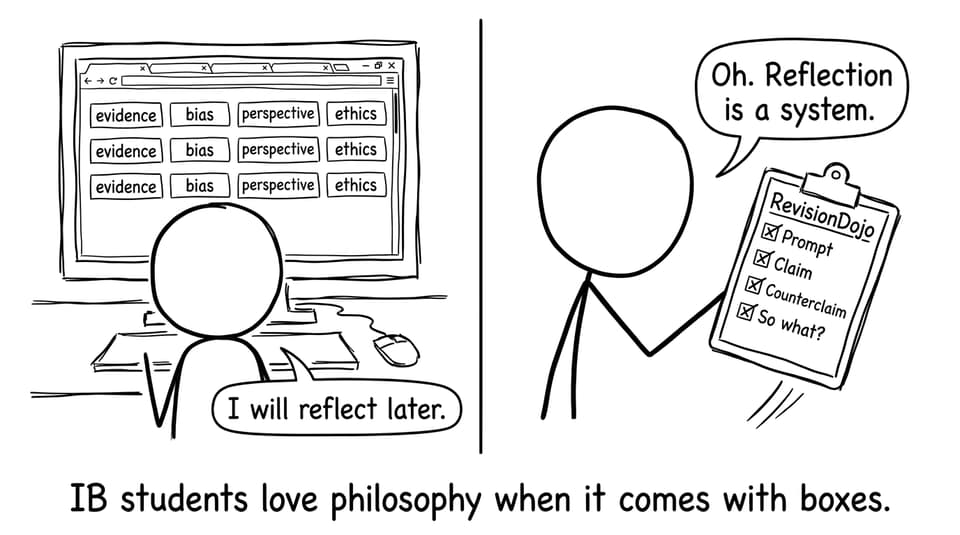
Build one claim, one counterclaim, and one evaluation.
-
Check your work against the criteria you will actually be assessed on.
-
Repeat weekly so TOK becomes familiar, not fragile.
RevisionDojo makes this loop easy to run because your reflections, feedback, and resources sit in one place rather than scattered across documents.
To orient yourself, start with the IB Theory of Knowledge (TOK) hub.
Why IB students disengage from TOK (and what fixes it)
Most IB students do not dislike thinking. They dislike uncertainty with no handrails.
TOK often gets taught as a set of big ideas without a daily mechanism for practicing them. So engagement becomes inconsistent: great discussions one week, silent confusion the next. And because TOK is assessed through the exhibition and essay, students can drift for months and then suddenly need depth on demand.
The fix is not “care more.” The fix is structure.
RevisionDojo is built around the idea that performance grows from tight feedback loops: understand, practice, reflect, improve. That logic works in Biology and Math. It also works in TOK when you treat reflection like a skill you train.
If you are studying across multiple subjects, it helps to anchor your routines in a single IB home base like the RevisionDojo all-in-one IB revision platform.
How RevisionDojo improves IB TOK engagement in daily study
Structured reflection that does not feel like journaling
Reflection in TOK is not “write more.” It is “think better.” The easiest way to lose engagement is to make reflection vague.
With RevisionDojo, you can work from guided prompts that push you toward the moves that score well in IB TOK:
-
What counts as evidence here, and what might distort it?
-
Which perspective is missing, and why does it matter?
-
Where could my claim be true in one context and weak in another?
That structure matters because it trains you to do TOK thinking on command, not only when inspiration shows up.
If you are currently building your essay plan, use the RevisionDojo TOK May 2026 Essay Guide as a model for how clear structure reduces anxiety and improves depth.
Rubric clarity: knowing what “good” looks like
Engagement rises when the target is visible. Many IB students disengage from TOK because the rubric feels like a foggy set of vibes.
RevisionDojo reduces that fog by translating criteria into actionable feedback. A practical place to start is the IB TOK Essay Grader, which helps you self-evaluate and understand what the assessment is actually rewarding.
When you can name what you are trying to improve (clarity, justification, implications, comparisons), your engagement stops being emotional and starts being tactical.
Connecting TOK to your other IB subjects (so it feels real)
TOK engagement improves when you borrow examples from the classes you already care about.
A simple method:
-
In Sciences: use a lab, a study, or a data controversy to ask what counts as reliable evidence.
-
In Humanities: use a current event to explore perspective, power, and interpretation.
-
In Arts: use an artwork to test whether meaning is discovered or created.
RevisionDojo’s ecosystem helps here because you can quickly refresh content using Study Notes, then turn insights into Flashcards for key TOK terms, then pressure-test your reasoning with AI Chat.
If you need help building a stable study routine across subjects while keeping TOK alive, the mindset in IB: I Study All Day but Remember Nothing applies directly: small daily loops beat occasional heroic sessions.
A practical IB TOK routine you can run in 30 minutes
TOK does not need hours. It needs frequency.
Try this 30-minute IB TOK engagement session twice per week:
-
5 minutes: choose one concept (certainty, evidence, bias, explanation).
-
10 minutes: write a mini reflection using a real example.
-
10 minutes: build a claim, counterclaim, and evaluation.
-
5 minutes: run a rubric check and write one “upgrade” sentence.
Inside RevisionDojo, this routine becomes smoother because the tools are designed to connect:
-
Study Notes help you clarify terminology quickly.
-
Flashcards keep key terms usable under pressure.
-
AI Chat helps you refine a knowledge question or evaluate an example.
-
Grading tools help you test whether your writing is actually improving.
And when exams get closer, Mock Exams and Predicted Papers are there for your subjects so TOK does not steal time from everything else. A strong IB student does not study more. They study with less friction.
For a broader system, see the workflow in the RevisionDojo app guide for IB exam prep.
For teachers and coordinators: making IB TOK engagement consistent
Even if you are a student, it helps to understand what schools are trying to solve.
TOK engagement varies widely across cohorts because:
-
reflections are not standardized,
-
feedback quality differs by teacher,
-
and it is hard to track growth without a shared system.
RevisionDojo supports alignment through shared rubrics, visible progress, and clear routines that can be used across classes.
If your school uses RevisionDojo, your experience improves because everyone is speaking the same language about what “good TOK thinking” looks like. If your school does not yet use it, you can point them to RevisionDojo for Schools.
For a bigger picture of whole-school consistency, these reads help:
-
Why RevisionDojo Is the Smartest Choice for Whole-School IB Revision
-
How IB Schools Can Use RevisionDojo to Streamline Exam Preparation
Using analytics without turning TOK into a spreadsheet
TOK is human. But improvement is trackable.
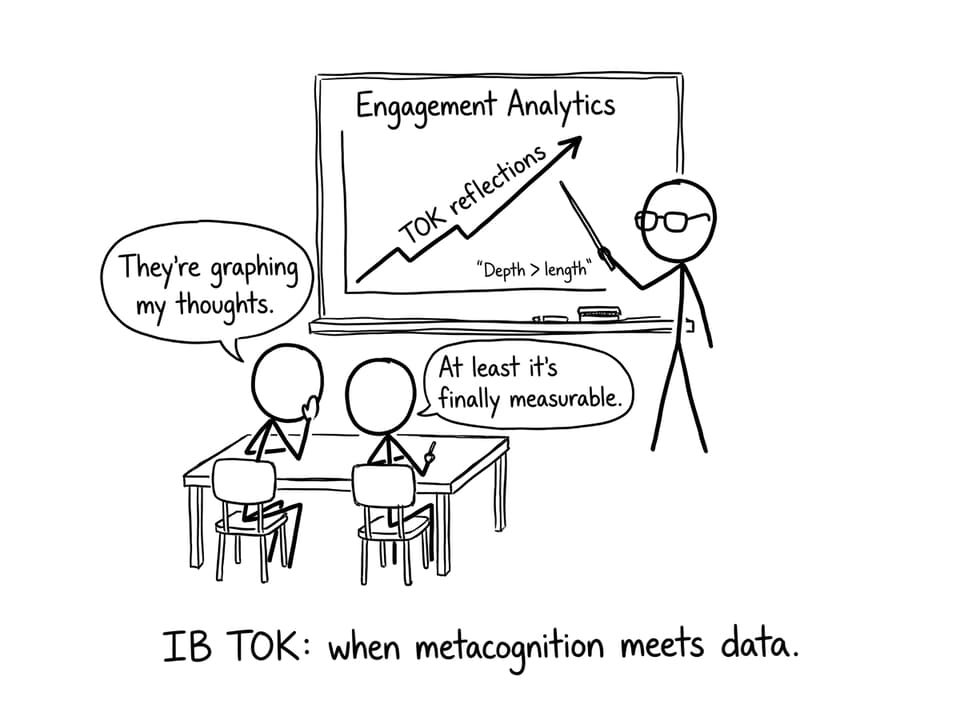
The healthiest way to think about analytics in IB TOK is not “they are measuring my thoughts.” It is “they are measuring my habits.” Are you reflecting regularly? Are you using specific examples? Are you comparing perspectives? Are you improving clarity over time?
That visibility helps you adjust earlier, not later.
FAQ
How do I stay engaged in IB TOK when it feels abstract?
Start by accepting that abstraction is part of the design, not a sign you are failing. Then give yourself a concrete routine that reduces decision fatigue, because IB students disengage when every session requires a brand-new plan. Pick one concept, one real example, and one knowledge question, and repeat that format until it becomes automatic. Engagement rises when you can see your thinking improve across weeks, not just within a single class discussion. Use short reflections that force specific choices: claim, counterclaim, evaluation. RevisionDojo supports this by making guided prompts, rubric checks, and feedback loops easy to repeat without reinventing your process each time.
Can RevisionDojo help with the IB TOK essay and exhibition specifically?
Yes, because TOK assessments reward structured thinking more than dramatic ideas. For the essay, you need a consistent method for building arguments, testing them against counterclaims, and linking back to the prescribed title with precision. RevisionDojo helps you practice that logic through guided reflection and rubric-aligned feedback, so you are not guessing what “good” looks like. The IB TOK Essay Grader is especially useful for self-checking drafts and understanding where marks are gained or lost. For the exhibition, the same principle applies: your objects are only as good as the commentary connecting them to a prompt and knowledge question. When you use RevisionDojo’s tools to tighten examples and improve clarity, your engagement becomes visible in the quality of your explanations.
What if I am overloaded with IB subjects and TOK keeps slipping?
That is the normal IB experience: the urgent always crowds out the important. The solution is to make TOK small enough to survive busy weeks, rather than scheduling “big TOK days” that never happen. Two 30-minute sessions per week, done consistently, will outperform a single intense session once a month. Use RevisionDojo as your single hub so TOK does not require extra setup time: open your notes, write a short reflection, and check it against criteria. If your brain feels fried, lean on pre-built systems like Flashcards for key terms and AI Chat to quickly refine a knowledge question or example. Over time, TOK stops feeling like a separate subject and starts feeling like a way of thinking you bring into everything else.
Closing: turning IB TOK engagement into a repeatable advantage
The quiet secret of TOK is that it rewards students who practice thinking the way athletes practice movement. Not perfectly. Just consistently.
If you want stronger IB TOK engagement, stop waiting for the lesson to feel inspiring. Build a small loop you can repeat: prompt, example, claim, counterclaim, evaluation. Then use RevisionDojo to keep that loop tight with Study Notes, Flashcards, AI Chat, Grading tools, and a clear view of what improvement looks like.
When you are ready to make TOK feel less like a mystery and more like a skill, start with the IB Theory of Knowledge (TOK) hub and explore RevisionDojo for Schools if you want your whole cohort aligned.
