



Choosing an IB revision platform can feel strangely similar to choosing the subjects themselves. Every option promises comprehensive resources, intelligent technology, and better results. Yet what matters is not how much a platform contains. It is whether your child can use it to identify a weakness, practise it, receive meaningful feedback, and improve.
For parents asking what to look for in revision platform options, the answer is reassuringly practical: prioritise current IB alignment, broad subject coverage, active practice, actionable feedback, transparent pricing, and access to human help when independent study is no longer enough.
A strong platform should reduce the number of decisions an already busy student must make. It should turn revision into a repeatable cycle rather than another complicated project.
A quick checklist for IB diploma parents
Before subscribing, ask whether the platform provides:
- Resources matched to the student's current IB subjects, level, and syllabus
- Clear explanations followed by active recall and exam-style application
- A searchable Questionbank with worked answers or marking guidance
- Feedback that explains how the response could improve
- Support for both examinations and internally assessed work
- Timed Mock Exams or other realistic simulations
- Visible pricing, billing terms, and feature limits
- Appropriate privacy, academic integrity, and tutoring safeguards
- An interface the student will realistically use without constant supervision
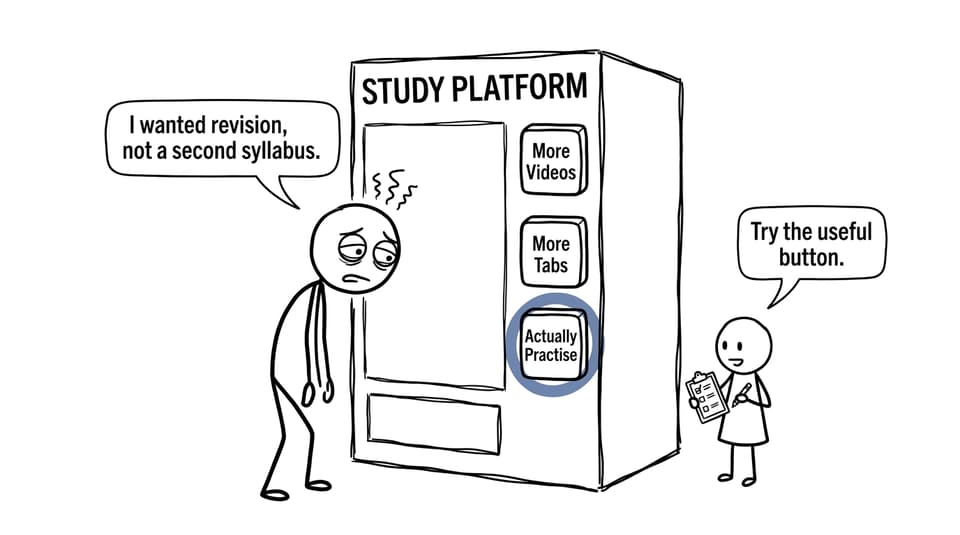
The final point is easily underestimated. A technically impressive platform has little value if reaching a relevant question takes ten clicks or if progress disappears among unrelated dashboards.
Start with genuine IB alignment
The IB Diploma Programme is not simply a collection of difficult school subjects. Its assessment combines externally marked examinations with internally assessed or teacher-marked components in most courses. The form of assessment also varies: a useful response in Mathematics does not look like a useful response in History, English, or Biology.
That makes generic revision libraries a poor benchmark. A platform should distinguish between subjects, Standard Level and Higher Level, syllabus versions, paper formats, command terms, and assessment criteria. Look for visible evidence of that structure rather than accepting an unexplained claim that content is “IB suitable.”
Ask your child to search for one precise topic from the course they are taking. Can they find matching notes, questions, and feedback? Then check a second subject with a different assessment style. A platform that serves Mathematics well may still offer shallow support for essay-based subjects.
RevisionDojo's central IB resources hub is useful for this initial coverage check because parents and students can explore resources through an IB-specific structure rather than adapting material written for another programme.
Look for a complete learning loop, not a content warehouse
Students rarely struggle because the internet contains too little information. They struggle because information does not automatically become retrievable knowledge or exam technique.
The most useful platforms connect four actions:
| Stage | What the student should be able to do |
|---|---|
| Understand | Learn a focused concept through concise notes or explanations |
| Recall | Retrieve definitions, methods, and relationships without looking |
| Apply | Answer IB-style questions under increasingly realistic conditions |
| Review | Understand errors and choose the next revision target |
This distinction matters. Watching an explanation can create familiarity, and familiarity can feel like mastery. The illusion usually breaks when the student must construct an answer alone.
For that reason, look beyond video counts. Check whether Study Notes lead naturally into Flashcards, whether Flashcards connect to relevant questions, and whether mistakes can be revisited. RevisionDojo's guide to studying for IB exams without burning out demonstrates how understanding, recall, application, and review can become one sustainable routine.
Evaluate the quality of practice and feedback
A Questionbank should do more than produce a large pile of questions. Students need filters that reflect how they study: subject, topic, level, difficulty, and question style. They also need explanations that reveal why an answer earned or lost marks.
When testing a platform, ask your child to complete several written responses. Then inspect what happens next. Does the feedback merely reveal an answer, or does it identify a missing step, weak explanation, incorrect command-term response, or imprecise use of evidence?
Useful feedback changes the next attempt. “Incorrect” is a result. “Your conclusion is unsupported by the data in the table” is direction. The latter gives the student something specific to practise.
This is particularly important for students who report studying for hours while retaining little. The issue may not be effort; it may be a revision process with no retrieval or correction stage. The practical strategies in why IB students study all day but remember nothing help parents recognise that difference.
Check whether timed practice feels realistic
Topic questions build individual skills, but final assessments also demand selection, pacing, stamina, and calm. A good revision platform should therefore progress from short exercises to timed sections and full Mock Exams.
Check whether the platform:
- Reproduces the relevant structure and time pressure
- Lets students practise without seeing answers prematurely
- Provides marking guidance after submission
- Records recurring weaknesses across attempts
- Makes it easy to return to the topics causing lost marks
Predicted Papers can add fresh simulation material, but they should be treated as broad preparation rather than a promise of what will appear. The real value lies in practising unfamiliar questions under controlled conditions. RevisionDojo explains this approach in its guide to choosing an IB Mock Exam platform.
Treat AI feedback as a tool, not an authority
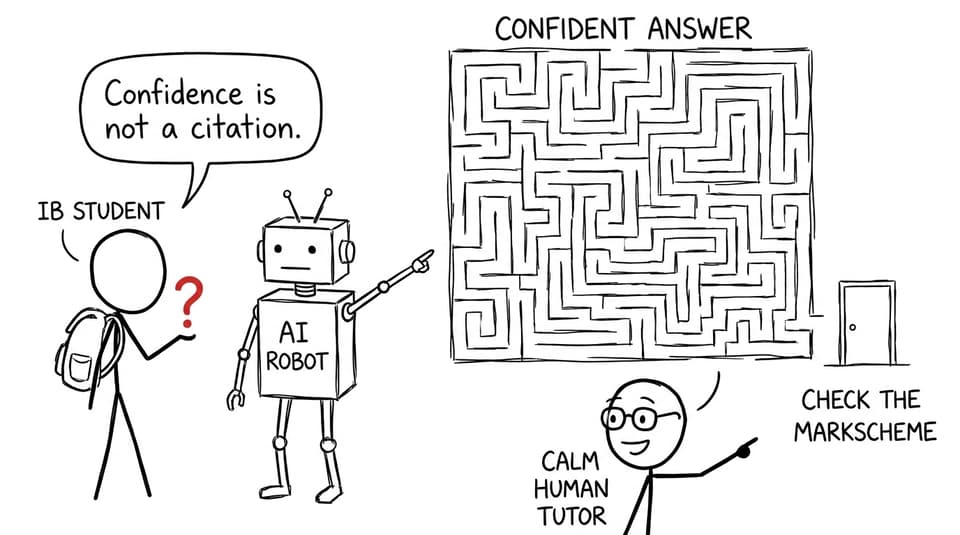
AI can make feedback faster, which is valuable when a teacher cannot review every practice response. But speed is not the same as certainty.
A responsible platform should explain what its AI is designed to evaluate, connect comments to IB-style criteria or marking logic, and encourage students to keep teachers involved in high-stakes decisions. Students should be able to question the feedback rather than simply accept a generated score.
The IB permits educational use of AI, but work submitted for assessment must remain the student's own. AI-produced material included in assessed work must be transparently acknowledged according to the IB's academic integrity guidance and the school's requirements. Parents should be cautious of any service promising to produce coursework for submission.
A safer use is formative: the student drafts independently, receives feedback, decides what is valid, revises in their own words, and confirms important issues with a teacher. RevisionDojo's IB Coursework Grader is designed around rubric-aligned feedback, while its Coursework Library helps students examine examples and understand expectations. Neither removes the need for original thinking.
Compare price by useful outcomes
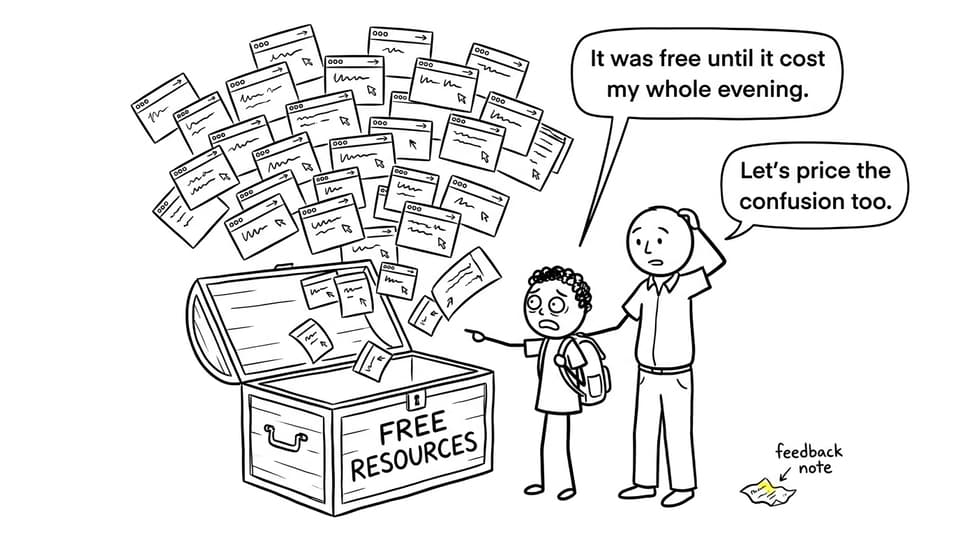
The cheapest resource is not always the lowest-cost option. Free material spread across dozens of websites may consume hours of searching, checking, and reorganising. An expensive subscription can be equally wasteful if most features are irrelevant to the student's subjects.
Compare the total package against the needs you identified:
- Which subjects and levels are included?
- Are Questionbank limits clearly stated?
- Are AI grading, Mock Exams, and Predicted Papers included?
- Is billing monthly, annual, or for a longer fixed period?
- Can the student test meaningful features before committing?
- Does tutoring require a separate payment or membership?
- How easy is cancellation?
Because subscriptions and promotions can change, verify the live RevisionDojo plans and pricing rather than relying on an old review or screenshot.
Decide when tutoring belongs in the plan
A revision platform and a tutor solve different problems. A platform is well suited to regular independent practice. A tutor becomes valuable when a student repeatedly misunderstands the same concept, cannot interpret feedback, needs accountability, or has a subject-specific obstacle that static resources do not resolve.
When comparing IB tutoring cost, look beyond the advertised hourly figure. Ask about tutor credentials, IB subject and level experience, lesson length, cancellation terms, platform fees, safeguarding arrangements, and what happens if the match is unsuitable. For a minor, parents should also understand communication boundaries and how concerns are reported.
A good integrated system lets practice data shape tutoring. Instead of spending a lesson discovering that the student struggles with equilibrium or textual analysis, the student can arrive with attempted questions and a visible pattern of mistakes. Families can review current tutor profiles and terms through RevisionDojo's IB tutoring page.
Test the platform with a real task
Marketing pages show what a platform contains. A short trial shows how it behaves.
Choose one genuine weakness and ask the student to complete this sequence:
- Find a concise explanation of the topic
- Recall the main idea without looking
- Answer several relevant questions
- Review every mistake
- Complete a short timed set
- Explain what they will study next
The test should take less than a week. Afterwards, ask three questions: Did the student know what to do? Did the feedback clarify the mistakes? Did the platform make the next step obvious?
This is more informative than asking whether the interface looks impressive. The RevisionDojo app workflow shows how Study Notes, Flashcards, the Questionbank, AI Chat, Grading tools, Predicted Papers, Mock Exams, the Coursework Library, and Tutors can operate as connected parts rather than isolated features.
Why RevisionDojo fits the evaluation criteria
The strongest platform is not necessarily the one with the longest feature list. It is the one that creates a shorter path from confusion to competent independent work.
RevisionDojo is built specifically around that path. Its subject coverage is organised for IB learners; Study Notes and Flashcards support understanding and recall; the Questionbank develops application; AI Chat and Grading tools provide rapid feedback; and Mock Exams and Predicted Papers support timed preparation. The Coursework Library extends the system to IA, EE, and TOK development, while Tutors provide human help when a student reaches the limit of self-study.
For IB diploma parents, that integration matters because it makes progress easier to discuss without micromanaging every session. A parent can focus on whether the student is practising consistently and acting on feedback, rather than assembling resources on the student's behalf.
Begin with one subject and one weakness. Explore RevisionDojo's support for parents and families, test the learning loop, and let the quality of the student's next attempt guide the decision. A revision platform should not add more noise to the IB. It should make the next useful action clearer.