
Burnout can make a capable student feel as if they have suddenly forgotten how to work. The laptop is open, the deadline is visible, yet beginning feels unusually difficult. This is not always laziness or poor discipline. IB student burnout can develop when sustained academic pressure outpaces your opportunities to recover.
The immediate response is not another productivity system. Reduce the pressure, protect basic needs, identify what genuinely matters, and tell someone you trust. Then rebuild a smaller, more sustainable way of studying.
This guide is educational and cannot diagnose a mental health condition. If distress is persistent, worsening, or interfering with everyday life, speak to a school counselor, healthcare professional, or trusted adult.
A quick IB burnout checklist
Look for patterns rather than treating one difficult day as proof of burnout:
- You remain exhausted after ordinary rest.
- Concentrating, remembering, or making decisions feels harder.
- You feel detached from subjects you previously valued.
- Small tasks trigger unusual frustration, anxiety, or hopelessness.
- Your sleep, appetite, relationships, or attendance are changing.
- You work for longer but accomplish less.
- You avoid assignments because the pressure feels unmanageable.
Academic burnout is commonly discussed through three connected experiences: exhaustion, growing distance from study, and reduced belief in your effectiveness. Stress usually says, “There is too much to do.” Burnout adds, “I have nothing left, and perhaps none of this matters.”
Explore the signs of burnout in IB students, but avoid using an online checklist as a diagnosis.
Why IB student burnout feels different
The IB does not create one isolated source of pressure. It creates several overlapping clocks.
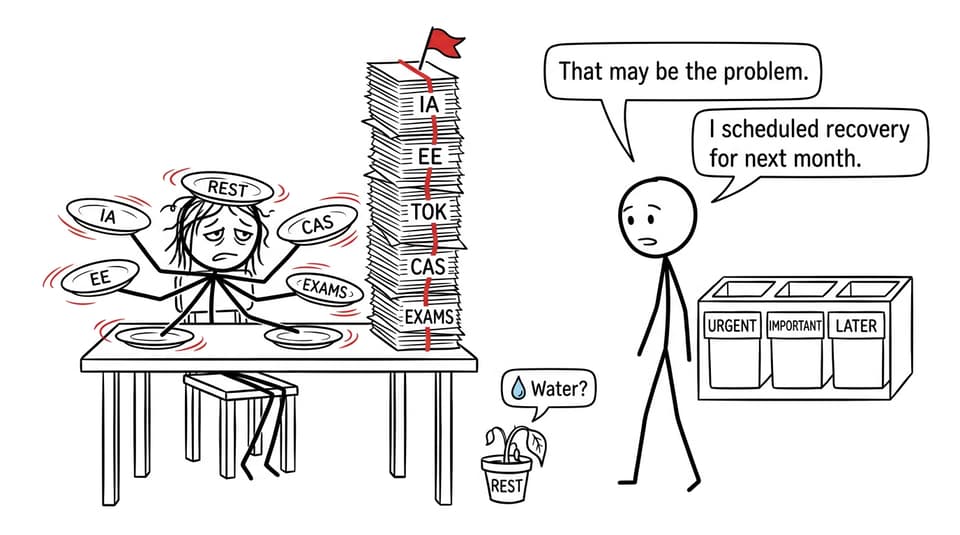
A student might be preparing for subject assessments while drafting an Internal Assessment, recording CAS evidence, refining an Extended Essay, and interpreting a TOK prompt. University applications, family expectations, extracurricular commitments, and ordinary teenage life continue in the background.
The difficulty is not simply the amount of work. It is the switching. Each task demands a different kind of thinking, while every unfinished responsibility remains mentally open. When deadlines cluster, the day can feel full before work begins.
Perfectionism intensifies this pattern. A student may spend two hours polishing minor work while delaying something more consequential. Another may compare their private confusion with a classmate’s public confidence. Sleep and recovery are then exchanged for the temporary feeling of being caught up.
Stress, burnout, and mental health conditions
These experiences can overlap, but they are not interchangeable.
Ordinary stress may involve worry, irritability, muscle tension, or poor sleep before an important deadline. It often improves when the event passes or the workload becomes manageable. Burnout tends to persist and may include emotional exhaustion, detachment, avoidance, and declining confidence.
Anxiety disorders, depression, eating disorders, and other health conditions require proper assessment. Burnout language should never dismiss continuing low mood, panic, severe sleep disruption, major appetite changes, or loss of interest across life.
Consider three questions:
- Duration: Has this continued after the immediate deadline passed?
- Breadth: Is it affecting school, sleep, relationships, and activities?
- Function: Are normal responsibilities becoming difficult to manage?
If several answers are yes, involve another person. RevisionDojo’s guide to mental health resources for IB students explains possible support routes.
An immediate burnout reset
Recovery rarely begins with a perfect monthly timetable. It begins by making the next 24 hours less punishing.
Tell one person what is happening
Choose a parent, caregiver, counselor, teacher, doctor, or IB coordinator. Use direct language if explaining everything feels difficult:
“My workload is affecting my sleep, concentration, and mental health. I need help deciding what can change.”
A coordinator may clarify priorities, coordinate conversations with teachers, or explain your school’s support procedures. Asking early creates more options than waiting until several deadlines have passed.
Triage the workload
Create three columns: must do, can wait, and pause or drop. Include coursework, revision, CAS, applications, and personal commitments. Ask a teacher or coordinator to check your decisions if exhaustion is affecting your judgment.
Choose one concrete next action. “Work on Biology” is vague. “Write the method limitations paragraph” gives your brain somewhere to begin.
Restore the physical floor
Food, hydration, movement, and sleep are not rewards for finishing. They are conditions that make thinking possible. Set a stopping time, eat something regular, and take a short walk or shower before planning more work.
Do not expect one early night to reverse weeks of exhaustion. Recovery is usually gradual.
IB stress management that protects your energy
A sustainable system does not demand maximum intensity every day. It assigns the right work to the energy available.
Plan by energy and consequence
Place demanding tasks, such as timed essays or unfamiliar HL concepts, when you are most alert. Save organization, light review, and administrative work for lower-energy periods.
Distinguish importance from anxiety. The task creating the loudest worry is not necessarily the one with the greatest academic consequence. Ask what is due first, what carries meaningful weight, and what requires another person’s input.
Use closed study blocks
“Study until I understand everything” has no finish line. Define the subject, task, and stopping point before beginning.
A manageable block could look like this:
- Review one subtopic for 10 minutes.
- Answer targeted questions for 20-25 minutes.
- Review errors for 10 minutes.
- Write tomorrow’s first action, then stop.
This approach favors active effort over endless rereading. The active recall guide for IB students explains how to turn review into retrieval and application.
Reduce resource-hopping
When you are tired, every decision costs something. Searching through websites and reorganizing notes can feel productive while postponing useful feedback.
RevisionDojo provides one connected IB workspace. Use Study Notes to clarify a concept, Flashcards to retrieve key knowledge, and the Questionbank to apply it. AI Chat can unblock a precise misunderstanding, while Grading tools can make feedback more concrete.
As energy returns, introduce Predicted Papers and Mock Exams gradually rather than beginning with full-length simulations. The Coursework Library can clarify expectations, and Tutors offer human guidance when independent study is not resolving a problem. This all-in-one IB revision workflow should remove avoidable friction, not fill every spare minute.
What not to do when you are burned out
Several instinctive responses can deepen the problem:
- Do not compensate automatically with all-night study.
- Do not build a schedule without space for delays or recovery.
- Do not use caffeine as a substitute for persistent sleep loss.
- Do not isolate yourself because you feel embarrassed about falling behind.
- Do not begin full timed simulations when a short diagnostic set is enough.
- Do not interpret reduced capacity as proof that you lack ability.
If exams are driving the pressure, use these IB exam stress management strategies and exam anxiety techniques alongside support from your school.
When to seek professional or urgent help
Self-management has limits. Speak to a qualified healthcare professional or school counselor when symptoms persist, worsen, or substantially affect sleep, eating, attendance, relationships, or your ability to function. You do not need to wait until the situation becomes unbearable.
If you feel unsafe, think you may harm yourself or someone else, or believe you cannot cope through the immediate period, treat it as an emergency. Contact local emergency services or a crisis line, go to an emergency department, and tell a trusted adult immediately. Do not remain alone with an immediate safety risk.
Recovery is not falling behind
Burnout creates a strange illusion: because time feels scarce, rest appears unaffordable. Yet continuing with an exhausted system often produces more hours, weaker concentration, and greater fear.
The better question is not, “How can I force myself through everything?” It is, “What would make the next week safer and more sustainable?” The answer may involve speaking to your coordinator, narrowing priorities, protecting sleep, or completing one small practice loop instead of staging an academic rescue mission at midnight.
RevisionDojo is the ultimate IB resource because its tools can make that smaller loop easier to maintain. Let Study Notes create clarity, Flashcards preserve memory, the Questionbank provide evidence, and AI Chat or Tutors help when you are stuck. Use Grading tools, Predicted Papers, Mock Exams, and the Coursework Library deliberately, not endlessly. Your preparation should support your life, not consume it.