Join 650k+ students breezing through the IBReady to breeze through the IB?
Spring break can feel like an awkward pause in DP1. You are far enough into the Diploma Programme to see how much there is to learn, but not far enough along to feel confident about all of it.
The answer is not to turn the holiday into a private examination season. A useful IB spring break plan should help you recover, repair a few important gaps, and prepare for the next stage of the year. For most students, that means completing a small number of focused sessions rather than studying every day.
This guide gives you a practical plan. Adapt it to your school's dates, current units, and internal deadlines, because there is no single universal IB calendar for DP1.
Your spring break checklist
Before making a detailed schedule, decide what a successful break would look like. A sensible target is to return with fewer loose ends, not perfect knowledge of six subjects.
Use this checklist:
Record every known test, draft, presentation, and coursework deadline.
Identify the 2-3 subject topics currently causing the most difficulty.
Choose one manageable task for Theory of Knowledge, the Extended Essay, or CAS.
Schedule several genuine rest days before adding study sessions.
Complete short retrieval and question-practice sessions.
Organize notes, files, and teacher feedback.
Prepare the first week back before the holiday ends.
Students who need a broader planning system can use the guide to choosing a planner that fits the IB workload. The important principle is simple: your calendar should show decisions, not aspirations. “Revise Biology” is an aspiration. “Complete 12 cell respiration questions and correct errors” is a decision.
Start with your real IB DP1 timeline
The phrase “spring break” hides an important fact. Different schools take their breaks at different times, follow different academic calendars, and set different internal deadlines. Some DP1 students may be approaching end-of-year assessments. Others may be beginning internal assessment discussions or choosing an Extended Essay direction.
Build your plan from the calendar your school actually uses.
Put fixed commitments in one place
min read
min read
min read
min read
Open a paper planner, digital calendar, or the RevisionDojo Study Planner. Add:
Your first day back
Tests scheduled for the following 3-4 weeks
Coursework proposals, experiments, outlines, and drafts
TOK presentations, exhibitions, essays, or class tasks assigned by your school
Extended Essay meetings or research checkpoints
CAS commitments and reflection reminders
Personal, family, travel, and work commitments
Schools normally create internal deadlines well before final IB submission dates. Those internal dates are the ones that should govern your current plan. If something is unclear, ask your teacher or DP coordinator rather than relying on a generic online IB calendar.
For coursework planning beyond the holiday, the IB IA deadlines term-by-term planner explains why drafts, feedback, and revisions need separate spaces in your schedule.
Notice what comes next
DP1 spring is often less about finishing the programme and more about building the runway into the final stretch of the first year. Content becomes more connected. Assessments begin to expose earlier misunderstandings. Core requirements feel less theoretical.
That is why spring break is valuable. A small gap repaired now is cheaper than the same gap carried into DP2.
Audit your six subjects without overthinking it
Give each subject a quick status check. Do not reread every notebook or calculate an elaborate score. Spend approximately five minutes per subject answering four questions:
What topic am I studying now?
Which earlier topic do I still misunderstand?
What kind of assessment task costs me the most marks?
What is the next concrete deadline?
Then classify the subject:
Status
What it means
Spring break response
Secure
Current work is understood and organized
Complete one short maintenance session
Unsteady
Knowledge exists, but recall or application is inconsistent
Schedule 1-2 focused practice sessions
Urgent
A major gap or approaching deadline creates risk
Make this one of your top two priorities
This stops every subject from claiming equal urgency. They rarely deserve it.
For a more realistic view of the weekly workload, read how much DP1 students should study outside class. Holiday study should not simply copy a full school-week routine. It should target the work with the highest return.
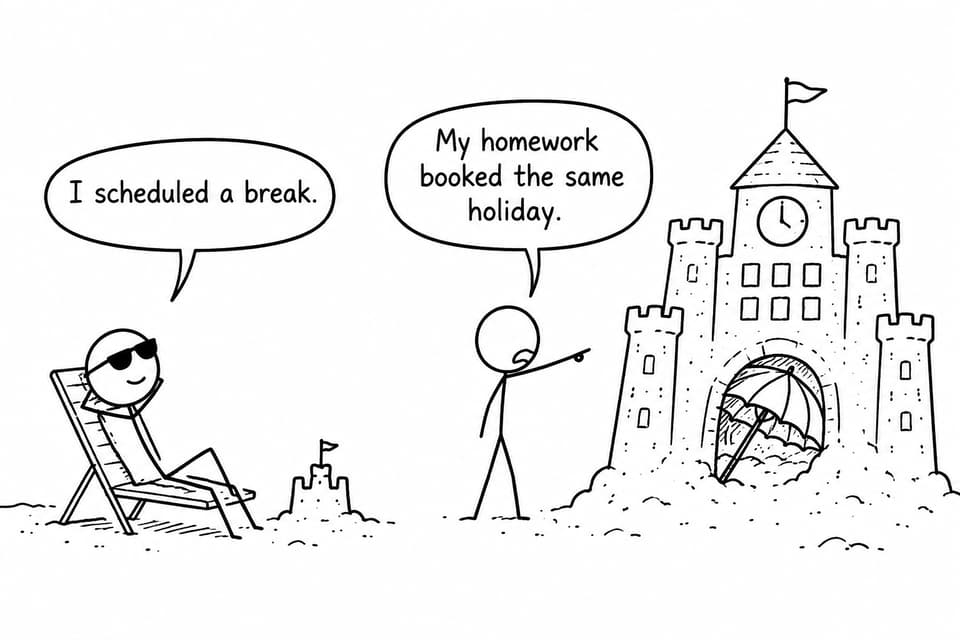
Two students discover that homework has booked the same beach holiday as their planned break
Build an IB spring break plan that protects rest
Rest is not what happens after every task is complete. In the IB, that moment may never arrive. Rest has to be scheduled while unfinished work still exists.
A balanced break can be divided into three phases.
Phase one: disconnect
Take the first 1-2 days off if your schedule allows it. Sleep, see friends, move around, and let the pace of school leave your system. Avoid using these days for guilty half-study, where books remain open but little learning occurs.
Phase two: complete focused blocks
Use the middle of the break for 45-75 minute sessions. One or two blocks on a study day will usually be more useful than an unfocused afternoon at a desk.
A sample seven-day plan could look like this:
Day
Main purpose
Suggested action
Day 1
Full rest
No scheduled academic work
Day 2
Audit
Build the calendar and rank subjects
Day 3
Weak subject one
Review concepts, then answer questions
Day 4
Rest or travel
Optional 15-minute flashcard review
Day 5
Weak subject two
Complete timed or structured practice
Day 6
Core and organization
Do one EE, TOK, or CAS task and file notes
Day 7
Reset
Prepare the first week back
For a two-week break, repeat the middle pattern without filling every day. Keep at least four full or nearly full rest days across the fortnight.
Phase three: restart gently
During the final 1-2 days, look forward rather than trying to rescue the entire term. Pack your materials, preview the first lessons back, and write down the three tasks that should happen first.
This reduces the friction of returning. The goal is not to feel completely ready. It is to know where to begin.
Use active study methods for each session
Short sessions only work when the method demands thought. Rereading can feel smooth because the material looks familiar, but familiarity is not the same as being able to explain or apply it.
Use a simple four-step structure:
Recall: Write what you remember without looking at notes.
Check: Compare your recall with reliable Study Notes or class materials.
Apply: Answer targeted questions from a Questionbank.
Correct: Record why each error happened and attempt it again.
RevisionDojo brings these stages together through its Study Notes, Flashcards, Questionbank, AI Chat, and Grading tools. If an explanation still feels unclear, AI Chat can help you unpack the idea, while question grading can identify where an answer lacks precision. Teacher guidance should remain the authority for school-specific expectations and assessed coursework.
The platform's guide for IB DP1 students offers a broader way to build these habits before DP2. You can also use RevisionDojo's Predicted Papers and Mock Exams when broader assessment preparation becomes appropriate. During DP1 spring break, however, targeted topic work is usually more useful than simulating an entire examination before you have covered the course.
Give the DP core one manageable action
The core can create unusual anxiety because its tasks develop over a long period. Vague instructions such as “work on EE” make that anxiety worse.
Choose one visible outcome instead:
Create a shortlist of possible Extended Essay topics.
Read and annotate two credible sources for an approved research area.
Turn teacher feedback into a revision checklist.
Update your CAS evidence and reflections.
Write three questions to take to your next supervisor meeting.
Organize your TOK examples by theme or area of knowledge.
Do not race ahead without guidance. Extended Essay and TOK processes differ by school, and assessed work must remain your own. RevisionDojo's Coursework Library can help you understand structure and standards, while Tutors can clarify concepts and planning decisions without replacing your independent thinking.
CAS also deserves continuity rather than a heroic holiday project. Check whether your ongoing experiences are documented and whether you know your next action. If you have missed expectations, speak with your CAS coordinator after the break.
Avoid the three common planning mistakes
Trying to fix every subject
Six subjects, the core, and personal commitments will not fit neatly into a short holiday. Choose two priority subjects, maintain the others lightly, and leave lower-value tasks alone.
Measuring time instead of outcomes
“Study Chemistry for two hours” says nothing about what should improve. “Explain equilibrium from memory, complete ten questions, and correct mistakes” gives the session an endpoint.
Making a schedule with no recovery space
A plan that collapses after one missed morning is not disciplined. It is fragile. Leave open blocks so travel, fatigue, or an unexpectedly difficult task does not ruin the week.
The RevisionDojo all-in-one IB resource can reduce some of this planning friction by keeping practice, explanations, feedback, and scheduling in one place. The tool matters less than the principle: know what you are doing, why it matters, and when you are finished.
Return with a smaller burden, not a perfect record
Spring break sits at a useful point in the IB DP1 timeline. You know enough to recognize your weaknesses, and you still have time to address them before they become part of DP2.
A good break will not transform every subject. It might clarify one difficult topic, organize one coursework process, and restore enough energy to think properly again. That is meaningful progress.
Before the holiday begins, create a free RevisionDojo account and download the free DP1 planner. Use it to map your school's IB calendar, protect your rest days, and convert broad worries into specific next actions. When the break ends, you will not need to wonder where to restart. The plan will already be waiting.