If you’ve ever stared at your subject selection form thinking, “This choice is going to decide my whole future,” you’re not being dramatic. You’re being honest.
Because IB SEHS and Environmental Systems and Societies (ESS) don’t just sound different. They train different ways of thinking. One teaches you to look inward--at the human body under stress, recovery, and pressure. The other teaches you to look outward--at ecosystems, sustainability, and the trade-offs we keep making as a species.
This guide is built for IB students preparing for exams: practical, clear, and honest about what each subject asks of you.
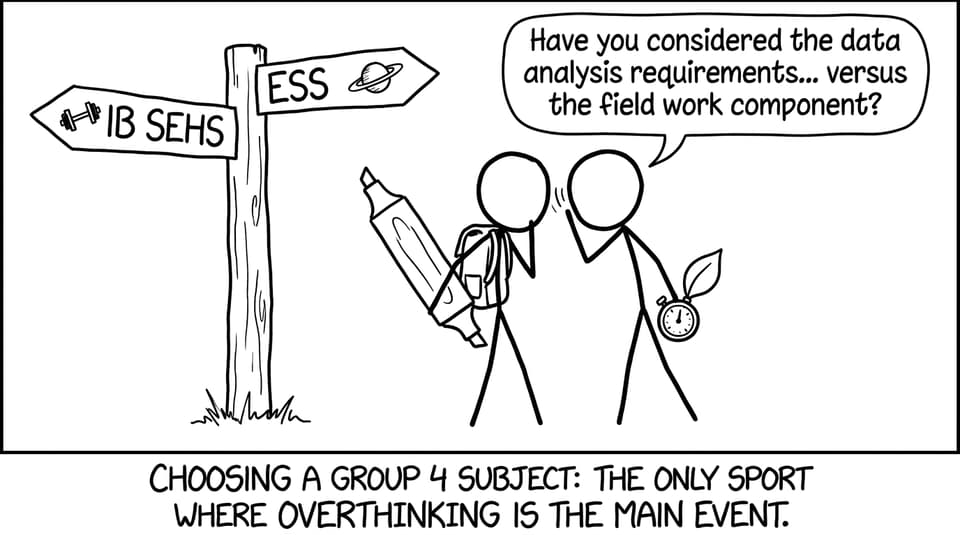
Student choosing between IB SEHS and ESS
Quick decision checklist (read this before you overthink)
Choose IB SEHS if you:
Like biology that feels useful tomorrow (training, health, performance)
Prefer lab-style investigations and measurable human variables
See yourself in medicine-adjacent fields (physio, sports science, nutrition, public health)
Choose ESS if you:
Care about climate, ecosystems, and human impact on the planet
Enjoy connecting science with society, policy, and real case studies
Like big-picture systems thinking (feedback loops, trade-offs, sustainability)
RevisionDojo was developed independently of the IBO and as such is not endorsed by it in any way.
What you actually study in IB SEHS (and what it feels like)
IB SEHS is human-centered science. You spend a lot of time asking: What changes performance? What protects health? What explains injury, fatigue, or adaptation?
Expect topics like:
Anatomy and physiology (the basics, but applied)
Energy systems, training principles, and fatigue
Nutrition and recovery
Biomechanics and movement analysis
Psychology of performance
The subject often feels like “Biology, but with a purpose you can measure.” If you enjoy thinking in variables (heart rate, VO2, lactate, power output, reaction time), IB SEHS tends to feel intuitive.
RevisionDojo makes this style of learning easier because you can move quickly between Study Notes, Flashcards, and the Questionbank without losing momentum. For example, if sports psychology clicks for you, you can go deep via Psychology of Sport, then immediately test yourself with exam-style questions.
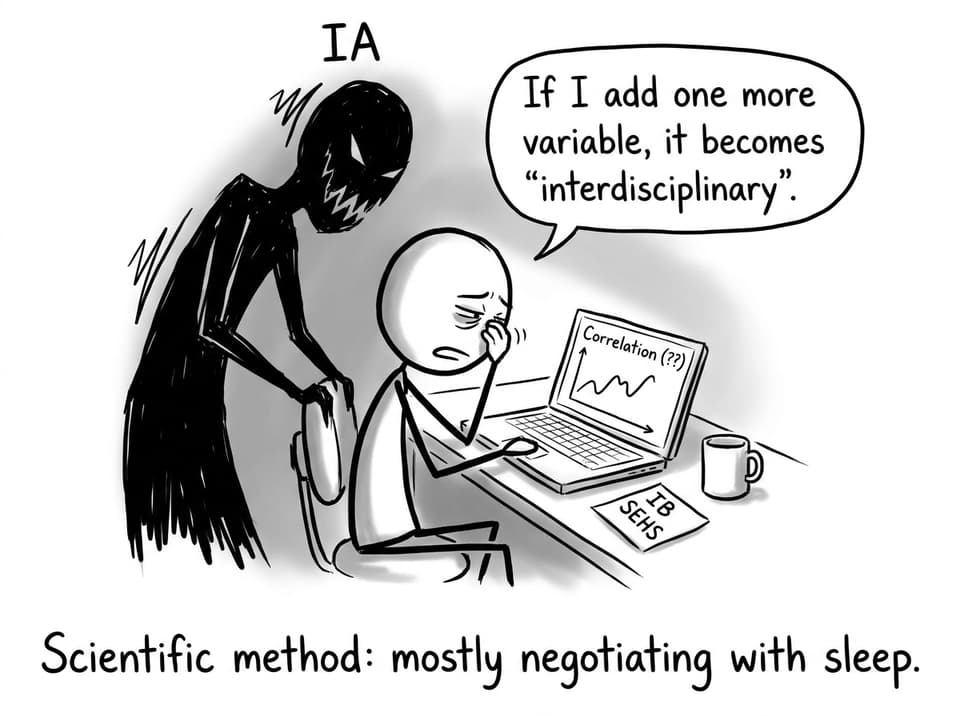
Late-night IA struggle comic
What you actually study in ESS (and what it feels like)
ESS is planet-centered and interdisciplinary. You’re constantly switching lenses: science, geography, economics, ethics, policy. The question underneath is usually: What happens next if we push the system here?
Expect topics like:
Ecosystems, biodiversity, conservation
Climate change, pollution, and energy choices
Resource management and sustainability
Human population, development, and environmental impact
Real case studies and evaluation language
If you like debates with evidence--and you enjoy building arguments that weigh stakeholders and consequences--ESS can feel deeply motivating.
This is where RevisionDojo’s exam loop helps in both subjects: drill with the Questionbank, then use AI Chat to clarify what the markscheme wanted, then retake a mini-set to lock the skill in.
Careers and goals: choosing based on “future you”
A useful way to decide is to picture what you’d be proud to work on at age 25.
Choose IB SEHS if you want to work closer to:
Human health and performance
Physiotherapy, sports therapy, kinesiology
Medicine-adjacent pathways (depending on uni requirements)
Coaching science, strength and conditioning, nutrition
If you’re still unsure, do a small “two-week trial” during revision season: study one IB SEHS topic and one ESS topic, then attempt timed questions for both. RevisionDojo is built for that experiment: Mock Exams and Predicted Papers give you realistic timing practice, while Grading tools help you understand why an answer earns marks (or doesn’t). For exam strategy, you’ll also like RevisionDojo App: The Smarter Way to Prep for IB Exams.
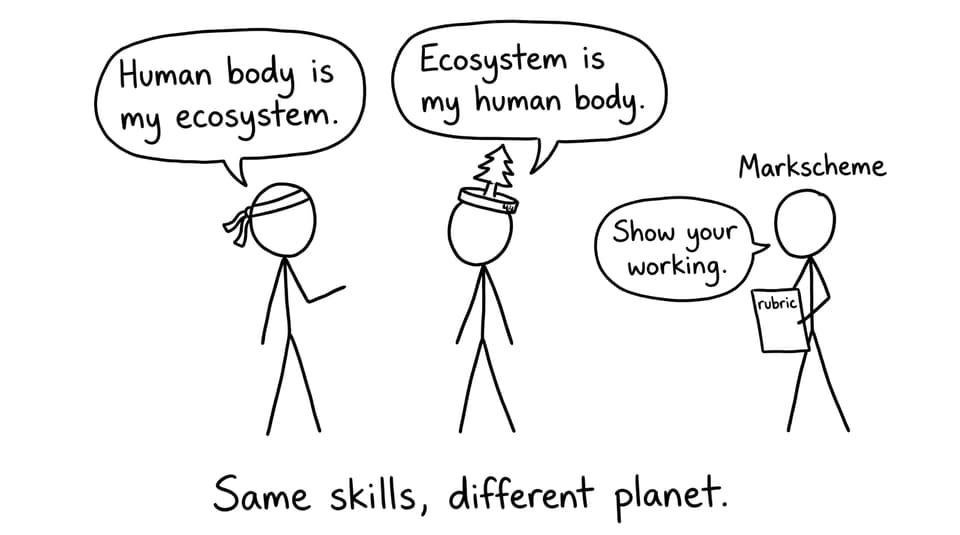
Debate about ecosystems comic
A simple exam prep plan (works for IB SEHS and ESS)
2x/week Learn: Patch understanding with RevisionDojo Study Notes (short, targeted)
Yes--IB SEHS is a Group 4 science subject. It’s treated as a science in IB structures, and the content is grounded in physiology, biomechanics, and health science. ESS is also recognized within the Group 4 space, but it’s famous for being interdisciplinary because it blends environmental science with societal decision-making. In practice, both are respected, but universities can differ in how they view prerequisites for specific degrees. If you are aiming for a highly specific science course, always check requirements early. When you’re researching, build your evidence base by comparing syllabi and question styles, not just what people say in hallways.
Which is easier: IB SEHS or ESS?
Neither is “easy” in the way people mean it at 11:47 p.m. the night before a test. IB SEHS can feel easier if you like concrete mechanisms, measurable variables, and biology-style explanations. ESS can feel easier if you enjoy writing evaluative responses, using case studies, and thinking in systems and trade-offs. The real determinant is whether you can practice exam questions consistently and learn from feedback. That’s why students who use a tight loop (Questionbank --> feedback --> retake) often outperform students who only reread notes. If you want a structure that keeps you honest, RevisionDojo’s Questionbank, Grading tools, and Mock Exams do exactly that.
Can I take both IB SEHS and ESS (and is it a good idea)?
In some schools, yes--and it can be a surprisingly strong combination. Together, they let you connect personal health with environmental health: air quality and respiratory performance, urban design and activity levels, climate and disease patterns, and more. The risk is workload management, because both subjects still require consistent practice and an Internal Assessment. If you’re already juggling demanding HLs, adding both might increase stress without increasing your score. But if you’re genuinely curious and organized, taking both can make your thinking more flexible and your university narrative more interesting. If you go this route, use RevisionDojo’s Flashcards and Study Notes to keep daily recall light, then rely on timed practice to prevent “comfort study.”
Choosing between IB SEHS and ESS (the calm conclusion)
The best subject choice is usually the one you can stick with on tired days, not just motivated ones.
If you want to understand the human body, train performance, and link science to health decisions, IB SEHS is likely your fit. If you want to understand the planet as a system and learn how science and society collide in real life, ESS will probably feel more meaningful.
Whichever you choose, RevisionDojo helps you turn intention into marks: Study Notes for clarity, Flashcards for recall, Questionbank for exam technique, AI Chat for fast help, Grading tools for better written responses, and Predicted Papers plus Mock Exams for realistic pressure practice. Start with the IB SEHS hub here: IB Sports, exercise and health science resources.
IB SEHS goal setting in sport made simple: goal types, SMART targets, common mistakes, and exam-ready tips using RevisionDojo practice tools.