Medicine has a way of turning subject choices into identity choices.
One day you’re a 16-year-old picking classes. The next, you’re quietly asking: Will this help me become the kind of person who can handle medicine?
That’s why IB SEHS is such an underrated win for future med students. It doesn’t replace the usual heavy hitters like Biology and Chemistry. It complements them by making the science feel human again: lungs that actually breathe, hearts that actually respond to stress, data that comes from real bodies, and conclusions that have to survive the messiness of reality.
If you’re an IB student preparing for exams and aiming toward medicine, IB SEHS can become your “applied advantage” -- and a surprisingly strategic way to study smarter.
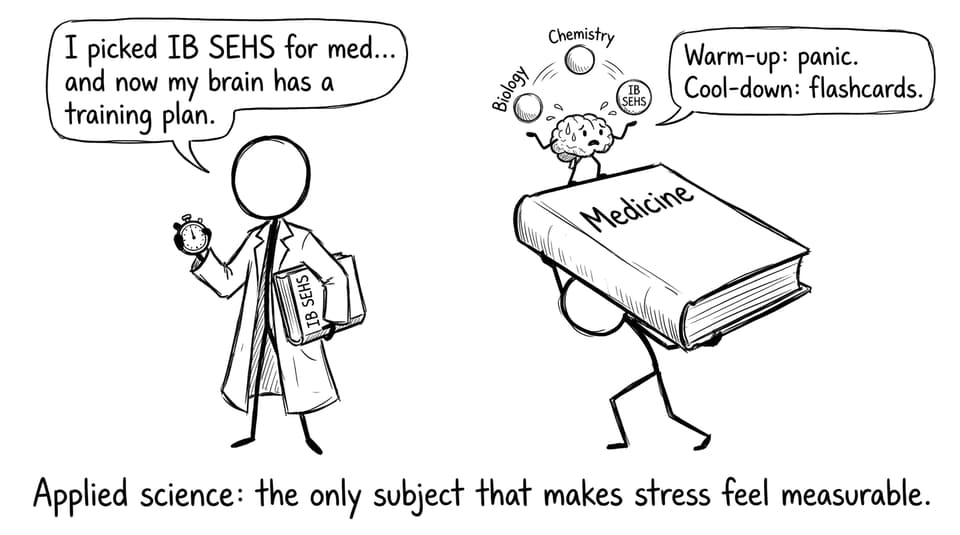
Student brain with a training plan
Quick checklist: why IB SEHS helps future med students
Use this as your fast filter. IB SEHS is a great fit for med-minded students if you want:
More human physiology you can visualize (not just memorize)
A subject that rewards application, not rereading
Stronger research design and data analysis for later study
Practice thinking in cause, effect, and evidence
Labs and investigations that feel close to healthcare contexts
A lot of science revision feels like collecting facts in the dark. You can do it, but it’s hard to feel confident.
IB SEHS is different because it keeps pulling you back to systems you already “know” from living inside them: cardiovascular function, respiration, movement mechanics, energy pathways, and nutrition.
That matters for medicine because med school doesn’t reward the student who can only define. It rewards the student who can explain.
In IB SEHS, you repeatedly practice questions like:
What changes when intensity rises?
Why does performance drop under certain conditions?
Which variable actually caused the outcome?
That rhythm -- mechanism, measurement, interpretation -- is basically a preview of how you’ll be asked to think later.
When you need a clean entry point into a tricky area, open a focused page like B.1 Generating movement in the body and revise with one goal: translate content into a cause-and-effect story.
IB SEHS makes Biology feel less abstract (and that helps exams)
Here’s the honest truth: many future med students can learn Biology, but they don’t always feel connected to it. There’s a lot to hold in your head at once.
IB SEHS helps by acting like a bridge between theory and reality. When you revise gas exchange, training adaptations, fatigue, or recovery, you’re constantly answering: So what does that mean for a human being?
That kind of transfer makes exam recall easier because you’re not retrieving isolated bullet points. You’re retrieving a mental model.
If you want the broader structure of Biology to pair alongside it, keep IB Biology Resources open as a second tab, and build links between topics as you revise.
IB SEHS strengthens research skills without feeling like research
Medicine is evidence-based, which is a polite way of saying: you will live inside uncertainty.
IB SEHS trains you for that earlier than most students realize:
designing investigations with controls and realistic limitations
collecting physiological or psychological data
applying statistics and interpreting what the numbers do (and don’t) prove
evaluating validity, reliability, and bias
And because it’s human-centered, the “messiness” is built in. That’s valuable practice. Real medicine is never as clean as a textbook diagram.
If coursework pressure is the part that spikes your stress, explore RevisionDojo’s SEHS coursework exemplars library and use it like a model gallery: not to copy, but to internalize what strong structure looks like.
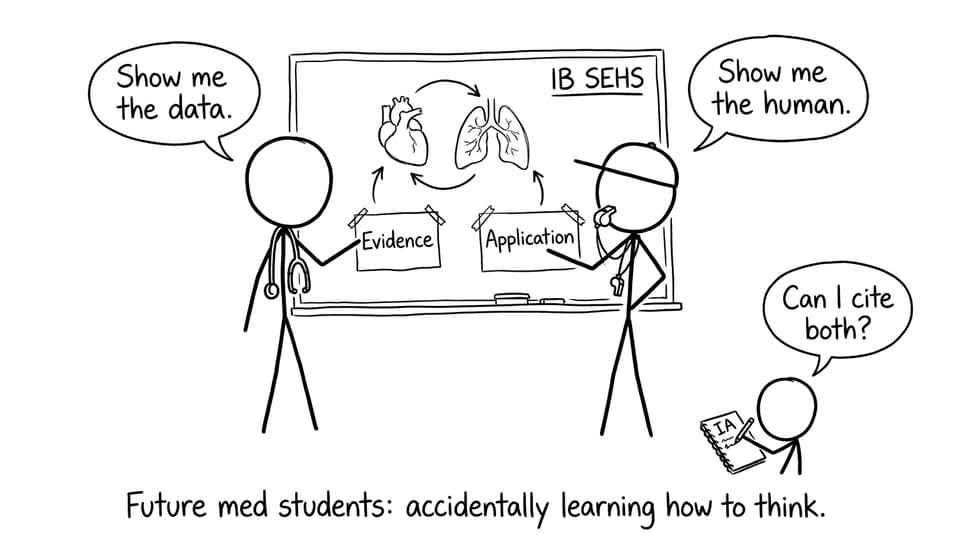
Doctor vs coach whiteboard debate
How to revise IB SEHS like a future med student (not a crammer)
The best IB SEHS revision rarely looks dramatic. It looks repeatable.
Here’s a simple loop that fits exam season:
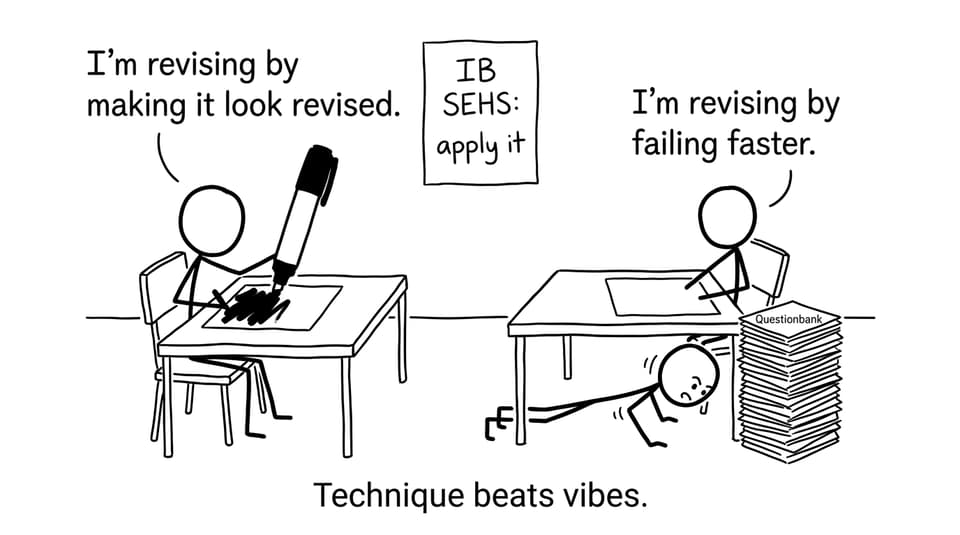
Learn fast, then test faster
Start with concise Study Notes and definitions, then move quickly into practice.
RevisionDojo’s Questionbank feature is built for this: you practice exam-style questions, get immediate feedback, and spot patterns in your mistakes.
Use Flashcards for definitions and mechanisms
Medicine has a vocabulary problem: you’re always learning new terms.
Use RevisionDojo Flashcards for daily recall bursts. Ten minutes a day doesn’t feel heroic, but it compounds.
Add pressure with full-paper practice
Once you’re consistent, simulate timing. This is where students separate “I understand” from “I can perform.”
For most students aiming at medicine, universities still prioritize Biology and Chemistry for entry requirements. IB SEHS works best as:
a complementary Group 4 science (SL or HL)
a way to deepen your human physiology intuition
a subject that strengthens your research and data-handling confidence
If you’re unsure whether to take IB SEHS at SL or HL, decide based on two things: your overall workload and whether you genuinely enjoy the applied side of science. Enjoyment matters, because it predicts consistency -- and consistency predicts grades.
Conclusion: IB SEHS is the subject that makes science feel human
Future med students don’t just need more content. They need better thinking habits.
IB SEHS helps you build them: applied physiology, evidence-based reasoning, research skills, and exam practice that mirrors real decision-making. It’s not a substitute for the usual prerequisites, but it’s an unusually good complement -- especially if you’re the kind of student who learns best when science connects to real bodies and real outcomes.
If you want to turn that advantage into exam results, RevisionDojo gives you the full system in one place: SEHS Study Notes, Flashcards, AI Chat for quick clarity, Grading tools for coursework, a Coursework Library for examples, and the Questionbank plus Predicted Papers and Mock Exams to train performance under time.