

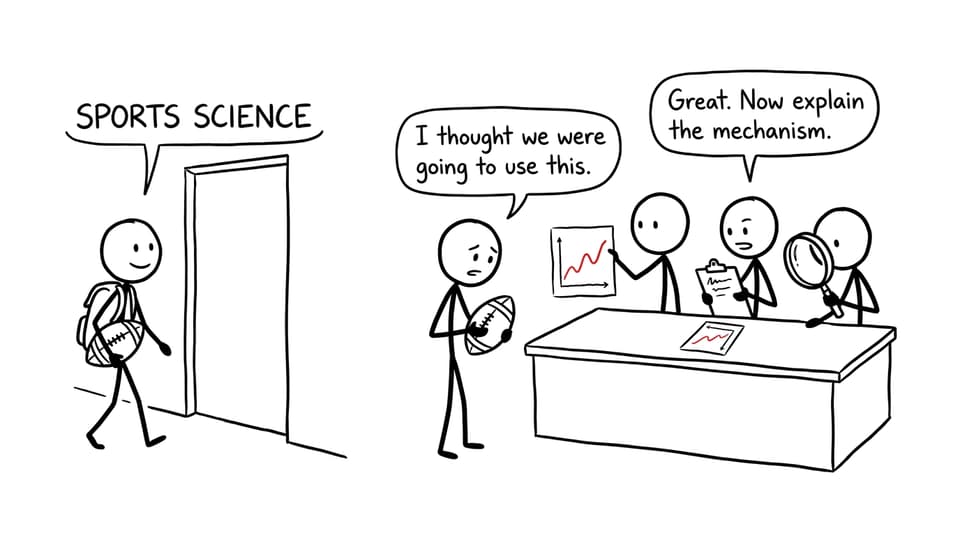
The biggest of the IB SEHS first term struggles is not memorizing anatomy or coping with calculations. It is realizing that familiar knowledge about sport is not the same as scientific understanding.
You may know that dehydration harms performance, training changes the body, or anxiety affects an athlete. IB Sports, Exercise and Health Science asks for something more precise: Why does it happen? What mechanism connects cause and effect? What does the evidence show?
That adjustment can feel sharp. The subject looks familiar from the outside, but its academic rules are new. Students who recognize this early can make the first term much easier.
The first-term adjustment checklist
Focus on these habits:
- Treat SEHS as an experimental science, not a general sports course.
- Learn definitions alongside mechanisms and applications.
- Translate command terms before answering.
- Practise interpreting graphs, tables, and experimental results weekly.
- Record variables, units, controls, and limitations during practical work.
- Use short retrieval sessions instead of repeatedly reading notes.
- Review mistakes while the topic is fresh.
The IB SEHS resource hub can serve as your course dashboard, connecting Study Notes, Flashcards, and focused practice by topic.
The real shock is moving from recognition to explanation
A student might read about heart rate, nutrition, motivation, or movement and think, “I understand this.” Often, the idea merely feels recognizable.
Recognition is comfortable. Explanation is demanding.
Suppose a question asks why heart rate rises during exercise. Saying that working muscles need more oxygen points in the right direction, but a stronger answer constructs a physiological chain. Exercise increases muscular demand for aerobic respiration. Oxygen consumption rises. Cardiac output must increase to support oxygen delivery and the removal of metabolic products. Heart rate contributes to that change.
The difference is not just extra detail. It is connected reasoning.
This is why students can enjoy lessons and still receive disappointing marks on an early test. They remember the outcome but cannot express the mechanism precisely.
The current SEHS course, first assessed in 2026, covers exercise physiology and nutrition, biomechanics, and sports psychology and motor learning. It also develops experimental and data-handling skills. These areas overlap, so success depends on connecting ideas rather than storing facts separately.
Use the syllabus-aligned SEHS Study Notes to see how terms, mechanisms, and examples fit together.
Build three layers of knowledge
The fastest way through the adjustment is to study every concept in three layers.
Define it
Start with exact terminology. A vague definition weakens everything built on top of it.
Use RevisionDojo Flashcards for brief retrieval sessions. Keep each prompt narrow enough to judge your answer accurately. “Explain everything about homeostasis” is too broad. “What is negative feedback?” creates a useful test.
Explain the mechanism
Ask what happens between the starting condition and the outcome. Use arrows while learning:
Stimulus → physiological response → performance consequence
For example:
Fluid loss → reduced plasma volume → lower venous return → reduced stroke volume → greater cardiovascular strain
Your final answer should use complete scientific sentences, but the chain exposes missing links. If one arrow remains unclear, use AI Chat to ask about that specific transition.
Apply it
Place the concept in an unfamiliar context, such as an endurance event, resistance-training session, rehabilitation programme, or experimental dataset.
Application is where knowledge becomes flexible. It is also where the Questionbank becomes more useful than another round of highlighting. Answer a small set, inspect the feedback, and rewrite one weak response. Noticing an omission is not the same as learning to correct it.
Command terms determine the answer
Two questions about the same topic may require different thinking.
- State requires a concise answer.
- Describe requires relevant characteristics, stages, or patterns.
- Explain requires reasons or a cause-and-effect mechanism.
- Analyse requires relationships, patterns, or component parts.
- Evaluate requires strengths, limitations, and a supported judgement.
Students often lose marks by answering the topic rather than the instruction. They see a familiar keyword, unload everything they remember, and overlook the verb controlling the response.
Before writing, identify the command term, consider the mark allocation, and decide what shape the answer needs. RevisionDojo’s guide to answering SEHS questions through command terms explains these distinctions in greater depth.
Data is not a separate chapter
New students sometimes treat graph interpretation as an occasional mathematical interruption. In SEHS, data is one of the main ways scientific understanding becomes visible.
Use this sequence:
- identify the variables;
- inspect axes, scales, and units;
- state the trend using relevant values;
- identify anomalies or variation;
- explain the pattern using SEHS theory;
- evaluate reliability or validity when requested.
“The value increased” is weaker than a quantified statement. Yet quoting numbers alone is not analysis. A strong response connects evidence to theory.
Practise that process with RevisionDojo’s guide to SEHS data-based questions. Early practice prevents data handling from becoming a skill postponed until formal exam preparation.
Practical work is training
The current SEHS scientific investigation requires students to gather and analyse data in response to their own research question. Its report has a maximum word count of 3,200 words, and the investigation contributes 24% of the final subject grade.
You do not need to design that investigation immediately. You should treat ordinary practical work as preparation for it.
After each practical, record the variables, controls, units, measurement precision, limitations, one realistic improvement, and the scientific explanation for the pattern. This turns classwork into a useful library of techniques and reflections.
The SEHS lab report guide supports good reporting habits, while the scientific investigation essentials clarify the larger task. Later, the Coursework Library can provide models, Grading tools can identify rubric-level weaknesses, and Tutors can help with difficult methodological decisions.
A first-term routine that stays small
You do not need an exam-season schedule. You need a repeatable loop:
- Two 25-minute learning sessions: study one subtopic and create a mechanism chain.
- Three 10-minute recall sessions: retrieve definitions, processes, and experimental vocabulary.
- One 30-minute application session: complete a short Questionbank set and rewrite one response.
- One 15-minute practical review: organize data, controls, limitations, and reflections.
Use Mock Exams and Predicted Papers later for timing and full-assessment rehearsal. During the first term, targeted practice usually matters more because it reveals exactly which link is missing. The beginner’s guide to IB SEHS offers a broader starting framework.
The adjustment becomes an advantage
The early shock comes from discovering that interest in sport does not automatically produce scientific answers. Familiarity is still useful because it gives you memorable contexts for physiology, biomechanics, nutrition, and psychology. Your task is to add precision.
Define the concept. Explain the mechanism. Apply it to evidence. Evaluate the method when required.
RevisionDojo brings that process together through Study Notes, Flashcards, the Questionbank, AI Chat, and Grading tools. As the course develops, Predicted Papers, Mock Exams, the Coursework Library, and Tutors can support its more demanding stages.
The first term does not need to prove how good you are at SEHS. It only needs to teach you how SEHS thinks.