
The moment you start counting points
There's a particular kind of silence that shows up after someone says "Oxbridge."
It's the silence where your brain immediately starts doing math.
You picture an offer letter as a number: 42, 43, 45. You picture your IB predicted grade as a verdict. And if you're honest, you don't just want to know whether Oxbridge is possible. You want to know whether it's likely, and what you can do about it.
So: Can you get into Oxbridge with your IB score?
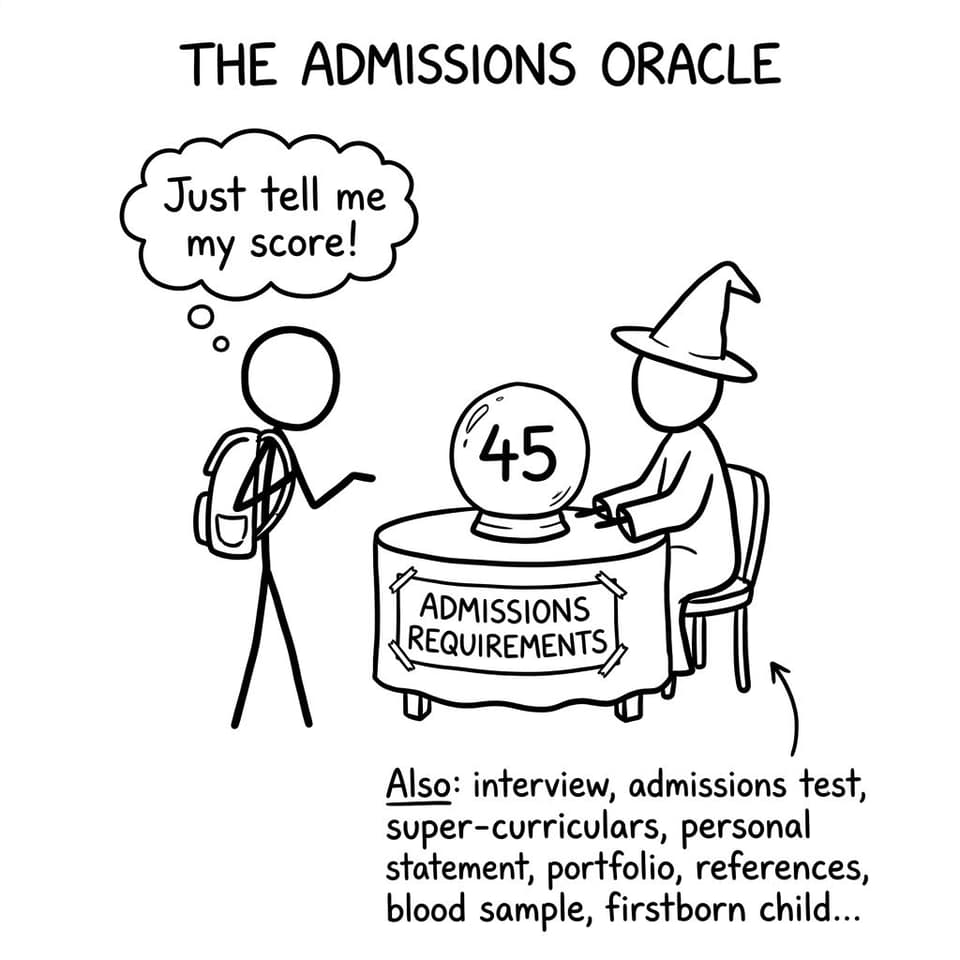
Yes. Many students do. But the IB score is only one part of the admissions story, and it's rarely the part that decides everything. Oxbridge selection is more like a spotlight than a scoreboard: grades get you seen, then subject fit, evidence, tests, written work, and interviews do the sorting.
If you're revising right now, that's good news. It means your fate isn't trapped inside a single number. It means you can still build the kind of application that feels inevitable in hindsight.
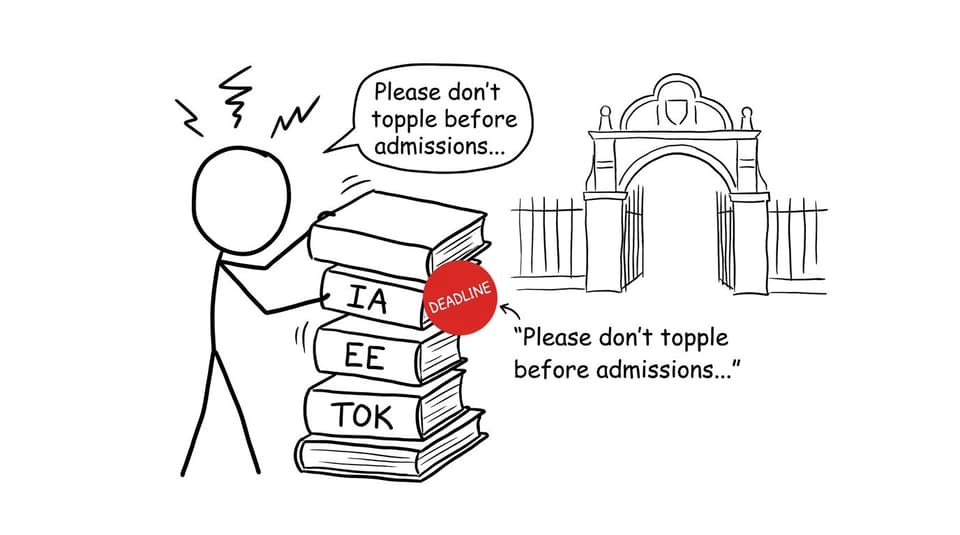
Quick checklist: what actually matters for Oxbridge (besides the IB)
Before we go deep, here's the reality check many IB students need:
- A competitive IB predicted grade (usually high)
- The right subjects at HL for your course
- Evidence of academic curiosity (super-curriculars)
- Strong performance in admissions tests (when required)
- Written work (for some courses)
- Interview performance (Oxford often heavily; Cambridge varies by course)
- A coherent narrative: why this subject, why you, why now
The IB matters because it signals you can handle workload and abstraction. But Oxbridge is also trying to predict something else: whether you'll thrive in tutorial or supervision-style learning.
What IB score do you need for Oxbridge?
Most competitive Oxbridge applicants have a very strong IB profile. In practice, offers commonly cluster around the low-to-mid 40s, often with specific Higher Level requirements.
Here's the important nuance: Oxbridge doesn't just care about your total IB points. They often care more about:
- Your HL scores in relevant subjects
- Your predicted trajectory (are you improving?)
- Whether your subject combination matches the demands of the course
A student with 41 but the perfect HLs for their course can look stronger than a student with 44 and mismatched preparation. The IB total is a summary. Oxbridge is reading the chapters underneath.
If you want a broader perspective on how Oxbridge views the diploma overall, this post is worth reading: Does OxBridge like IB better?
The hidden difference: "getting an offer" vs "meeting the offer"
A lot of anxiety comes from mixing two separate moments.
Getting shortlisted
This is where your IB predicted grades and academic signals matter most. Oxbridge needs a way to manage volume. Strong predicted grades are often the entry ticket.
Meeting your conditions
This is where your actual IB exam performance matters. Offers are conditional for many applicants, and meeting them is its own challenge.
If you're an IB student preparing for exams, this distinction changes your strategy: you're not only trying to look qualified. You're trying to become reliably qualified under timed pressure.
That's why RevisionDojo is built around making performance repeatable: Study Notes to compress the syllabus into what matters, Flashcards to keep recall alive, and the Questionbank to turn knowledge into marks.
Useful starting points:
What Oxbridge really sees when they see an IB score
Think of your IB score like a passport stamp. It doesn't tell the full story of your trip. It shows that you've been somewhere demanding.
Oxbridge admissions tutors often read your grades as answers to quiet questions:
- Can this student handle dense reading and abstract argument?
- Do they have the stamina for long-term projects (EE, IAs)?
- Are they consistent, or do they spike occasionally?
- Is their strength aligned with the subject they're applying for?
That last one is huge.
A 7 in HL Math AA for Engineering says something different than a 7 in HL English for PPE. The IB lets you show specificity. Use that.
If your predicted IB score isn't "Oxbridge level"
This is the part no one wants to say out loud: sometimes the predicted number isn't where you want it to be.
But low prediction is not always a final judgment. It's often a signal about evidence. Teachers predict what they've seen repeatedly, not what you hope to become.
If you want your predicted IB score to move, you need a short window where you become predictably better. Not louder. Not more stressed. Just more measurable.
A practical approach:
- Pick 2 HL subjects where gains are most realistic
- Do weekly timed practice (not just notes)
- Track errors by type (concept, method, command term, structure)
- Retake similar questions after 48 hours
RevisionDojo's loop is designed for this: learn quickly, practise a lot, get feedback, repeat. Use AI Chat when you're stuck in the "I don't even know what I don't know" phase. Use Mock Exams to make timed work feel normal. Use Predicted Papers and analytics when you need realistic pressure without chaos.
Two posts that match this mindset:
The admissions test problem (and why IB revision still helps)
Many Oxbridge courses require an admissions test. Students sometimes treat this like a separate universe from the IB.
But the overlap is real.
The IB trains you to:
- read carefully
- handle unfamiliar prompts
- write under time
- justify answers, not just state them
That's exactly the muscle admissions tests and interviews pull on.
So even if you're thinking "I need to revise for Oxbridge, not just the IB," you're not choosing between two paths. You're choosing whether your IB revision builds transferable skills.
This is where active practice matters more than passive review.
If your revision looks like rewriting notes, it will feel comforting and produce little change. If your revision looks like timed questions, markscheme comparison, and iteration, your IB score rises and your Oxbridge readiness rises with it.
A calmer strategy: build an "Oxbridge-ready IB week"
Oxbridge applicants often burn out because they try to do everything at once. A better model is fewer goals, repeated.
Here's a weekly structure that many IB students can actually sustain:
Two deep sessions (HL focus)
- Use Study Notes to rebuild one weak concept
- Do 30-60 minutes of targeted Questionbank practice on that same concept
- Ask AI Chat to explain why your answer drops marks
Three short sessions (memory maintenance)
- 7-12 minutes of Flashcards
- 10-15 minutes of mixed questions
One realism session
- Sit a timed block using Mock Exams or Predicted Papers
- Review mistakes like an analyst: what pattern keeps repeating?
If you want a full platform overview of how RevisionDojo fits together, this explains the full system clearly: RevisionDojo App: The Smarter Way to Prep for IB Exams
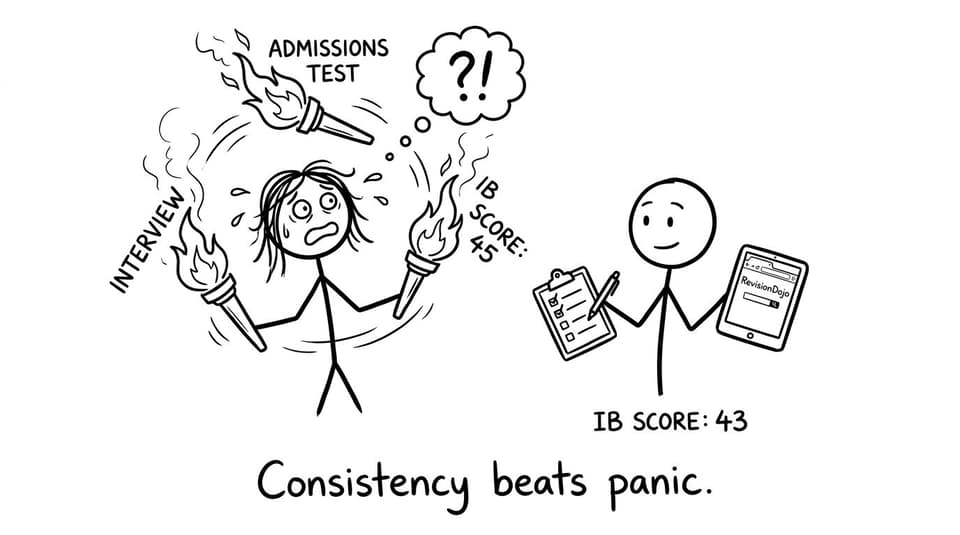
Interview readiness: the part your IB score can't do alone
The Oxbridge interview is often described like a conversation. It is. But it's a conversation with rules.
Interviewers tend to probe:
- Can you think out loud without collapsing?
- Can you handle being wrong and continue?
- Do you use evidence, definitions, examples?
- Do you connect ideas across topics?
Your IB helps here because it forces you to practice structured thinking across disciplines. TOK especially can be useful if you learn to make arguments cleanly.
Still, interview readiness is built through practice that resembles the interview.
One simple technique: take a hard question from your RevisionDojo Questionbank, answer it out loud, then ask yourself, "What assumption did I make?" Do that once a day for two weeks and you'll sound like a different person.
The quiet truth: Oxbridge isn't a number, but the IB still matters
If you came here wanting a single cutoff, you're not alone. It would be comforting if Oxbridge admissions worked like a lock and your IB score was the key.
But it's more human than that.
Your IB score is the most visible proof that you can do hard things for a long time. Oxbridge still wants the rest of the proof: the way you think, the way you read, the way you respond when the problem doesn't match your notes.
That's why the best plan is simple: raise your IB performance while training the skills that make Oxbridge interviews and tests feel familiar.
If you want one place to do that without juggling ten resources, make RevisionDojo your home base: Questionbank for high-volume exam-style practice, Study Notes for clarity, Flashcards for daily recall, AI Chat for instant explanations, plus Grading tools, Mock Exams, Predicted Papers, a Coursework Library, and Tutors when you need a human layer.
Start here and build the loop: RevisionDojo for IB