


When people say the MYP changed in 2014, it can sound like a curriculum rumor. But if you have ever opened an on-screen exam, stared at a rubric, and wondered why the task feels like a real-world problem instead of a worksheet, you have already felt the impact of MYP Next Chapter.
The update mattered because it quietly rewired what the MYP rewards: not just knowing content, but transferring it. And for IB students preparing for exams, that shift is good news. It means your preparation can be more strategic, more repeatable, and less dependent on last-minute memorization.
If you want a central place to orient your revision, start with the Middle Years Programme (MYP) Hub. It is the cleanest way to see how MYP subjects, skills, and exam practice fit together.
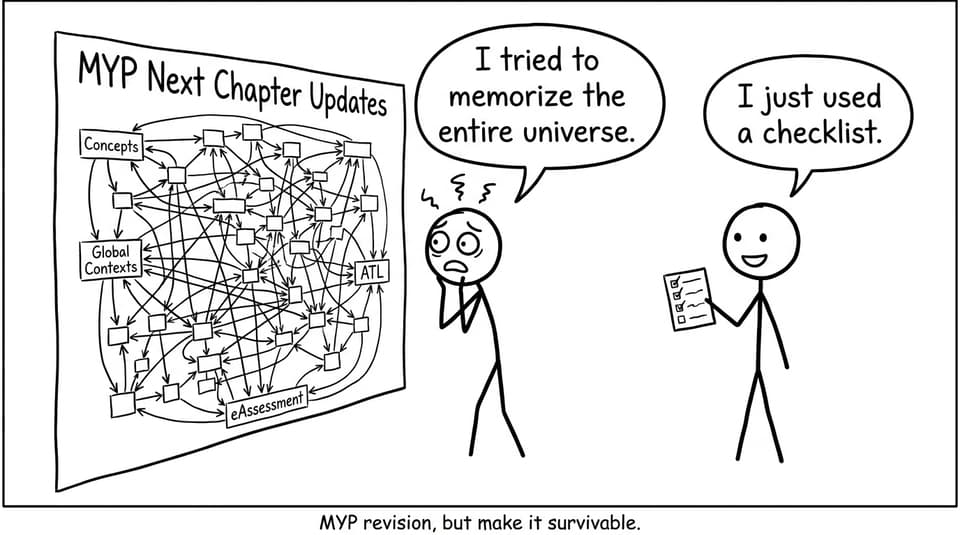
A quick checklist: what changed in MYP after 2014?
Use this as your fast scan before you revise. The MYP Next Chapter updates focused on:
-
Concept-based learning (big ideas over isolated facts)
-
Stronger use of global contexts in every unit
-
More curricular flexibility in later years
-
MYP eAssessment (on-screen exams and ePortfolios)
-
A bigger, clearer role for ATL skills (Approaches to Learning)
-
Better alignment across the IB continuum (PYP to MYP to DP/CP)
To make those changes practical, pair this article with the MYP Revision Guide: Study Tips for Success for an exam-focused routine.
Why the MYP Next Chapter update happened
By 2014, the MYP had been running for about two decades. Education had shifted: more digital work, more interdisciplinary problems, and more emphasis on skills that travel across subjects. The update aimed to keep the programme rigorous while making it clearer, more flexible for schools, and more consistent in assessment.
For students, the most important takeaway is this: modern MYP tasks are built to test what you can do with your knowledge, under constraints. That is exactly what exams do.
Conceptual understanding became the center of MYP
Before Next Chapter, some classrooms treated the MYP like a content checklist. After 2014, the programme pushed harder toward concept-driven learning: key concepts, related concepts, and global contexts shaping the unit.
That matters for revision because concepts create compression. Instead of memorizing 40 separate facts, you learn the “idea behind the facts” and practice applying it.
A practical way to study conceptually:
-
Pick the key concept (e.g., systems, relationships, change)
-
Write a two-sentence explanation in your own words
-
Do exam-style questions that force transfer (new scenarios)
-
Review using the criteria language, not just the model answer
RevisionDojo is designed for that loop: use Study Notes to get clear quickly, then move immediately into practice using the Questionbank.
Global contexts became a real tool, not decoration
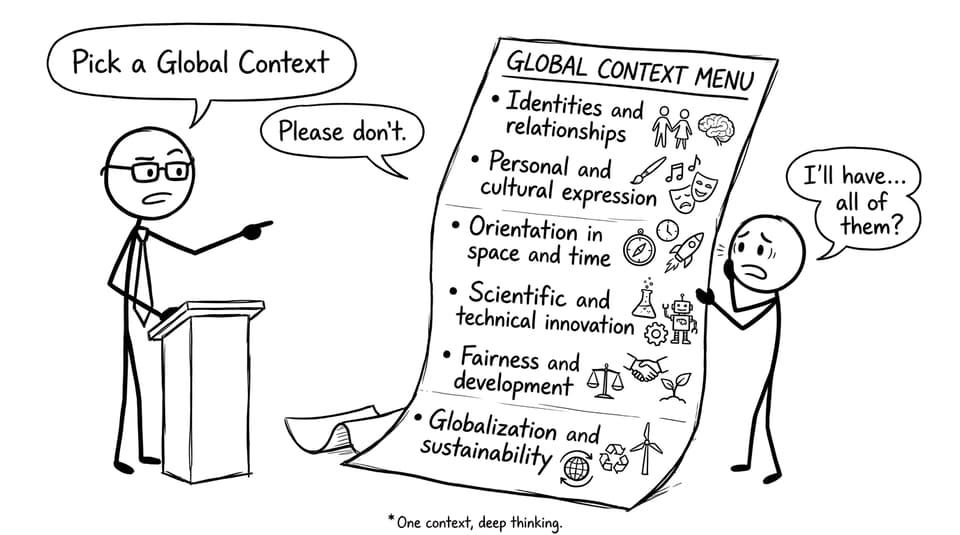
The six global contexts did not just get listed; they became a required lens for inquiry across the MYP. They are:
-
Identities and relationships
-
Personal and cultural expression
-
Orientation in space and time
-
Scientific and technical innovation
-
Fairness and development
-
Globalization and sustainability
For exams, global contexts help you avoid generic answers. They push you to be specific about why this matters and who it affects. If your response feels flat, it is often because your context is too vague.
A strong exam move in MYP is choosing one context and going deep: define it, connect it to the scenario, and use it to justify decisions.
More flexibility in Years 4 and 5 (and what it means for you)
Next Chapter also increased curricular flexibility. Schools were given more room to reduce subject group requirements in Years 4 and 5 (while still meeting programme expectations). The goal was to let schools adapt to local systems and let students go deeper in areas that fit their pathway.
For you, the student takeaway is simple: your MYP experience may look different from a friend’s at another school, but the core logic stays the same. The programme still rewards criteria-based performance, conceptual understanding, and communication.
So when you revise, focus less on “what did my friend cover?” and more on “what does my assessment actually reward?”
MYP eAssessment changed the feel of revision
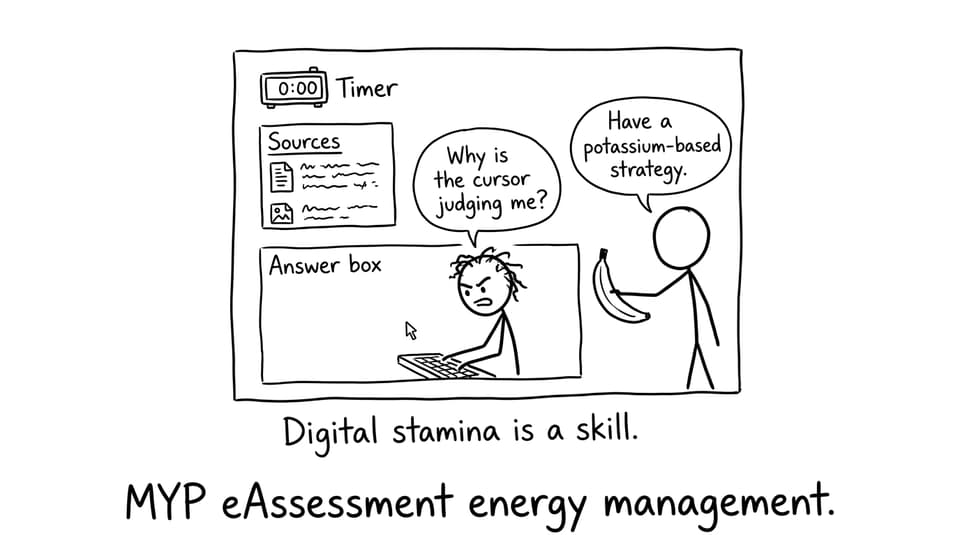
The most visible Next Chapter change was MYP eAssessment: on-screen exams and ePortfolios that can lead to the MYP Certificate.
For exam prep, digital assessment creates a new kind of skill: on-screen stamina. Reading sources on a screen, planning under time pressure, typing clearly, and managing the interface are all part of performance.
If you are preparing for that format, read Tips for Success in MYP eAssessments and then build structure using MYP eAssessments: 30-Day Study Plan That Works.
ATL skills moved from “extra” to “exam engine”
ATL skills (Approaches to Learning) became more central in the updated MYP: thinking, research, communication, self-management, and social skills.
Students sometimes treat ATL like reflection homework. But in exams, ATL is what helps you:
-
decode command terms accurately
-
plan responses under time pressure
-
communicate in a way the criteria can reward
-
recover when you hit a hard question
To make ATL feel concrete, use Linking ATL Skills to Conceptual Understanding in the MYP. If you want to make ATL a daily habit (without adding time), Embedding ATL Skills Seamlessly in Daily Lessons is a strong follow-up.
How to revise for MYP Next Chapter with less stress
Here is a simple, exam-shaped routine that fits the post-2014 MYP.
The 3-step MYP loop (45-75 minutes)
-
10-15 min: patch understanding with notes (one concept, one context)
-
25-40 min: do targeted questions (timed when possible)
-
10-20 min: review mistakes using criteria language and rewrite one response
On RevisionDojo, this becomes smoother because the tools connect: Questionbank, Study Notes, Flashcards, AI Chat, Grading tools, Predicted Papers, Mock Exams, Coursework Library, and Tutors.
If you are also balancing multiple deadlines, Balanced Subject Group Load: Managing Time in the MYP is worth keeping open while you plan your week.
FAQ
What is “MYP Next Chapter” in simple terms?
“MYP Next Chapter” is the name often used for the major set of updates introduced around 2014 to modernize the MYP. The changes focused on making learning more concept-driven, more connected to real-world contexts, and more consistent in how students are assessed. For students, that means you are rewarded for explaining, justifying, analyzing, and transferring knowledge to unfamiliar situations. It also means criteria language matters more than your feelings about how “good” an answer sounded. When you prepare for MYP, you should practice showing your thinking clearly, not just collecting facts. A helpful place to start is the Middle Years Programme (MYP) Hub, because it organizes the programme in a student-friendly way.
How did MYP eAssessment change what I should practice?
MYP eAssessment pushed students to perform in digital conditions, which changes how revision should look. You still need conceptual understanding, but you also need digital stamina: reading sources on-screen, navigating tools, typing structured answers, and pacing yourself for the full sitting. The biggest mistake is studying only with notes and then expecting your exam performance to appear automatically. Instead, you should practice in the same shape as the assessment: timed tasks, criteria-based self-checking, and short review loops that turn mistakes into rules. If you are unsure what the format demands, read Tips for Success in MYP eAssessments and then commit to the routine in MYP eAssessments: 30-Day Study Plan That Works. The MYP rewards preparation that is visible and repeatable.
Do ATL skills really matter for MYP exams, or are they just school talk?
ATL skills matter because they are the behaviors that produce marks under pressure. In the MYP, it is not enough to “know it” if you cannot communicate it clearly, manage your time, or interpret the task correctly. Thinking skills help you move from description to analysis; communication skills help you structure responses so criteria are obviously met; self-management keeps you steady when a question feels unfamiliar. ATL also helps you revise better: planning sessions, tracking weak areas, and reflecting on what actually improved performance. If ATL feels vague, use Linking ATL Skills to Conceptual Understanding in the MYP to turn it into a concrete study routine. The modern MYP is designed so that ATL shows up in your results, whether you notice it or not.
Closing: treat MYP as training, not a phase
The 2014 MYP Next Chapter updates did not just refresh documents; they changed what success looks like. Concepts, global contexts, ATL skills, and eAssessment all point to the same message: the MYP is practice for thinking clearly in unfamiliar situations.
If you want that to translate into exam confidence, build a simple loop and repeat it: Study Notes for clarity, Flashcards for recall, Questionbank for application, AI Chat for quick explanations, and Mock Exams plus Predicted Papers for stamina. Start at the Middle Years Programme (MYP) Hub, pick one subject, and run the loop today. Your future self will feel the difference the next time a “weird” question appears and you realize you know exactly what to do.