
If you’ve ever stared at an MYP task sheet and thought, I know the topic… so why does this feel like a different sport? you’re not alone.
The MYP rewards something slightly rarer than “knowing”: it rewards showing your thinking. That can feel uncomfortable at first, especially when exams are coming and you want certainty. But once you understand what the MYP is trying to measure (and how), your stress drops. Your studying gets more efficient. Your grades become less mysterious.
This MYP FAQ is written for IB students preparing for assessments who want clear answers, not vague reassurance. We’ll cover the structure, the criteria, the big projects, and the quickest ways to study.
Quick MYP checklist (save this before exam season)
Use this as your fast “am I doing the right things?” scan for MYP success:
-
Know your subject’s criteria A--D and what top-band work looks like.
-
Translate every task into: Which criterion is this really testing?
-
Practice under time limits at least weekly.
-
Turn feedback into one visible action for the next attempt.
-
Keep active recall going (short, daily) so knowledge stays usable.
If you want a home base for resources, start with the Middle Years Program (MYP) hub, then use targeted practice loops with RevisionDojo’s Questionbank, Study Notes, Flashcards, AI Chat, Grading tools, Predicted Papers, Mock Exams, Coursework Library, and Tutors.
What is the IB MYP, in plain English?
The MYP (Middle Years Programme) is the IB framework for students aged 11 to 16. It’s built to connect learning to the real world through concept-based inquiry.
In practice, that means you’re not just asked to repeat information. You’re asked to apply it: explain, analyze, create, reflect, justify. This is why the MYP can feel harder than traditional curricula even when the content isn’t “harder” on paper.
The good news is that the skills you build here are the same skills that later make DP feel less intimidating: criterion awareness, reflection, research habits, and the ability to write in a structured way under pressure.
Who can join the MYP?
Most students start the MYP in Year 1 (often Grade 6), but students can join at different stages depending on the school.
The key requirement is that your school is an authorized IB World School offering the programme. From a student perspective, that mostly matters because it shapes how you’re assessed, how units are designed, and how your work is moderated.
If you’re new to the programme, one smart move is to skim a few student-focused posts in the All #MYP Posts collection so the language and expectations stop feeling foreign.
What are the eight MYP subject groups?
In the MYP, students usually study these eight subject groups each year:
-
Language and Literature
-
Language Acquisition
-
Individuals and Societies
-
Sciences
-
Mathematics
-
Arts
-
Physical and Health Education
-
Design
Schools aim for a balanced programme. In later years, some schools reduce the number of groups to allow more specialization.
If you want a concrete example of what revision can look like in one subject, explore subject pages like MYP Standard Mathematics Resources and notice how RevisionDojo organizes skills, topics, questions, and feedback into one loop.
How is MYP learning different from “normal school”?
The MYP is designed around three ideas that change how you should study:
Concept-based inquiry
Instead of memorizing isolated facts, you keep returning to big concepts (like systems, relationships, change) and applying them.
Global contexts
Units connect to real-world frames (identity, sustainability, fairness, innovation). This is why questions can feel broader than the textbook.
Approaches to Learning (ATL)
ATL skills (research, communication, self-management, collaboration, thinking) are not “extra.” In the MYP, they are part of what you’re meant to get better at.
When studying, this means your plan should include both content and skill practice. RevisionDojo makes this easier because you can learn quickly with Study Notes, then apply immediately in the Questionbank, then fix gaps using AI Chat feedback.
How are MYP students assessed and graded?
Most confusion about the MYP comes from one fact: you are not ranked against your classmates. You are scored against criteria.
Each subject uses four criteria (A--D), each typically scored 0--8. Those four achievement levels are combined to produce a final grade from 1--7.
If you want the full breakdown (and how to use it to improve fast), read How Are MYP Students Graded? Criteria Explained and pair it with MYP Rubrics: Aligning to IB Criteria (A--D).
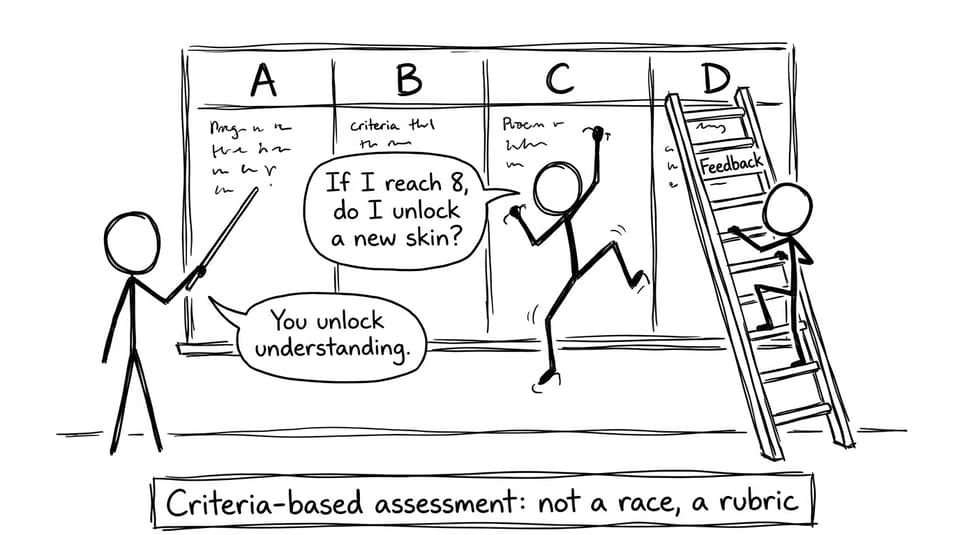
The simplest way to study for MYP criteria
Before you revise a topic, ask one question: What would a top-band response have to show?
Then build practice around proving that. On RevisionDojo, that usually looks like:
-
Read a short section of Study Notes for clarity.
-
Do a tight set of Questionbank questions on that exact skill.
-
Review mistakes and write one “next time I will…” rule.
-
Keep the skill alive with Flashcards.
This criteria-first approach is also why tools like Mock Exams and Predicted Papers are useful: they train you to perform under time and structure, not just understand in comfort.
What is the MYP Personal Project?
The Personal Project is the capstone experience in MYP Year 5. It’s an independent project where you explore an interest, create a product/outcome, and write a report showing your learning.
The project isn’t only about having a cool idea. It’s about showing the cycle: investigating, planning, taking action, reflecting. In other words, it’s a structured way to prove independence.
For a complete student-friendly walkthrough, use MYP Personal Project: The Ultimate Student Guide. And when you need to calibrate what “strong” actually looks like, browse IB Personal Project (MYP) Examples.
A practical Personal Project tip that saves hours
Don’t wait until the end to “write it up.” In the MYP, evidence matters. Save drafts, screenshots, feedback, and short dated reflections as you go.
If your school allows it, you can also use the MYP Personal Project Grader to check alignment to the rubric before submission. For broader writing support, RevisionDojo’s Grading tools and IB Coursework Grader can help you build a consistent feedback loop.
What is Service as Action (SaA)?
Service as Action is a core part of the MYP that connects learning to community impact through action and reflection.
Students often think SaA is just “hours.” But the real focus is whether you can show: purpose, meaningful action, and thoughtful reflection.
If you’re unsure how to start or what counts, use What Is Service as Action (SaA) in IB MYP? Guide for Beginners and, for quality control, read How Is Service as Action Evaluated in IB MYP?.
What is the MYP Certificate?
The MYP Certificate is an optional qualification available in Year 5 for students who complete the required assessments, the Personal Project, and Service as Action expectations.
The key idea is that the certificate is meant to represent balanced achievement: academic performance plus the programme’s project and service components.
If you’re aiming for the certificate, plan early. Exam prep tends to expand to fill all available time, and your project and service reflections can become last-minute stress if you don’t protect small weekly slots.
How does MYP prepare you for the Diploma Programme?
The MYP is basically quiet training for DP life:
-
Criteria-based thinking becomes natural (useful for DP rubrics).
-
Research and reflection habits build stamina.
-
Interdisciplinary thinking helps you connect ideas across subjects.
-
Self-management skills keep you steady when deadlines stack.
If you want to make exam prep feel structured, not chaotic, the posts MYP Revision Guide: Study Tips for Success and MYP eAssessments: 30-Day Study Plan That Works are strong starting points.
FAQ: MYP questions students ask most
Is the MYP actually “hard,” or is it just different?
The MYP is usually “different” before it feels “hard.” Many students understand the content but lose marks because they don’t match the criteria language. The programme rewards skills like analysis, reflection, and structured communication, so vague answers can cap your score even when you know the topic. That’s why learning to read rubrics is such a high-leverage move in the MYP. Once you start practicing with criteria in mind, tasks become more predictable. RevisionDojo helps because it turns study into a loop: Study Notes for clarity, Questionbank for application, and AI Chat plus Grading tools for rapid improvement.
How can I improve my MYP grade quickly?
Pick one subject and one criterion, then train it like a skill, not a chapter. In the MYP, improvement often comes from tightening method: clearer structure, better evidence, more precise command-term responses, stronger reflection. Do short timed practices weekly so your brain learns “exam mode,” not just “homework mode.” Keep an error log and convert repeated mistakes into simple rules you can apply next time. Then use Flashcards to keep command terms, definitions, and key processes alive through active recall. On RevisionDojo, this is exactly what the platform is built for: Questionbank practice, Mock Exams, Predicted Papers, and targeted review.
What should I do if my Personal Project is falling behind?
First, reduce the project to a weekly minimum that you can actually sustain. The MYP Personal Project rewards evidence of process, so small, consistent progress beats heroic last-minute writing. Next, make your goal and success criteria visible so your reflection has a target, not just feelings. Then build an “evidence tray”: dated screenshots, photos, drafts, feedback, and short reflections that you can later use in the report. If you’re stuck on structure, compare your headings to strong samples in the IB Personal Project (MYP) Examples. Finally, use a rubric-aligned check like the MYP Personal Project Grader to catch missing strands before submission.
Closing: turn the MYP into a map, not a mystery
The MYP feels stressful when it’s foggy. It becomes manageable when it becomes a map: criteria A--D, clear command terms, visible evidence, and practice that looks like the real task.
If you want that map in one place, use RevisionDojo as your MYP home base: start with the Middle Years Program (MYP) hub, then build your routine with the Questionbank, Study Notes, Flashcards, AI Chat, Grading tools, Predicted Papers, Mock Exams, Coursework Library, and Tutors. Your future self will thank you for making progress feel repeatable.
