


The most difficult adjustment in IB History is not the reading load. It is discovering that knowing what happened is no longer enough.
Many students enter their first term expecting harder content and longer timelines. Instead, they encounter a different definition of historical knowledge. Facts matter, but only when they support an argument. Sources matter, but only when they are interpreted in relation to a question. An accurate essay can still underperform if it narrates events rather than explaining them.
This is the adjustment behind many IB History first term struggles: moving from remembering history to thinking like a historian. The skill can be trained. You do not need encyclopedic knowledge. You need a repeatable method for turning selective evidence into defensible judgement.
The first-term adjustment checklist
By the end of your first term, aim to:
- distinguish narrative from analysis
- identify the precise demand of a question
- write a thesis that makes a judgement
- select evidence because it proves a claim
- explain how context affects a source's usefulness
- plan before writing
- use feedback to repair one weakness at a time
Your first target is not mastering every assessment. It is learning to make facts work.
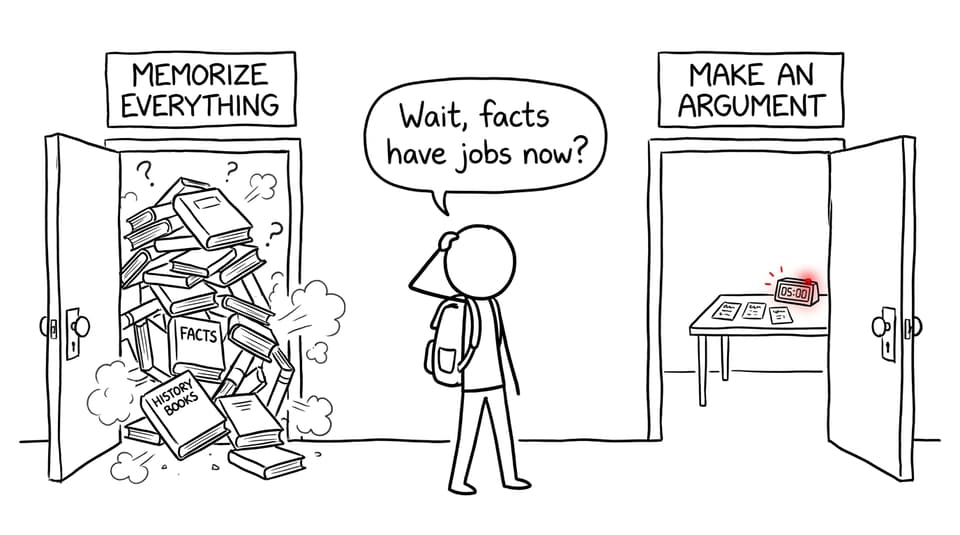
Why factual recall suddenly feels insufficient
Earlier history courses may reward clear chronological accounts supported by accurate dates. Those habits remain useful, but IB History adds interpretation, comparison, evaluation, and supported conclusions.
For students beginning the revised course in August 2026, with first assessment in 2028, historical inquiry and four concepts receive particular emphasis: cause and consequence, continuity and change, perspectives, and significance. Confirm your examination session with your teacher because students completing the earlier course follow a different assessment format.
The deeper skill remains consistent. You must decide what evidence means. If a question asks whether economic weakness caused a political crisis, a descriptive response recounts the economic problems. An analytical response judges their importance, compares them with another factor, and explains why one factor carried greater weight.
The narrative trap behind IB History first term struggles
Narrative writing sounds knowledgeable, which is why it is deceptive. A paragraph may contain leaders, policies, dates, and consequences without answering the question. The student is saying, “Here is what I know.” The task is asking, “What does this prove?”
Use this paragraph test:
- Claim: What part of your answer does the paragraph establish?
- Evidence: Which precise example supports it?
- Reasoning: Why does that evidence prove the claim?
- Qualification: What limits the explanation?
- Judgement: How important is it relative to alternatives?
RevisionDojo's guide to writing clear IB History arguments develops this method further. After presenting evidence, explain why, how, or to what extent it supports your answer.
Build evidence banks, not endless timelines
Students often respond to uncertainty by making larger notes. Every lesson becomes six pages, and every date receives equal attention. Revision then feels like holding an entire library in working memory.
Instead, organize material around arguments. For each issue, record two or three possible claims, two precise examples for each claim, a counterargument, a limitation, and a provisional judgement. A topic such as the causes of a conflict might be divided into structural conditions, immediate triggers, individual decisions, and relative importance.
Use the RevisionDojo IB History resource hub and Study Notes to clarify unfamiliar material. Then close the notes and retrieve the argument using Flashcards. Retrieval reveals what you can genuinely use without allowing repeated reading to create false confidence.
Read the question before answering it
A strong response begins before the first paragraph. Identify the command term, timeframe, region or actors, and concept being tested. Then draft a one-sentence answer.
A useful thesis answers the exact question, gives the main reason for its judgement, and acknowledges an important qualification. Saying that a leader was “very significant” merely repeats the prompt. A stronger thesis identifies where that leader mattered, explains the limits of personal influence, and judges significance through the scale, duration, or depth of change.
Practise without always writing complete essays. Choose a prompt from the IB History Questionbank, spend five minutes creating a thesis and paragraph plan, and check whether every point serves the question. Several thoughtful plans often build adaptability more efficiently than one rushed response.
Treat sources as evidence with limits
The second shock often arrives during source work. Identifying an author, date, and purpose is not a complete evaluation.
A source is not universally useful or useless. Its value depends on the inquiry. A government speech may be limited as an account of private motives but valuable for studying public messaging. Bias does not automatically invalidate evidence. Sometimes that bias is precisely what makes a source revealing.
The RevisionDojo primary source analysis guide offers a practical framework. Ask what the source communicates, who produced it, what it can establish, what it cannot establish alone, and which evidence could corroborate it.
For students first assessed in 2028, redesigned Paper 1 places source content, context, and diverse perspectives within a framing inquiry. The Paper 1 source analysis guide explains that format. Other examination sessions should follow their teacher's guidance.
Use a manageable weekly practice cycle
Progress usually comes from short feedback loops rather than heroic weekend sessions.
First, study one narrow subtopic and reduce it to three claims and six useful examples. Use Study Notes or ask RevisionDojo's AI Chat a focused question when the content remains unclear.
Next, retrieve names, policies, chronology, and concepts with Flashcards. Apply that knowledge through one source exercise, thesis drill, or Questionbank paragraph.
Then use Grading tools to identify whether the weakness is knowledge, relevance, analysis, source use, structure, or timing. Rewrite the weakest section instead of merely reading the feedback. The guide to moving from MYP History to DP History can help students whose previous tasks were more descriptive.
Later, Predicted Papers and Mock Exams can build full-response confidence. The Coursework Library supports historical inquiry, while Tutors provide focused human guidance when an argument remains unclear.
Adjusting to IB History means changing your method
A disappointing first essay rarely proves that you are not a history student. More often, it shows that an old method has reached its limit.
Ask where the chain from claim to evidence to reasoning broke. Build smaller evidence banks, practise theses, evaluate sources in relation to specific inquiries, and rewrite weak paragraphs.
RevisionDojo brings this process together through its Questionbank, Study Notes, Flashcards, AI Chat, Grading tools, Predicted Papers, Mock Exams, Coursework Library, and Tutors. Use it not simply to know more history, but to practise what IB History rewards: selecting, interpreting, comparing, and judging evidence with purpose.