


The moment grade boundaries start living rent-free in your head
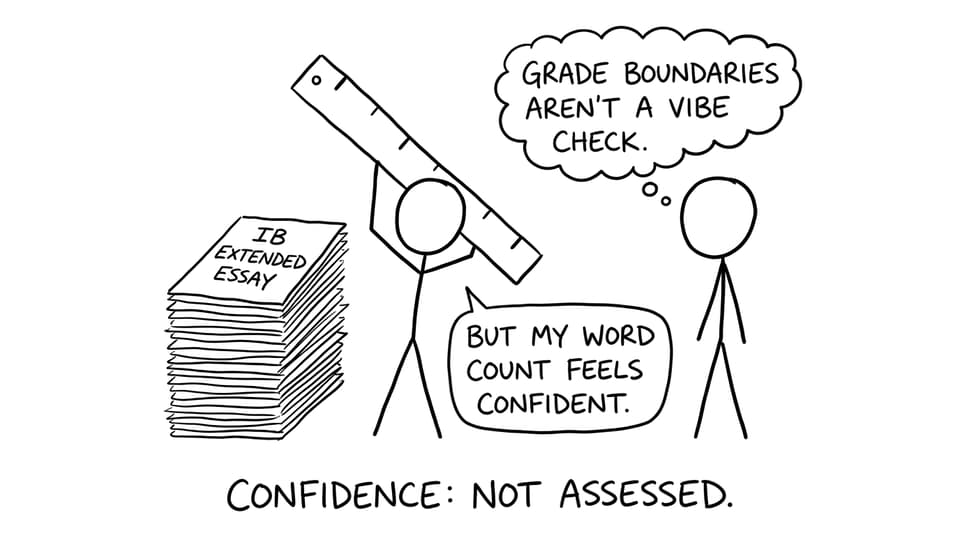
You can feel it coming: the quiet panic of wondering whether your IB Extended Essay is “good” or just “long.” The thing about grade boundaries is that they look comforting on paper (a neat set of ranges), but they’re really a mirror. They reflect how well your IB Extended Essay aligns with what the rubric rewards: focus, method, analysis, and engaged reflection.
This guide explains the IB Extended Essay 2025 grade boundaries (final marks out of 34) and gives you a simple way to aim for the top band without turning your EE into an all-consuming project.
IB Extended Essay 2025 grade boundaries (final mark out of 34)
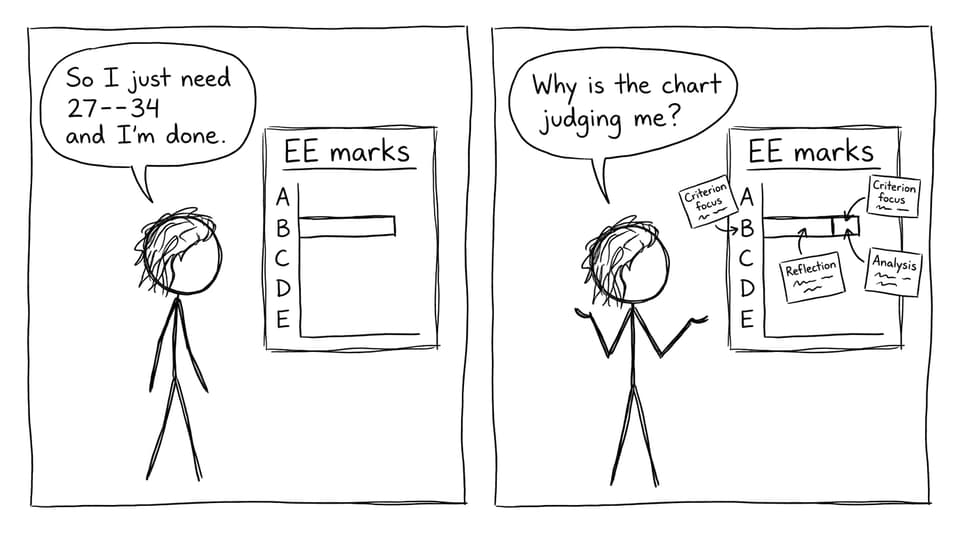
For the IB Extended Essay in 2025, the final grade boundaries are:
-
Grade A: 27-34
-
Grade B: 21-26
-
Grade C: 14-20
-
Grade D: 7-13
-
Grade E: 0-6
Keep this framing in mind: boundaries tell you the result, not the route. Your day-to-day wins come from improving the parts of the IB Extended Essay that move marks reliably.
A quick checklist to target an A (27-34)
Use this as a fast diagnostic before your next major editing session:
-
Your IB Extended Essay research question is narrow, specific, and answerable in 4,000 words.
-
Your structure makes an argument (not a tour of facts).
-
Every body section contains evidence and analysis of that evidence.
-
You evaluate limits, reliability, alternative explanations, or counterarguments.
-
Your reflection shows real decision-making (what changed, why, and what you learned).
When you want a clear starting point, use the IB Extended Essay Guides hub to get unstuck fast.
What actually moves marks in the IB Extended Essay
Make your research question do more work
A strong IB Extended Essay is like a well-designed experiment: it narrows uncertainty. If your question is too broad, you’ll end up summarizing. If it’s sharply scoped, analysis becomes almost unavoidable.
To refine your question, borrow examples and checklists from How to Craft the Perfect IB Extended Essay Research Question. If you’re already drafting, use Mistakes to Avoid in IB Extended Essays as a last-minute “spot the leaks” tool.
Upgrade description into analysis (the A/B separator)
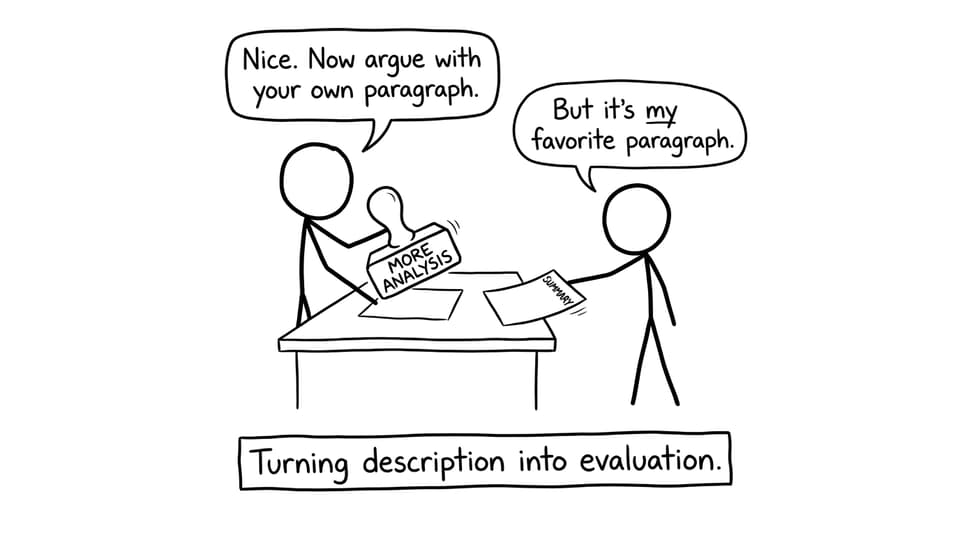
Many EEs fall into a trap: the writing is clear, the sources are credible, but the paragraphs don’t argue. An examiner should be able to underline your claim in each paragraph, then point to the evidence that proves it, then find your explanation of why that evidence matters.
If you want a practical method, follow How to Make Your IB Extended Essay Analytical, Not Descriptive and steal its paragraph-level checks.
Protect your time so the EE doesn’t eat exam prep
The hidden cost of the IB Extended Essay isn’t just writing time. It’s the way it can quietly take over your whole schedule.
A calmer approach is milestone-based planning: lock your weekly EE blocks, and keep your subject revision moving using RevisionDojo’s Questionbank, Study Notes, and Flashcards. For a timeline you can actually follow, use How to Manage Time Efficiently While Writing Your EE.
How RevisionDojo helps you score higher without extra stress
RevisionDojo works best when you treat your IB Extended Essay like a loop: draft, get feedback, revise the highest-impact section, repeat. Use the AI Chat to pressure-test whether a paragraph answers your question, the Grading tools to see rubric-aligned weaknesses, and the Coursework Library to internalize what strong academic writing looks like.
If you need a full workflow, start with Mastering IB Extended Essays: How to Research, Write, and Revise, then tighten the final details with Mastering the IB Extended Essay Word Count. For deeper guidance, RevisionDojo Tutors can help you reduce scope, sharpen evaluation, and improve clarity fast.
FAQ
Are IB Extended Essay grade boundaries the same every year?
No, IB Extended Essay grade boundaries can change from session to session. Boundaries are set after marking to maintain consistent standards across different cohorts. That means you should treat boundaries as a target range, not a promise. The smarter strategy is to focus on what the rubric consistently rewards: a focused research question, methodical investigation, and sustained analysis. If you build those well, you’re resilient to small boundary shifts. In practice, the strongest EEs are not written “for the boundary” but written to satisfy the criteria cleanly.
What mark range do I need for an A in 2025?
For 2025, an A on the IB Extended Essay is 27-34 marks out of 34. The useful takeaway isn’t just the number, but what it implies: to reach that band, you need more than good English and lots of sources. You need a coherent argument where your evidence is interpreted, compared, and evaluated. You also need engagement that sounds real, not performative, in your reflection. If you’re currently in the B range, the biggest jump usually comes from improving analysis and evaluation, not from adding more background information. RevisionDojo’s rubric-aligned tools make it easier to find the exact sections that will move you upward.
What are the fastest improvements I can make if my draft feels “stuck”?
Start by checking whether every section of your IB Extended Essay directly answers the research question. If a paragraph is interesting but doesn’t help you answer the question, it often needs cutting or repositioning. Next, add “evaluation sentences” where you test your own claims: reliability, limitations, alternative interpretations, or why one explanation is stronger than another. Then run a structure check: does your introduction promise the same investigation your conclusion actually delivers? Finally, shorten the feedback loop: use RevisionDojo’s Grading tools for criterion-based direction, ask AI Chat one specific question at a time (for example, “Where is my argument still descriptive?”), and revise only the highest-impact page before you expand changes across the whole draft. This approach keeps progress measurable and reduces the spiral of endless rewrites.
Closing: use boundaries as a compass, not a verdict
Grade boundaries aren’t there to scare you. They’re there to remind you that your IB Extended Essay is assessed, not admired. Use the 2025 boundaries to set your target, then spend your energy where marks actually move: a sharp question, strong analysis, and purposeful reflection.
When you’re ready to tighten your EE while still preparing for exams, make RevisionDojo your home base: Questionbank, Study Notes, Flashcards, AI Chat, Grading tools, Predicted Papers, Mock Exams, the Coursework Library, and Tutors, all designed to turn effort into results for the IB Extended Essay and beyond.