


If you have ever left a TOK discussion thinking, “That was interesting… but what do I do with it in an exam?” then IB Digital Society is the missing bridge.
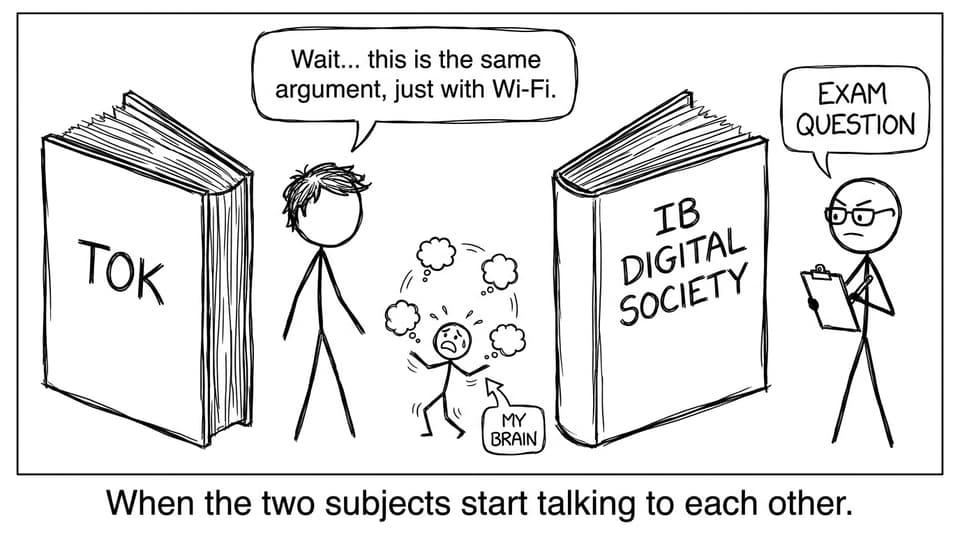
TOK trains you to notice what most people skip: assumptions, power, evidence, perspective. IB Digital Society gives those ideas a real place to land: algorithms, surveillance, misinformation, online identity, digital inequality. Put them together and you get something rare in the IB: a skill loop that makes multiple subjects easier at the same time.
Quick checklist: why IB Digital Society fits TOK so well
Use this as a fast pre-exam reminder of what the pairing actually gives you:
-
A shared habit of questioning “obvious” claims
-
Better evaluation (trade-offs, unintended consequences, stakeholder perspectives)
-
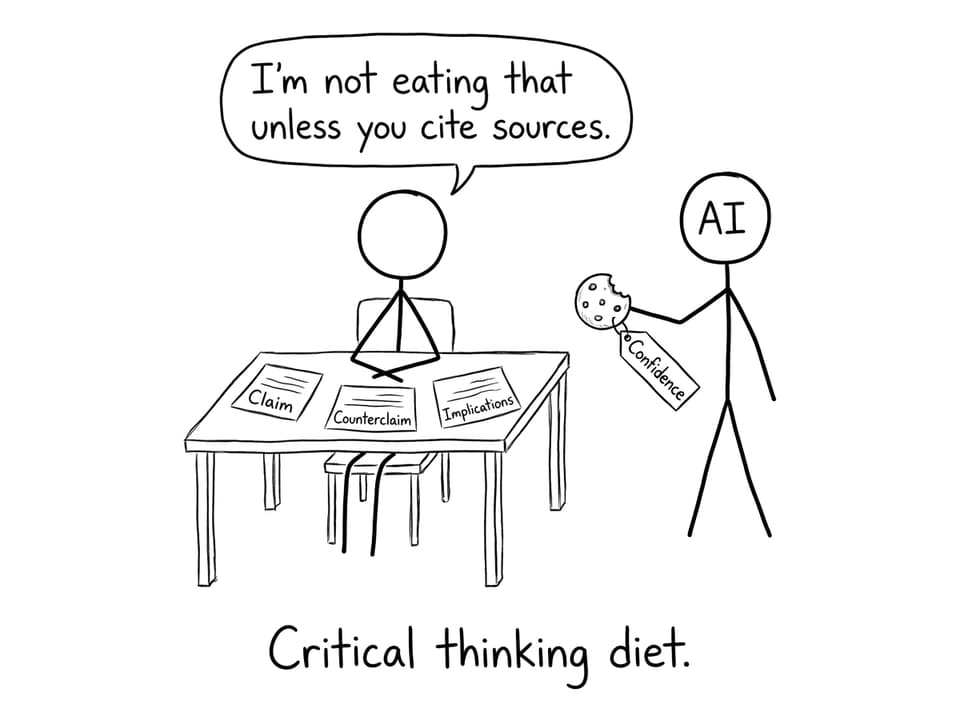
Stronger writing structure: claim, counterclaim, implication
-
More confident handling of unfamiliar stimuli
-
Cleaner, more precise use of command terms
If you want the syllabus and practice tools in one place, start with the IB Digital Society Resources hub.
TOK gives the lens; IB Digital Society gives the case studies
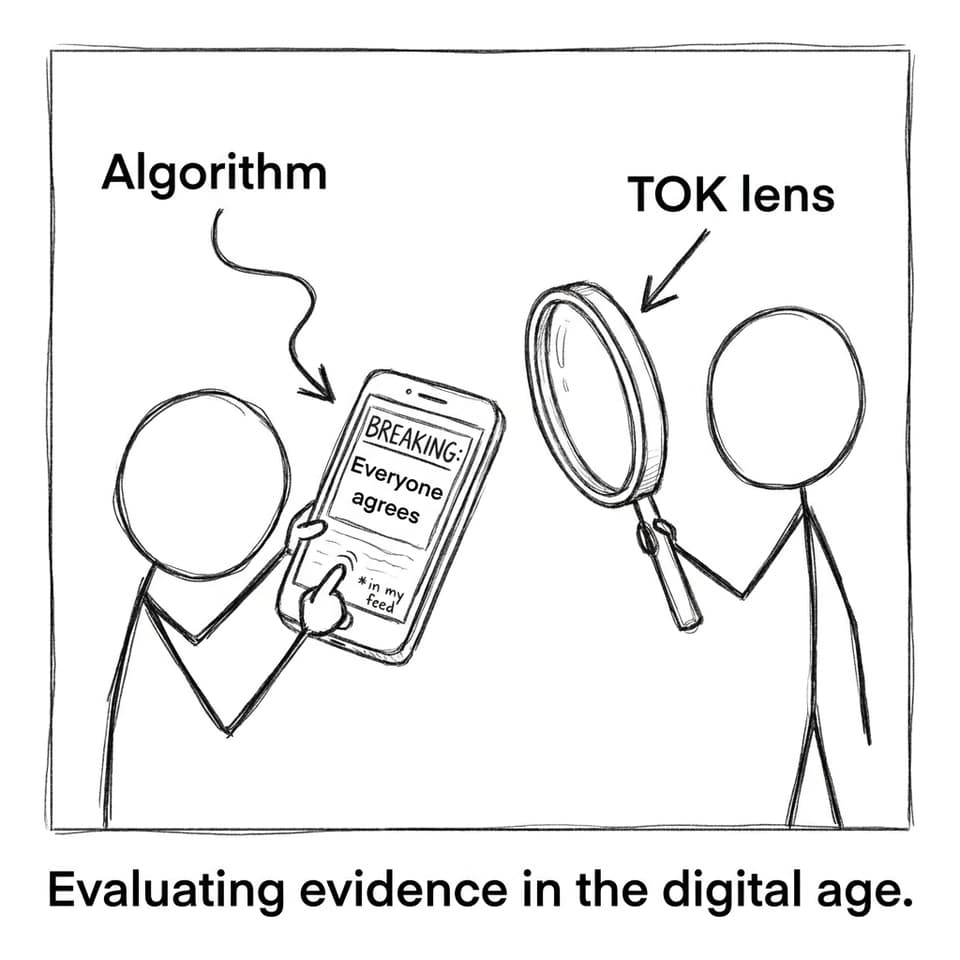
TOK is the course where you learn to ask: What counts as evidence? Who decides? What are the limits of this method? Those questions can feel abstract until you meet them again in IB Digital Society, where nearly every topic is basically TOK wearing modern clothes.
Think about a typical Digital Society discussion:
-
Is AI-generated text “knowledge” or just convincing language?
-
When does personalization become manipulation?
-
How do we decide whether a source is credible when attention is the currency?
TOK gives you a vocabulary for uncertainty and bias. IB Digital Society forces you to apply that vocabulary to systems that shape real lives. That is why your essays start sounding less like summaries and more like evaluation.
For a solid foundation in the course itself, skim What Is IB Digital Society? A Beginner’s Guide.
IB Digital Society exam answers improve when you think like TOK
Exams reward structured thinking, not just “having opinions.” The quiet advantage of TOK is that it trains you to build an argument that can survive scrutiny. In IB Digital Society, that usually means moving beyond describing a platform or policy and instead explaining mechanisms and trade-offs.
A practical way to do this is to rehearse three moves:
Define the digital system, not the headline
Name the system precisely: a recommender algorithm, a moderation policy, a biometric database, an encryption feature. Headlines are vague; systems are examinable.
Evaluate with stakeholders and time horizons
Who benefits now? Who pays later? What changes in the long term? This is where TOK-style perspective becomes mark-earning analysis.
Use command terms as your structure
Command terms are the invisible markscheme. If you miss the verb, you miss the marks. Keep a quick refresher open: IB Command Terms: Write What Examiners Actually Want.
To sharpen your concept vocabulary, RevisionDojo’s Inquiry in IB Digital Society, Explained Simply is a clean reset.
Communication skills: the shared “hidden curriculum”
TOK and IB Digital Society both reward students who can do something deceptively hard: explain a complex idea without sounding messy.
When you practice TOK presentations or essay paragraphs, you are quietly training the same muscles Digital Society needs: defining terms, building a line of reasoning, addressing a counterclaim without collapsing your main claim.
This also ties directly to the kind of learner the IB wants you to become. If you need a quick reminder of the traits examiners love to see in writing, revisit Understanding the IB Learner Profile: Traits for Success or the more exam-focused breakdown in The 10 IB Learner Profile Traits Explained.
Extended Essay bonus: using Digital Society + TOK habits together
Even if your Extended Essay is not in IB Digital Society, TOK habits can upgrade it: clearer assumptions, stronger source evaluation, more honest limitations. If your EE is in Digital Society, this pairing is even more direct: your research question, evidence standards, and ethical framing can all become sharper.
Two useful next steps:
-
Build your argument habits with EE vs TOK in 2027: How the IB Core Works Together
-
When your draft exists but feels weak, use How to Improve Your IB Extended Essay Draft
If you are looking for an organized DS pathway, RevisionDojo also has a Digital Society Coursework Guide and the examiner-written IB Digital Society IA Guide.
FAQ
Do IB Digital Society and TOK overlap too much?
They overlap in the type of thinking, not in the content you study. TOK is about how knowledge works across areas of knowledge, and it often stays at the level of methods, justification, and perspective. IB Digital Society is more grounded: you analyze specific digital systems and their impacts on people and communities. That difference matters in exams, because Digital Society needs applied examples, mechanisms, and evaluation in context. TOK prepares your mind to do that evaluation without getting lost. When they overlap, it usually feels helpful, like seeing the same skill from two angles.
How does this pairing help me score higher in exams?
It helps you turn “interesting points” into structured, mark-ready arguments. TOK trains you to treat claims as debatable and to ask what counts as good evidence, which pushes your Digital Society responses beyond description. IB Digital Society then gives you repeated practice using that habit with real prompts and unfamiliar stimuli. Over time, you get faster at building claim, counterclaim, and implications under time pressure. You also get better at choosing the right depth for the command term. The result is writing that is clearer, more evaluative, and easier for an examiner to reward.
What should I revise first if I am behind in both?
Start by stabilizing your “argument engine” before you try to memorize more material. In IB Digital Society, pick 8-12 reusable case studies and attach each one to themes like power, inequality, ethics, and culture. In TOK, practice writing one clean knowledge question and one paragraph that includes a real counterclaim. Then run a loop: revise a concept, test it with a question, get feedback, and fix one weakness. RevisionDojo is built for that loop: Study Notes and Flashcards for recall, Questionbank for targeted practice, AI Chat for stuck moments, and Grading tools to see what your writing is actually doing.
Closing: make IB Digital Society your TOK training ground
TOK teaches you to think carefully; IB Digital Society teaches you to think carefully about the world you actually live in. That is why the subjects fit so well: one gives you the lens, the other gives you the practice.
If you want a single home base to turn that pairing into exam performance, use RevisionDojo’s Questionbank, Study Notes, Flashcards, AI Chat, Grading tools, Predicted Papers, Mock Exams, Coursework Library, and Tutors to keep your revision tight and feedback-driven. Start with the IB Digital Society Resources hub, and treat every practice response as both Digital Society revision and TOK skill-building.