



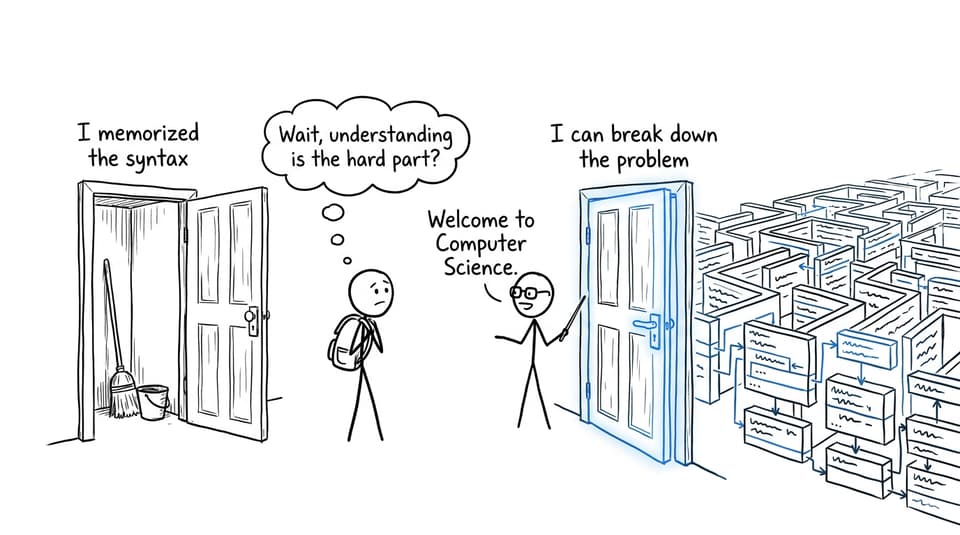
The biggest adjustment shock in IB Computer Science is not usually the amount of coding. It is discovering that knowing programming syntax does not automatically mean you can solve a problem.
A student may understand variables, loops, and if statements. Then a question describes a school registration system, asks for an algorithm, and everything suddenly feels uncertain. The blank page is not caused by missing syntax. It appears because the student has not yet learned to turn a messy situation into precise computational steps.
That translation is at the heart of many IB Computer Science first term struggles. Fortunately, it is a skill rather than an innate talent. Your goal is to build a repeatable path from problem to algorithm, algorithm to code, and code to tested solution.
The first-term adjustment checklist
When a programming task feels overwhelming, follow this sequence:
- State the required output in one sentence.
- Identify the inputs and important constraints.
- Remove details that do not affect the solution.
- Break the task into small subproblems.
- Solve a tiny example manually.
- Express the method in plain English or pseudocode.
- Trace the steps using test data.
- Translate the verified logic into Python or Java.
- Test normal, boundary, and invalid cases.
- Record what caused any incorrect result.
This can feel slower than immediately typing code. In reality, it prevents the longer experience of writing fifty uncertain lines and not knowing which assumption failed.
Why the adjustment feels unexpectedly difficult
Many subjects teach content first and application second. Computer Science often asks students to learn and apply an idea almost simultaneously.
You meet variables, data types, selection, iteration, functions, and data structures. Yet a question rarely says only, “Write a loop.” It provides a context and expects you to decide whether a loop belongs there, what should repeat, when it should stop, and which information must change.
That is computational thinking. Under the current IB Computer Science course, first assessed in May 2027, programming may be completed in Python or Java. However, the broader work includes specifying, decomposing, abstracting, designing, testing, and evaluating solutions. The language matters, but the reasoning travels further.
Students who have coded before can still experience this shock. Prior experience may make syntax easier, while unfamiliar problems, pseudocode, tracing, and explanation remain difficult.
Translate problems into algorithms
Imagine a task asking you to process a list of test scores and display how many exceed a chosen threshold.
A syntax-first approach asks, “How do I write a loop?” A problem-first approach asks:
- What information enters the algorithm?
- What result must it produce?
- What action must be repeated?
- When should the count increase?
- What should the counter equal initially?
Once these questions are answered, the code becomes less mysterious. The solution needs a list, a threshold, a counter initialized to zero, a loop through the scores, and a condition that increments the counter.
This is why computational thinking in IB Computer Science matters from the opening weeks. Decomposition divides the task. Abstraction removes irrelevant details. Pattern recognition connects it with familiar counting problems. Algorithmic thinking places the solution in an unambiguous order.
Do not let the programming language make the first decision. Decide what the solution must do before deciding how Python or Java will express it.
Use a three-layer method before coding
Explain the solution like a human
Write the method in ordinary language. For the score example: begin the count at zero, inspect each score, add one when the score exceeds the threshold, and display the final count.
If another student could not follow your instructions without guessing, clarify them before coding.
Convert the explanation into pseudocode
Pseudocode removes the distraction of exact language syntax while preserving the algorithm's structure. It exposes whether your sequence, conditions, and loops make sense.
Treat it as a bridge between thought and implementation, not another notation system to memorize. RevisionDojo's guide to practising IB Computer Science pseudocode shows how short conversion and tracing exercises strengthen that bridge.
Translate and test
Translate one logical block into code at a time, then test it before adding complexity. If the result is wrong, distinguish between a syntax error and a logic error. Syntax errors prevent the language from interpreting an instruction. Logic errors allow the program to run but produce an incorrect result.
RevisionDojo's debugging techniques notes cover trace tables, breakpoints, step-by-step execution, and temporary output statements.
Trace instead of guessing
A loop can look obvious while behaving differently from what you expect. A boundary may be wrong, a counter may update too early, or a variable may not reset.
Tracing slows the algorithm down enough to observe it. Create a column for each changing variable, then execute the instructions line by line with a small input. Test one item, contrasting values, an exact boundary, and a case where the condition is never true.
Use the IB Computer Science Questionbank to attempt a focused question, trace your solution, inspect the feedback, and solve a similar problem without notes. Reattempting matters because recognizing a correction is easier than independently producing it.
Build a sustainable weekly routine
Consistency usually works better than occasional programming marathons. Try this rhythm:
- Twice a week: complete a 20-minute drill involving selection, loops, or functions.
- Twice a week: trace an algorithm and translate it between English, pseudocode, and code.
- Once a week: answer a short theory question.
- Once a week: review your error log and redo one difficult problem.
Use the new-syllabus Computer Science Study Notes when an idea is unclear, then move into active work. The B2 Programming resources connect Study Notes, Questionbank practice, Flashcards, and lessons.
RevisionDojo's AI Chat can help when you are stuck, but use it diagnostically. Ask which assumption is wrong or request an input that could break your solution. Grading tools can identify imprecise explanations. Later, Predicted Papers and Mock Exams support timed practice, while the Coursework Library and Tutors help with demanding computational solutions.
What progress should look like
First-term progress does not mean writing elaborate programs without mistakes. A better sign is that your response to difficulty has changed.
By the end of term, you should be better able to identify inputs and outputs, reduce a problem, draft an algorithm, trace it, and isolate an error. Confidence does not arrive because programming becomes effortless. It grows because confusion becomes manageable.
When IB Computer Science feels unusually hard, resist memorizing more syntax without context. Return to the problem. Make it smaller. Write the steps. Trace them carefully. Then code.
RevisionDojo brings together Study Notes, Flashcards, the Questionbank, AI Chat, Grading tools, Predicted Papers, Mock Exams, the Coursework Library, and Tutors as the ultimate IB resource. Your first term is not about proving that you already think like a computer scientist. It is where you begin learning how.