

Computational thinking is the quiet skill that saves you time in IB Computer Science. It’s what happens in the five minutes before you touch your keyboard--when you decide what the problem really is, what information matters, and what steps would solve it even if the coding language changed tomorrow. Students who skip that step often feel like the subject is “random.” Students who build it start seeing the same shapes in every question.
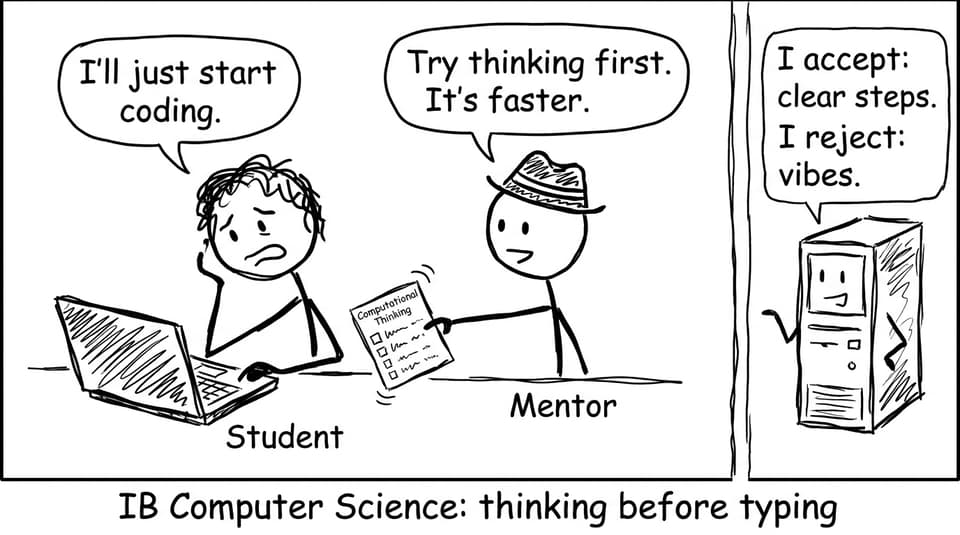
What computational thinking means in IB Computer Science
In IB Computer Science, computational thinking is a structured way to turn a messy scenario into something a computer could follow. It’s not a programming language, and it’s not “being good at Java/Python.” It’s the reasoning layer underneath.
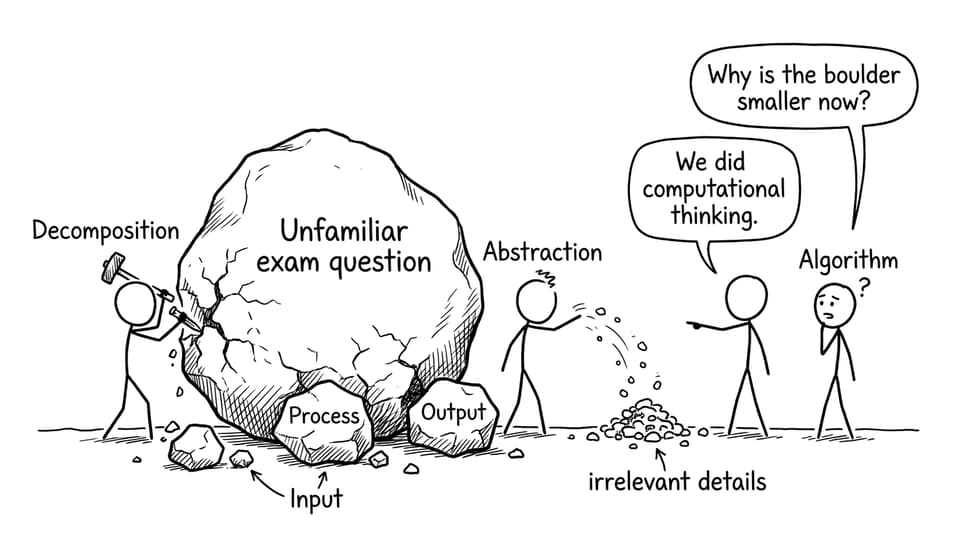
At its core, it usually includes four moves:
-
Decomposition: break one big task into smaller parts.
-
Pattern recognition: notice what’s repeated or similar across cases.
-
Abstraction: keep the essential details, ignore noise.
-
Algorithmic thinking: write clear, ordered steps that always work.
If you want a syllabus-aligned hub to practise these ideas, start with RevisionDojo’s Computational thinking, problem-solving and programming.
A quick checklist to use on exam questions
Before you write pseudocode or explain a solution, run this short checklist (it’s especially helpful for IB Computer Science Paper-style problem solving):
-
What are the inputs and outputs?
-
What constraints matter (size limits, sorting, “must be efficient”)?
-
Can I decompose this into 2–5 subproblems?
-
What patterns suggest a known technique (searching, sorting, recursion)?
-
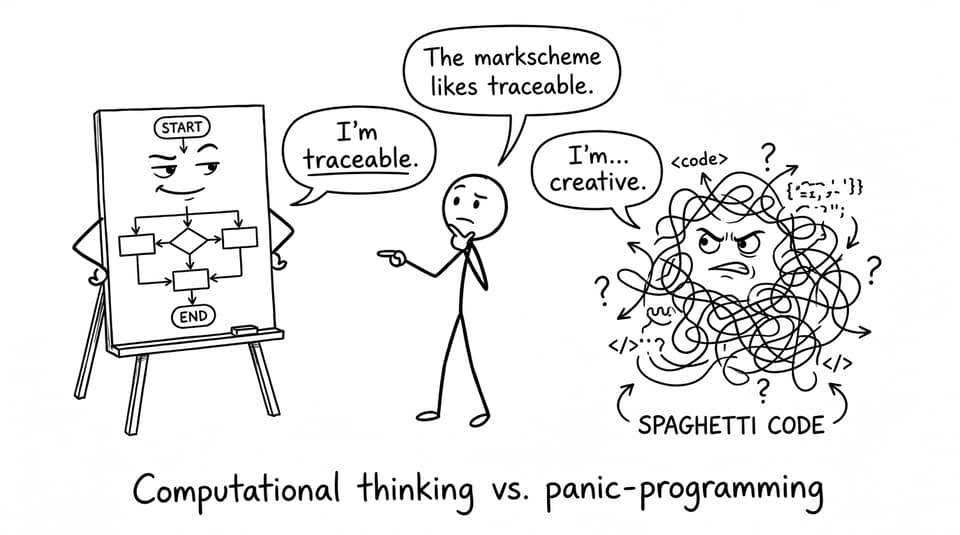
Can I express the solution as steps someone else can trace?
For extra practice under exam pressure, use the B1 Computational thinking Questionbank and check your weak spots with B1 Computational thinking Flashcards.
Computational thinking vs programming (the order matters)
A common trap in IB Computer Science is to treat programming as the starting point. In reality:
-
Computational thinking comes first: you design a solution you can justify.
-
Programming comes second: you implement that solution in code.
That’s why the IB can test strong thinking without asking you to write a full program. Flowcharts, tracing tables, and pseudocode are all ways to show your reasoning clearly. If you want to connect “thinking” to “building,” RevisionDojo’s Connecting computational thinking and program design is a good bridge.
Where it shows up most in the syllabus
Computational thinking is everywhere in IB Computer Science, but you feel it most when questions demand structure, not memorisation:
-
algorithm design and tracing
-
debugging and testing logic
-
choosing data structures and justifying them
-
evaluating solutions (efficiency, clarity, constraints)
To revise the “how” behind it (not just definitions), use RevisionDojo’s B1.1 Approaches to computational thinking Notes and the focused lesson page B1.1 Approaches to computational thinking Lessons.
Conclusion: think first, then type
The fastest way to feel more confident in IB Computer Science is to build a repeatable thinking process: decompose, spot patterns, abstract the noise, then write steps a computer could follow. Once that habit clicks, coding becomes implementation, not guessing.
If you want to train that skill daily, use RevisionDojo’s IB Computer Science Resources alongside the B1 Computational thinking Questionbank and targeted notes. You’ll walk into the exam with something better than confidence--you’ll have a method.