




Starting IB Chemistry can feel strangely reassuring. The first lessons contain familiar words: atoms, isotopes, equations and mass. Then a calculation asks you to connect several of those ideas, and familiarity suddenly offers little protection.
The biggest adjustment behind many IB Chemistry first term struggles is not content volume. It is the shift from recognizing chemistry to constructing a precise chain of reasoning. Students must interpret the question, choose a model, convert quantities, control units and judge whether the answer makes chemical sense.
The mole and early stoichiometry often deliver this shock first. Adjusting to IB Chemistry therefore means learning a repeatable process, not simply spending longer with your notes.
The first-term adjustment checklist
When a Chemistry question feels overwhelming, check whether you can:
- identify what is given and what must be found
- explain the chemistry before choosing an equation
- convert the given quantity into moles
- use balanced equation coefficients as mole ratios
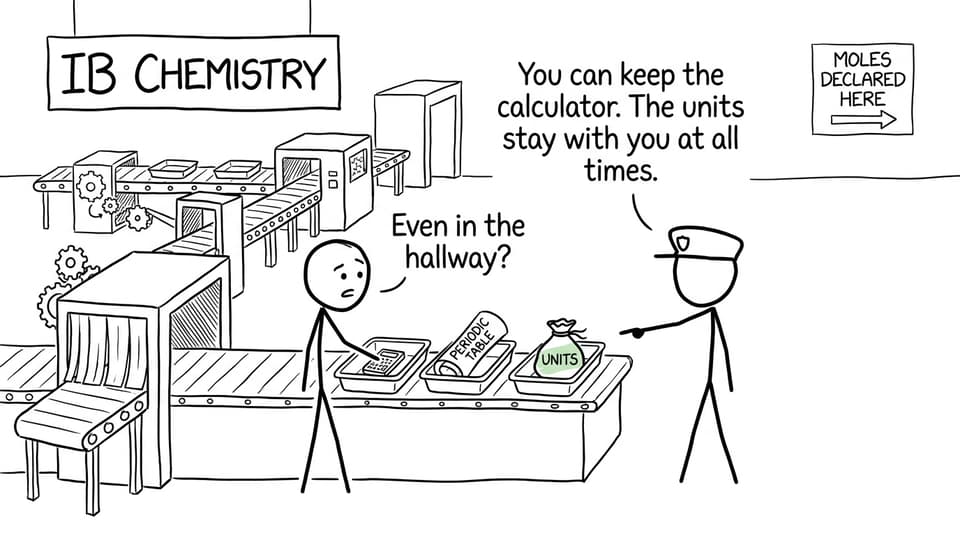
- keep units visible throughout your working
- check precision and whether the answer is plausible
- diagnose an error instead of copying the solution
Together, these habits form the operating system of the subject.
Why the mole becomes the first major obstacle
The mole is difficult because it is both a concept and a conversion tool. You cannot see one mole as immediately as you can see a test tube, yet it connects microscopic particles to laboratory measurements.
For mass calculations, the central relationship is:
Here, is the amount in moles, is mass and is molar mass. Knowing the equation is only the beginning. A question may require you to calculate moles, apply a coefficient ratio and convert the result into mass, concentration, gas volume or particle count.
No individual step looks impossible. The challenge is choosing and sequencing every step independently. The guide to the mole in IB Chemistry can rebuild this foundation before you begin broader IB Chemistry stoichiometry practice.
The deeper problem is translation, not mathematics
Students often describe themselves as bad at calculations. Frequently, arithmetic is not the main problem. The harder task is translating between forms of chemical information.
Suppose a question gives the mass of one reactant and asks for the concentration of another. The hidden route may be:
mass → moles → equation ratio → moles → concentration
Write that route before touching the calculator. It separates chemical decisions from arithmetic and makes errors easier to locate.
A dependable routine is:
- Write or confirm the balanced equation.
- State the given and required quantities with units.
- Convert the given quantity into moles.
- Apply the coefficient ratio.
- Convert to the requested quantity.
- Check units, precision and plausibility.
The step-by-step stoichiometry question guide applies this method to solutions, gases, yields and limiting reactants.
Why rereading creates false confidence
Notes can look understandable while they remain open. Recognition feels like knowledge because each line is familiar. The illusion disappears when a blank question asks you to generate the method.
Use syllabus-aligned IB Chemistry Study Notes to learn an idea, then close them and test whether you can reconstruct it. Effective revision moves through four stages:
- Understand: explain the model in your own words.
- Retrieve: reproduce the method without support.
- Apply: answer a targeted unfamiliar question.
- Repair: identify why a mark was lost and try again.
The guide to using Chemistry revision notes effectively explains how to replace passive reading with active recall.
A one-week first-term recovery plan
The answer is not a heroic weekend. It is a short feedback loop repeated until the method becomes familiar.
Build one calculation map
Create one page connecting mass, particles, concentration and gas information to moles as your class introduces them. Put the required units beside every relationship. Keep the map compact enough to recreate from memory.
Practise focused question sets
Complete 5-8 questions on one skill, such as converting mass to moles, and mark them immediately. Once that method is stable, add equation ratios and a final conversion.
The stoichiometric relationships Questionbank develops the decision-making that rereading cannot. Avoid long mixed sets until you know where your calculation chain breaks.
Keep an error log by cause
Do not record a problem as merely a careless mistake. Classify it:
- equation not balanced
- wrong conversion relationship
- inverted mole ratio
- inconsistent units
- premature rounding
- misread command term
- weak chemical explanation
Add one corrective rule beside each error. For example: “Convert to before using .” The common IB Chemistry exam mistakes guide helps identify recurring patterns.
Retest without looking
Wait two or three days, then attempt a similar question without the original solution. Delayed retrieval reveals whether the method is genuinely yours.
Change your IB Chemistry study rhythm
The current IB Chemistry course connects ideas through Structure and Reactivity, with practical work forming an important part of learning. Success therefore involves interpreting models, processing data, evaluating methods and communicating scientific reasoning.
Use Flashcards for definitions, conditions and relationships. Use AI Chat to investigate why a step works. Apply the idea in the Questionbank, then use Grading tools to identify what your response failed to communicate.
Later, Predicted Papers and Mock Exams can develop timing and mixed-topic judgment. The Coursework Library supports scientific communication, while Tutors can address conceptual gaps that repeated independent practice has not resolved. The IB Chemistry topic-by-topic revision guide helps connect these resources as the syllabus expands.
What progress should look like
Progress does not mean eliminating every arithmetic slip. It means becoming able to locate your uncertainty.
By the end of the first term, aim to recognize a calculation route before computing it. You should be able to explain why equation coefficients represent mole ratios, keep units attached to your working and distinguish conceptual errors from numerical ones. You should also use the official data booklet as a working resource rather than opening it only before an assessment.
The first difficult month can feel like evidence that you are not suited to Chemistry. More often, it shows that the subject now expects a different kind of thinking. RevisionDojo makes that transition manageable by connecting Study Notes, Flashcards, the Questionbank, AI feedback and structured practice in one place.
The goal is not to avoid the adjustment. It is to build a system strong enough to absorb it.