



A methodology section usually falls apart in the same quiet moment.
You’re deep into your investigation, the math (or experiment) is finally working, and your brain makes a deal: I’ll explain it later. Later becomes a paragraph of formulas, a screenshot of a graph, and a vague sentence that starts with “Then I…”
For an IB Internal Assessment, that deal costs marks. The methodology isn’t where you show off difficulty. It’s where you prove you had a plan, you made justified choices, and someone else could follow your thinking without living inside your head.
This guide shows how IB students can write the methodology section with maximum clarity, whether you’re doing a Math IA model, a science investigation, or a humanities-style method of selecting sources. Along the way, you’ll see a structure you can reuse, a checklist you can paste into your draft, and simple wording tricks that make examiners relax.

IB methodology section clarity checklist
If you want a fast way to check whether your IB methodology section is clear, scan for these items:
-
Your research question/aim is stated in one sentence.
-
Key variables (or criteria for choosing sources) are defined with units or boundaries.
-
Each method is named and justified (not just listed).
-
Steps are in a logical order that matches your results section.
-
Assumptions and limitations are stated early, not hidden at the end.
-
Verification is explained: how you checked accuracy, validity, or reliability.
-
A reader could replicate your work from this section alone.
When you’re revising, treat this like a mark-saving filter.
Why the IB methodology section matters more than you think
In IB coursework, methodology is the bridge between intention and evidence. Examiners can forgive a small arithmetic slip. They struggle to forgive a process they can’t follow.
A clear methodology section signals three things:
-
Control: you weren’t improvising; you were testing something.
-
Communication: your notation, definitions, and sequencing are examiner-friendly.
-
Appropriateness: your methods match your aim and your course level.
This is why methodology supports communication and mathematical/scientific quality at the same time. It’s also why students who “did a lot” sometimes score lower than students who “did the right amount and explained it well.” In IB, clarity is a kind of rigor.
If you want to align your whole IA structure before you write, pair this guide with How to Structure Your IB Math IA Logically so your methodology naturally sets up your exploration.
The best structure for an IB methodology section
Think of your methodology as a map a calm stranger could follow. A good map doesn’t just show the destination. It shows why you chose that route.
Start by restating the aim (one clean sentence)
Open your IB methodology section by repeating your aim in a way that predicts the method.
Good:
“This investigation models the cooling of a liquid over time using an exponential decay function and evaluates the model’s fit using regression and percentage error.”
Why this works: it tells the examiner what you’re doing and how you’ll judge it. You’ve created a promise you can fulfill.
If you’re still refining the overall IA path, the IB Math AI Internal Assessment: Step-by-Step Guide is a useful reference point for how each section supports the rubric.
Define your variables, data, or selection criteria
Clarity often fails here because students assume the reader “gets it.” In IB, don’t assume.
Include:
-
What each variable means (symbol and plain English).
-
Units and measurement intervals (or boundaries for categories).
-
Data source: primary collection, database, simulation, or defined values.
-
A short note on conditions: what you kept constant and why.
This isn’t filler. It prevents confusion later when you interpret results.
For sciences and psychology, methodology often depends on variable control and ethical clarity. If that’s your context, compare your draft to 2.2 Research Methodology to see the level of specificity expected.
Name each method and justify it in one sentence
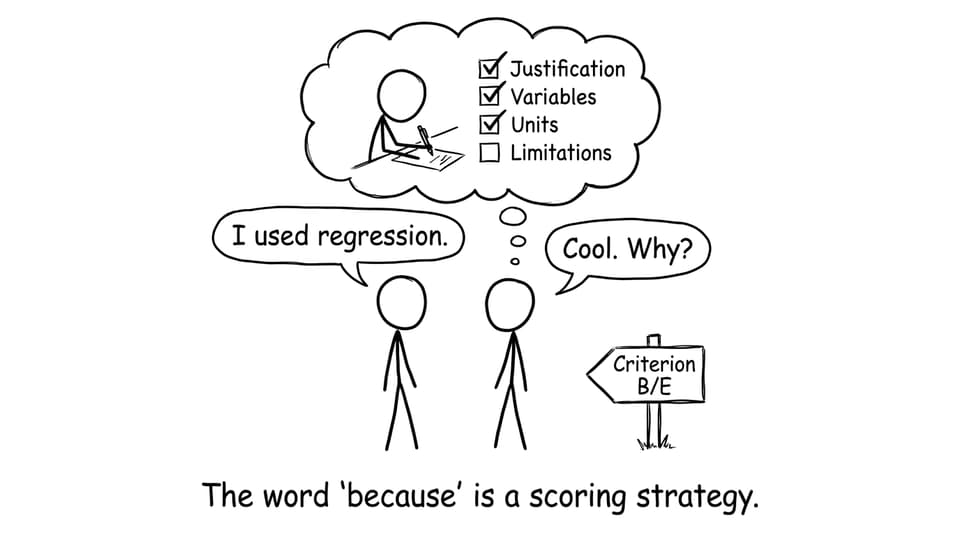
A powerful IB methodology habit is this rule:
Every method gets a “because.”
Examples:
-
“Linear regression was used because the scatter plot suggested an approximately linear relationship.”
-
“A logistic model was tested because growth is bounded by a carrying capacity in the chosen context.”
-
“Sources were selected using the criteria X and Y because the investigation compares two interpretations within the same time period.”
This is how you turn technique into reasoning.
Write the process as steps with transitions
Now you earn clarity with pacing. The reader should never wonder, “Where did that number come from?”
Use steps like:
-
First, I...
-
Next, I...
-
To calculate...
-
Substituting X into Y...
-
Therefore...
A practical pattern for an IB Math IA methodology:
-
State the model form.
-
Define parameters.
-
Explain how parameters will be found (algebra, regression, transformation).
-
Explain what you will compare (observed vs predicted).
-
Explain error or fit metric.
Write one idea per paragraph. If a paragraph contains two new operations, split it.
If you want a rubric-aligned way to self-check, the IB Maths AI IA Grader helps you audit whether the explanation level matches the criteria. RevisionDojo’s Grading tools are most useful when you run them early, while changes are still easy.
Explain verification: how you will test reliability or accuracy
Many IB students stop methodology right after the calculation steps. But examiners love the moment you show that you don’t blindly trust your own work.
Depending on subject, verification could be:
-
Repeated trials and averaging.
-
Uncertainty and percentage error.
-
Residual plots or R² (used carefully, explained clearly).
-
Comparing to a known theoretical value.
-
Cross-checking with a second method.
If your methodology includes any software (GeoGebra, Desmos, a spreadsheet), name what you used it for and what you still did manually. Transparency reads as maturity.
Writing style rules that make IB examiners breathe easier
Clarity is not just structure. It’s sentence-level choices.
Use consistent tense and voice
Pick one:
-
Past tense: “Data were recorded…”
-
Present tense: “This investigation uses…”
Both work. Switching between them makes the methodology feel unedited.
Define notation the moment it appears
In IB, symbols without definitions create friction. The moment you write (r), tell the reader what it represents and what values it can take.
Integrate math with explanation
A methodology section is not a formula dump. After each key equation, add one sentence:
-
what it calculates,
-
why it matters,
-
what will be substituted into it.
Keep the reader oriented
Small phrases do big work:
-
“To link this to the research question…”
-
“This matters because…”
-
“At this point, the model is ready to test…”
If you want to practice this skill in exam conditions (where clarity also wins marks), RevisionDojo’s Questionbank is designed for explanation-aware practice with feedback that pushes you to justify steps, not just reach answers.
Common IB methodology mistakes (and how to fix them)
Mistake: listing tools instead of decisions
Bad:
“I used regression, then I used calculus.”
Fix: add purpose and order.
“Regression was used to estimate parameters for the model, and calculus was then applied to analyze the rate of change predicted by the fitted function.”
Mistake: assumptions hidden in the conclusion
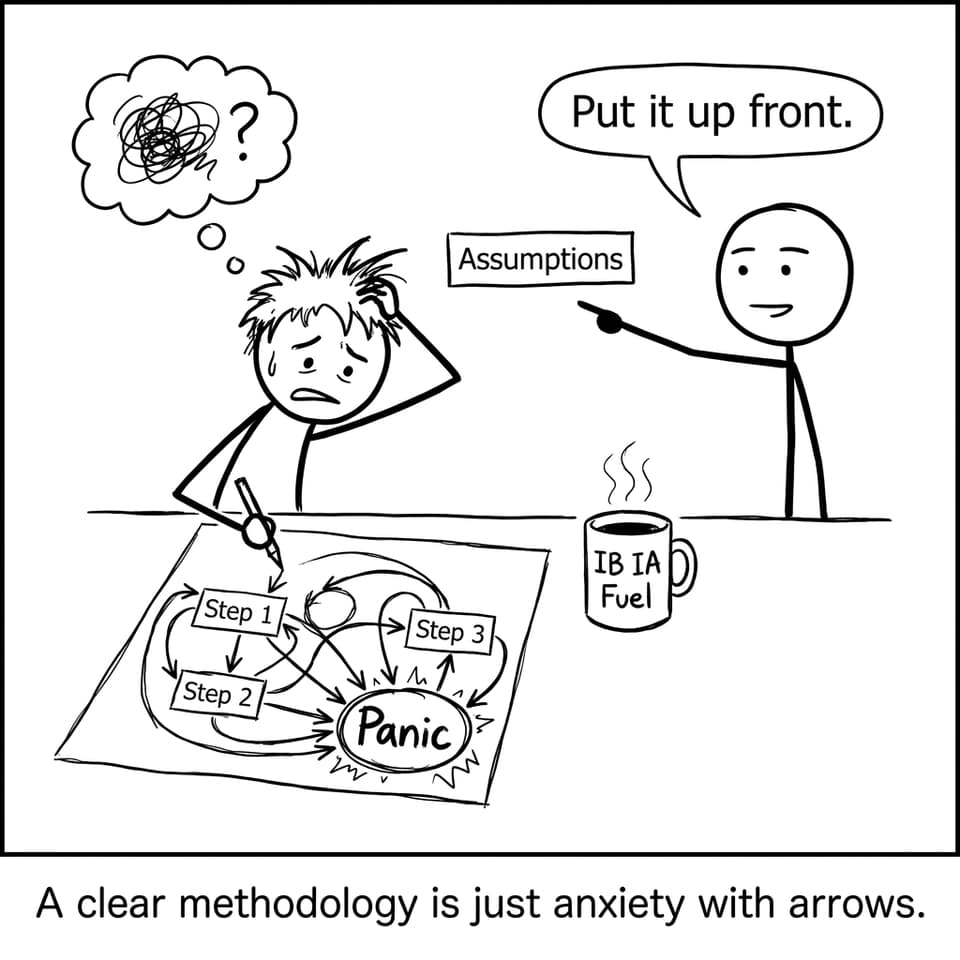
Assumptions belong near the start because they shape everything.
Write:
-
“Assume constant room temperature…”
-
“Assume negligible air resistance…”
-
“Assume sources are representative of…”
Then later, you can evaluate how risky that assumption was.
Mistake: steps that are not replicable
If another student cannot repeat your process, your methodology is too vague.
Replace:
- “I measured it a few times.”
With:
- “The measurement was repeated five times at 30-second intervals using a digital thermometer (±0.5°C).”
Mistake: no link back to the research question
Every major step should answer: “How does this move me closer to the aim?”
If a step doesn’t, cut it. Complexity is not a requirement in IB. Appropriate, well-explained math is.
For more examples of what “detailed enough” looks like, compare your draft to Crafting a Comprehensive Methodology Section for Your IA.
A strong IB methodology paragraph template you can steal
Use this as a model and adapt it.
“To investigate how the rebound height of a ball changes over successive bounces, bounce heights were recorded using video analysis at 60 fps. The heights were defined as (h_n), where (n) is the bounce number, and measured in meters with an estimated uncertainty of ±0.02 m. A geometric sequence model (h_n = h_0 r^n) was chosen because each bounce was expected to lose a roughly constant proportion of energy, suggesting a constant ratio (r). The parameter (r) was estimated using regression on the logged model, and the model’s accuracy was evaluated by comparing predicted heights to recorded heights and calculating percentage error for each bounce.”
Notice what it does: aim, variables, justification, steps, verification. That’s the IB methodology rhythm.
Closing: write your IB methodology like a calm story
A clear IB methodology section is the story of your thinking, told slowly enough that someone else can walk behind you. It doesn’t rush to the “cool math.” It earns the math by explaining the choices that made it reasonable.
When you build that kind of clarity, the rest of your IA gets easier. Your results make sense because the steps were defined. Your reflection becomes sharper because the assumptions were named. And the examiner can reward you without guessing what you meant.
If you want a single place to tighten your whole workflow, RevisionDojo is built for the full IB loop: Study Notes to patch understanding, Flashcards to lock recall, the Questionbank to build marks, AI Chat to unblock confusion, Predicted Papers and Mock Exams to train timing, plus Grading tools, a Coursework Library, and Tutors when you need feedback that actually changes your draft. Start by pressure-testing your methodology with How to Write a Clear IA Methodology Section, then run it through the grader and revise until every step reads like it couldn’t be misunderstood.