

The quiet power of an IB Math IA introduction
The first time most IB students write a Math IA introduction, they treat it like a formality. A few sentences. A quick aim. Maybe a mention of “real life.” Then they rush into the math.
But examiners don’t read introductions like decorations. They read them like promises.
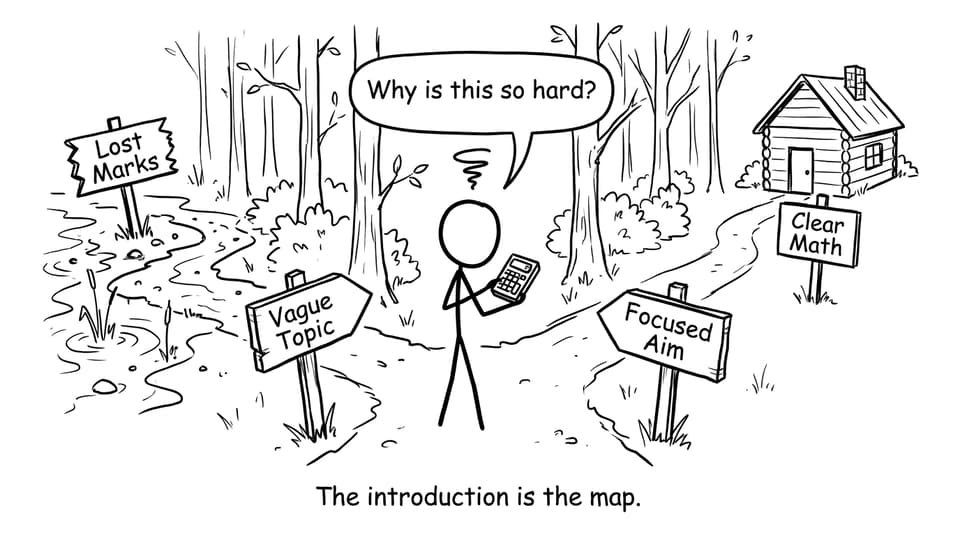
A strong IB Math IA introduction tells the reader what you are exploring, why you care, and how mathematics will carry the investigation. It sets a tone of control: focused, curious, and mathematically intentional. If your first paragraph is vague, everything after it feels like guesswork.
RevisionDojo exists for this exact moment: when you have a good idea, but you need the IB-standard structure to make it convincing. Between the IB Mathematics Analysis and Approaches (AA) IA Guide and the IA/EE Guides hub, you can build an introduction that sounds like you, while still reading like a top-scoring IB exploration.

A quick checklist for your IB Math IA introduction
Before you write a single line, make sure you can answer these seven questions. If you can, the introduction becomes easy.
-
What personal curiosity started this idea?
-
What is the context (in plain language) of the situation you are modelling or analysing?
-
What is your aim (or research question-style aim) in one sentence?
-
Which IB math areas will you use (statistics, calculus, functions, geometry, etc.)?
-
What data, tools, or technology will support your approach?
-
What will you produce (model comparison, optimisation, prediction, evaluation of fit, etc.)?
-
What is the roadmap for the reader?
If you need inspiration for feasible, math-rich directions, scan The Best IB Math IA Topics for 2025 and then narrow down until your aim becomes testable.
Start with curiosity, not drama (IB loves honesty)
The best IB introductions sound personal without sounding like a diary entry. You are not trying to impress anyone with emotion. You are trying to show ownership.
A useful pattern is:
-
One sentence of personal trigger (what made you notice the problem)
-
One sentence of mathematical lens (how you realised math could explain it)
Example tone (adapt to your topic):
“While tracking my running times across different rest intervals, I noticed the results were not improving linearly. This led me to explore whether a function-based model could describe the relationship between rest time and sprint performance.”
That simple pairing tells the examiner: this is an IB student thinking like a mathematician.
To see what “personal engagement” looks like when it’s done well, read Using IA/EE Exemplars to Improve Your IB Math IA. Better yet, open RevisionDojo’s Coursework Library and browse Maths AI IA exemplars for introductions that feel authentic and clean.
Clarify the context so a stranger can follow
After the hook, your job is to ground the reader. Not with everything you know, but with what they need.
Write context like you are explaining it to a smart friend who hasn’t taken your class.
Good context includes:
-
what is being measured or modelled
-
what variables matter
-
what you are holding constant (even if only approximately)
-
what “success” looks like in your exploration
Avoid overloading this section with formulas. In an IB Math IA introduction, clarity beats complexity.
If your topic is likely to involve substantial modelling or statistical analysis later, it can help to preview your plan by reading How To Structure An IB Math IA Effectively. It reinforces what belongs in the intro vs the body.
State a focused aim that’s measurable
Your aim is the spine of your IB exploration. If it bends, everything bends.
Aim statements that score well are:
-
specific (mentions variables)
-
measurable (you can actually compute something)
-
mathematical (it leads to methods, not just description)
A strong template:
“This exploration aims to determine how (X) affects (Y) by modelling the relationship using (method), and evaluating the model’s fit using (criteria).”
Notice what this does: it gives you a built-in plan, and it tells the examiner the math is coming.
If you want a second structure reference, How to Structure Your IB Math IA Logically pairs well with this step, because it shows how the aim feeds the sections that follow.
Name the mathematics (without turning it into the body)
Examiners want evidence that your IB Math IA is genuinely mathematical. The introduction is where you quietly prove that you know what tools you’ll use.
One or two sentences is enough:
“The exploration will use regression modelling and residual analysis to compare candidate functions, alongside statistical measures (such as correlation and goodness of fit) to evaluate accuracy and limitations.”
Or, if it’s calculus-focused:
“The exploration will use differentiation to optimise the model and integration to estimate cumulative change over time, supported by graphing technology for validation.”
If you are revising those methods for exams alongside coursework, RevisionDojo’s subject hubs are the fastest way to keep your fundamentals strong: IB Mathematics Applications & Interpretation Resources and IB Mathematics Analysis and Approaches Resources.
Mention tools and methods like a professional
A common IB mistake is either:
-
not mentioning tools at all, or
-
mentioning them like a shopping list.
Instead, connect tools to purpose:
-
“I will use graphing technology to test candidate models and compare parameters.”
-
“I will use spreadsheet calculations to automate repeated computations and reduce arithmetic error.”
Then keep your promise later.
RevisionDojo makes this practical because your workflow can stay in one place: Study Notes to refresh concepts, Flashcards to keep definitions sharp, AI Chat to debug confusion, and Grading tools to check clarity against criteria. When you want to stress-test methods, build targeted practice using the How to Use the Questionbank for Targeted Math Revision approach.
Add a short roadmap (and stop)
The final lines of your IB Math IA introduction should tell the reader what’s coming. This sounds small, but it creates a “professional document” feeling instantly.
A clean roadmap looks like:
“I will first define the variables and collect/justify the dataset, then develop and compare mathematical models, interpret results using appropriate metrics, and end with a reflection on limitations and possible improvements.”
Aim for 200-300 words total for most intros. Enough to orient. Not enough to overwhelm.

Common mistakes IB examiners notice fast
Being broad to feel “smart”
Broad topics read like avoidance. Narrow topics read like control. In IB math, control earns marks.
Turning the introduction into the whole IA
If your intro contains five equations, your body has nowhere to build. Save the heavy math for the sections where you can explain and reflect.
Forgetting the “why”
IB wants personal engagement, but it has to be intellectual. Tell the truth: what made you choose it, and why math is the right language to explore it.
If you want a rubric-aligned reminder of what the IA actually is, skim Essentials of the Internal Assessment. It clarifies expectations without drowning you in jargon.
Closing: write an IB introduction that earns trust
A great IB Math IA introduction is not flashy. It is precise. It tells the examiner, quietly, that you know where you’re going.
If you want to write your IB introduction like a pro, use RevisionDojo as your drafting loop: start with exemplars for tone, use Study Notes and Flashcards to keep methods sharp, ask AI Chat to sanity-check your aim, then run your draft through Grading tools before you commit.
When the introduction is clear, the rest of the IA stops feeling like a maze and starts feeling like a path.