

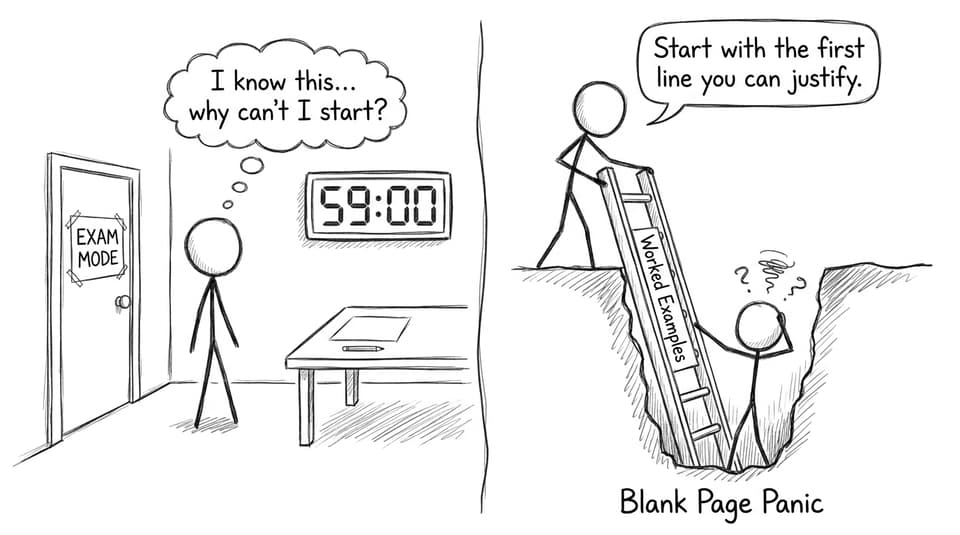
If you have ever stared at an IB question and felt your brain go oddly quiet, you have met the real enemy of revision: the blank first step. Not the hard algebra. Not the long essay. The start.
That is why IB students who improve quickly often share a secret that sounds almost boring: they study worked examples. Not as entertainment. Not as a way to avoid thinking. As a training ground for how marks are actually earned.
A worked example is a guided walk through examiner-style reasoning. It shows the sequence of moves, the justification behind each move, and the structure that makes an answer easy to award marks to. If you use worked examples actively, you learn faster because you stop guessing what “a good solution” looks like. You start copying the logic, not the handwriting.
Quick checklist: worked examples the IB way
Use this short checklist before each session. It keeps worked examples from turning into passive scrolling.
-
Pick one specific IB topic (not an entire unit).
-
Find 2-4 high-quality worked examples (exam-style, not just textbook-style).
-
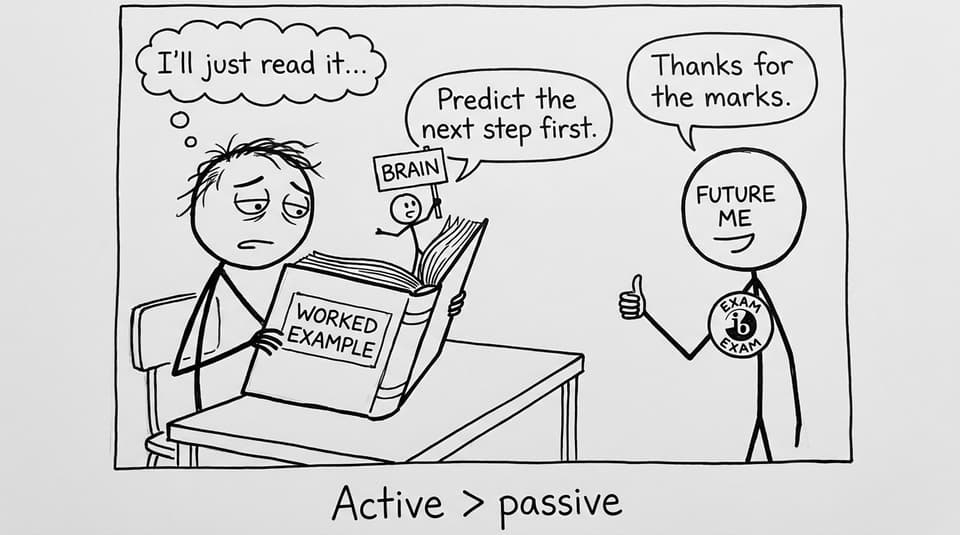
Cover the next step and predict it before you reveal it.
-
Annotate the reasoning (why this method, why this step, why this form).
-
Run the Example -> Imitate -> Apply cycle immediately.
-
Log one mistake pattern and schedule a reattempt in 48-72 hours.
For practice sets with step-by-step solutions and fast feedback, start inside RevisionDojo’s IB Questionbank guide and build your sessions from there.
Why worked examples help IB students learn faster
The IB rewards more than correct answers. It rewards method, clarity, and control. Worked examples help you see what that looks like in real time.
A strong worked example teaches you three things at once:
-
Decision-making: what the solver chooses to do first, and why.
-
Structure: how the solution is laid out so each step earns marks.
-
Efficiency: where a simpler method exists, and when not to use it.
This is why worked examples are especially powerful for IB Math, Physics, Chemistry, and any subject where mark allocation depends on process. And they still matter in essay subjects, because model responses show how arguments are built, not just what facts appear.
When you want a broader weekly system around this, pair worked examples with the loop in How to Study for IB Exams: Step-by-Step Guide.
The IB worked example method: predict, justify, compress
Most students “read” worked examples the way they read social media: eyes moving, brain passive, confidence rising for no good reason. The fix is a simple rhythm.
Predict the next step
Cover the solution. Read the question carefully. Then write what you think the next line should be.
Not the full solution. Just the next line.
In IB-style questions, the first move is usually one of these:
-
define variables or rewrite given information
-
pick a formula and state it
-
sketch a diagram or annotate a graph
-
set up an equation before substituting numbers
Then reveal the worked example and compare.
If you were wrong, that is not failure. That is calibration. You just learned what your instincts currently miss.
Justify the move
After you reveal the step, add a tiny note in the margin:
-
“used substitution because expression matches pattern”
-
“took log to linearise”
-
“set derivative = 0 to find stationary points”
-
“defined terms first because command term is ‘explain’”
This is where learning happens in IB revision: connecting actions to reasons.
Compress into a reusable template
At the end, compress the solution into a 3-6 line method template you could apply to a similar question.
If you cannot compress it, you probably do not own it yet.
To make this faster, you can use RevisionDojo’s Study Notes to confirm the core concept, then return to examples immediately. The notes act like a map; the worked examples are the training hike.
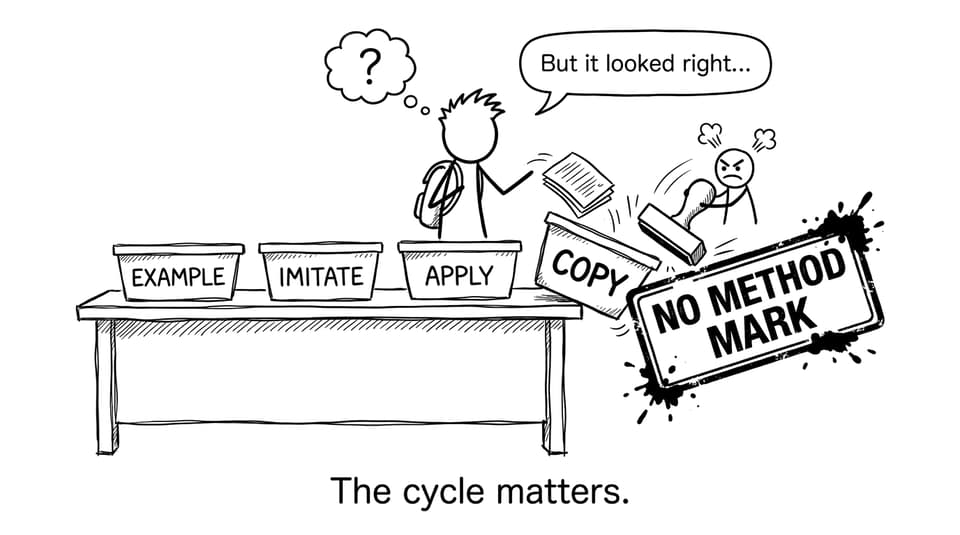
Example -> Imitate -> Apply (the fastest learning loop)
This is the loop that turns worked examples into marks.
Example
Choose one worked example and study it actively using the predict/justify/compress approach.
Imitate
Do a near-twin question while the method is still warm. Same topic, similar structure. Try to reproduce the logic without looking.
Apply
Now change the surface features. Different numbers, different context, maybe a twist in wording. Force your brain to adapt the method, not recite it.
This is where RevisionDojo becomes practical, not motivational: the Questionbank lets you filter by topic and difficulty so you can find the “imitate” and “apply” questions right away, instead of hunting through random worksheets. For a math-specific workflow, see How to Use the Questionbank for Targeted Math Revision.
How to use RevisionDojo features with worked examples
Worked examples are not a single tool. They are a practice style. RevisionDojo gives you multiple ways to run that style across your IB subjects.
Use Questionbank for clean, repeatable practice
When you study a worked example, your next move should be: “Where are three more like this, but not identical?”
That is exactly what the Questionbank is for: topic-tagged practice with solutions and feedback so you can move from recognition to recall.
If you are doing IB Math AA, you can jump into a topic set like IB Math AA Calculus Questionbank and run the loop: one worked example, then two imitation questions, then one application question.
Use Flashcards to lock the micro-steps
Most IB mistakes are not “I forgot everything.” They are “I forgot the one condition that changes the method.”
Turn those into flashcards:
-
“When do I use chain rule vs product rule?”
-
“What does ‘hence’ require me to do?”
-
“What is the required concluding statement in this proof style?”
RevisionDojo’s Flashcards make this easy to maintain daily, even when you only have 10 minutes.
Use AI Chat to remove friction, not replace thinking
After a worked example, ask AI Chat (Jojo AI) one tight question:
-
“Why is this substitution valid?”
-
“What is the alternative method and why is it worse here?”
-
“What would an examiner penalize in my line 3?”
One question. Then you go back to practice. That is how IB students get speed without becoming dependent.
Use Grading tools and Mock Exams to test transfer
Worked examples build skill; Mock Exams and Grading tools test whether the skill transfers under time pressure.
A good weekly pattern is:
-
early week: worked examples + Questionbank loops
-
mid week: a short timed set in exam conditions
-
end week: review, error log, and a reattempt
For general exam readiness, Best Resources for IB Exam Preparation ties these parts together.
Use Predicted Papers for strategic rehearsal
When you are close to exams, Predicted Papers help you rehearse common distributions of topics and difficulty. The goal is not to “guess” the exam. It is to practice under realistic pressure, then use worked examples to repair what broke.
Common mistakes IB students make with worked examples
Mistake: copying line-by-line
Copying feels productive because your page fills up. But your brain is outsourcing the hard part: choosing the next step.
Fix: force prediction before each reveal.
Mistake: studying ten similar examples in a row
Repetition builds familiarity, not flexibility.
Fix: study fewer examples, but vary the question type and context. Then use the apply step.
Mistake: never returning to the hard ones
If you only understand an example while it is in front of you, you do not understand it yet.
Fix: schedule a reattempt 48-72 hours later. Spaced review turns recognition into recall.
When you want a calmer endgame plan, keep this nearby: What to Do the Night Before IB Exams.
Closing: learn IB faster by borrowing expert thinking
Worked examples are not a shortcut around effort. They are a shortcut around wasted effort.
When you study worked examples actively, you borrow expert thinking until it becomes your own. You stop treating IB questions like surprises and start seeing them as patterns with logic you can justify.
If you want one place to run the full system, use RevisionDojo as your hub: Questionbank for targeted practice, Study Notes for clarity, Flashcards for retention, AI Chat for quick unblocking, Grading tools for feedback, plus Predicted Papers and Mock Exams for realistic rehearsal. Your job is to show up and run the loop. The marks follow.
For exam-day execution once your learning is solid, keep IB Exam Day Checklist: The Ultimate Guide bookmarked and boringly follow it.