If you’ve ever tried to revise IB SEHS by “just reading the textbook,” you know the feeling: you understand it while you’re reading, then the next day it’s gone. Not because you’re not capable. Because IB SEHS rewards applied understanding, exam wording, and consistency--not heroic last-minute effort.
RevisionDojo is built for that reality. It turns your revision into a loop you can repeat: learn the idea, recall it under pressure, practice it like the exam, then fix the exact mistakes you keep repeating. This guide shows you how to use RevisionDojo for IB SEHS success with a simple workflow you can start today.
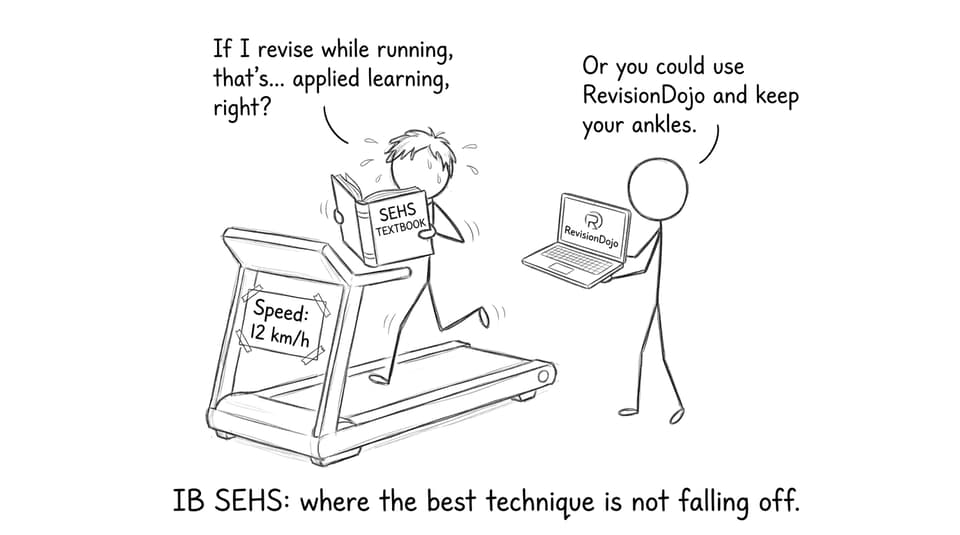
A student tries “applied learning” on a treadmill
Quick start checklist for IB SEHS on RevisionDojo
Use this as your default weekly plan for IB SEHS:
Study Notes for one subtopic (20--30 minutes)
Flashcards for key definitions (10 minutes daily)
Questionbank set on the same subtopic (25--40 minutes)
AI Chat when you’re stuck (2 minutes instead of 20)
One timed block using Mock Exams/Exam Mode or a paper-style session (1--2 times per week)
For coursework: use the Coursework Library and the Grading tools early, not at the end
In IB SEHS, “knowing” a topic is rarely the same as “being able to use it.” A clean way to close that gap is to revise by subtopic, not by chapter. RevisionDojo’s SEHS pages are organized exactly like that, so you can focus your attention where marks are actually earned.
For example, if movement feels fuzzy, open a specific page like B.1 Generating movement in the body and aim for clarity, not coverage. Then do one thing most students skip: write down two ways that concept could show up in an exam response.
If your class is currently on sport psychology, you can do the same with a full topic collection like Psychology of Sport. That’s IB SEHS revision done the way examiners reward it: precise, connected, and usable.
Turn “I read it” into “I can recall it” with Flashcards
IB SEHS has a quiet tax: definitions. Lactate threshold, VO₂ max, arousal, coping strategies, planes of movement, lever classes. If you only revisit them when they appear in homework, they won’t be available in the exam when you need them quickly.
Use RevisionDojo Flashcards as a daily anchor. Ten minutes is enough if you’re consistent. The goal isn’t to feel productive; it’s to make recall automatic so your brain has space for analysis and evaluation.
A useful habit: whenever you miss a Questionbank question, convert the missing idea into one new flashcard immediately. That single card can be worth multiple marks later, because IB SEHS often stacks marks on accurate terminology.
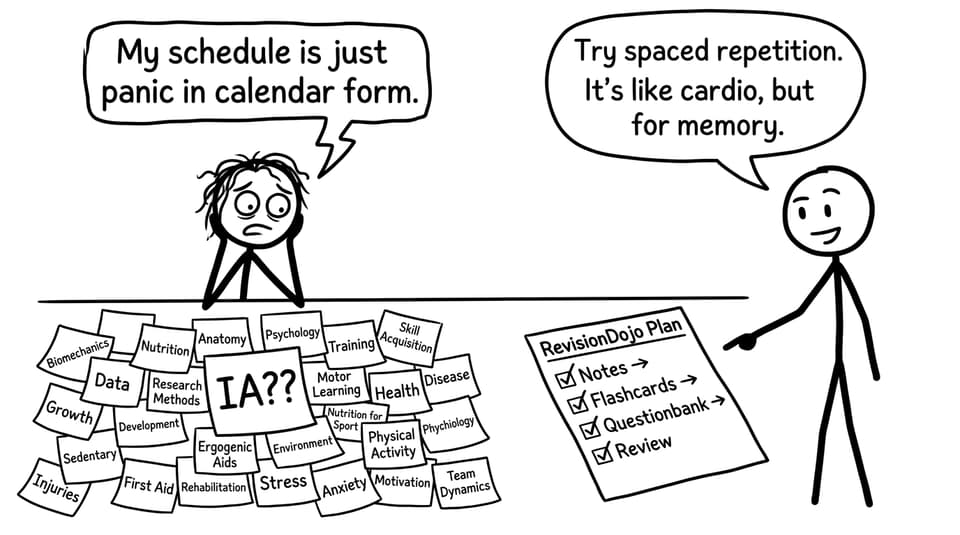
A sticky-note explosion meets a calm plan
Use the Questionbank to train exam instincts (not just content)
Most students don’t lose marks in IB SEHS because they never studied. They lose marks because they answered a different question than the one asked.
That’s where targeted practice matters. RevisionDojo’s Questionbank lets you drill by topic, so you can build pattern recognition: what “outline” usually expects, what “explain” demands, and how “evaluate” changes the structure of your response.
Try this simple loop:
Pick one SEHS subtopic.
Do a short Questionbank set.
Review the feedback.
Write down your recurring mistake pattern (not the question).
Reattempt a similar set 48 hours later.
That spacing is where learning sticks. It’s also how IB SEHS stops feeling like an endless list of facts and starts feeling like a skill.
Make your IA less stressful with the Coursework Library and Grading tools
The IB SEHS IA isn’t hard because it’s impossible. It’s hard because it’s easy to drift for weeks, then panic when your draft finally meets the rubric.
RevisionDojo helps you avoid that spiral in two practical ways:
Run your writing through the IB SEHS IA (2026 syllabus) Grader early. The win is not a score; it’s knowing which criterion is weak while you still have time to fix it.
If you treat the IA like a series of weekly checkpoints, IB SEHS becomes manageable. If you treat it like one giant task, it becomes emotional.
Practice under pressure with predicted papers and timed mocks
Knowing content without timing is like knowing training theory without ever training.
Use IB Predicted Papers by IB Examiners (Free) as realistic rehearsal material. The point is to build stamina and decision-making: when to move on, how long to spend on a response, and how to structure answers under stress.
A strong approach is:
Sit one timed section.
Mark and review mistakes immediately.
Drill weak topics in the Questionbank the next day.
Retake a short timed set at the end of the week.
This is the quiet advantage: RevisionDojo gives you IB SEHS resources that connect, so you’re not jumping between disconnected websites and losing momentum.
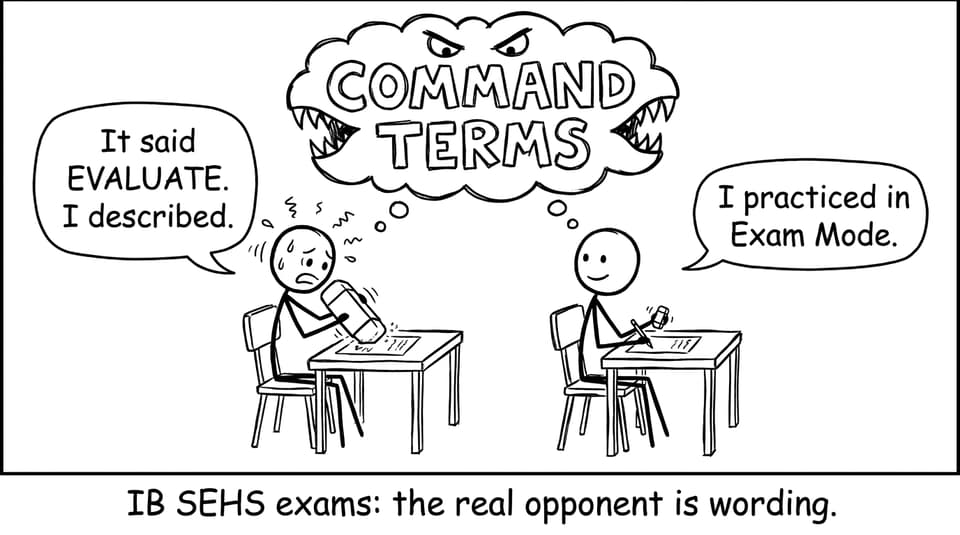
Command terms as the real exam villain
Conclusion: Make IB SEHS feel trainable again
The students who do well in IB SEHS aren’t the ones who never struggle. They’re the ones who build a system that keeps working even when motivation drops.
RevisionDojo gives you that system: Study Notes to understand, Flashcards to retain, Questionbank to apply, AI Chat to stay unstuck, Grading tools and the Coursework Library to protect your IA marks, and Predicted Papers and Mock Exams to rehearse the real thing.
If you want your next IB SEHS study session to feel calmer and more effective, start at the IB Sports, exercise and health science Resources page and run the checklist once. Then repeat it. That repetition is where the results come from.
IB SEHS goal setting in sport made simple: goal types, SMART targets, common mistakes, and exam-ready tips using RevisionDojo practice tools.