

If you’ve ever left an IB Math exam thinking, “My answer is right… so why did I lose marks?”, you’re not imagining things. You can type the same calculation into a calculator twice, get the same decimal, round it perfectly, and still watch marks disappear.
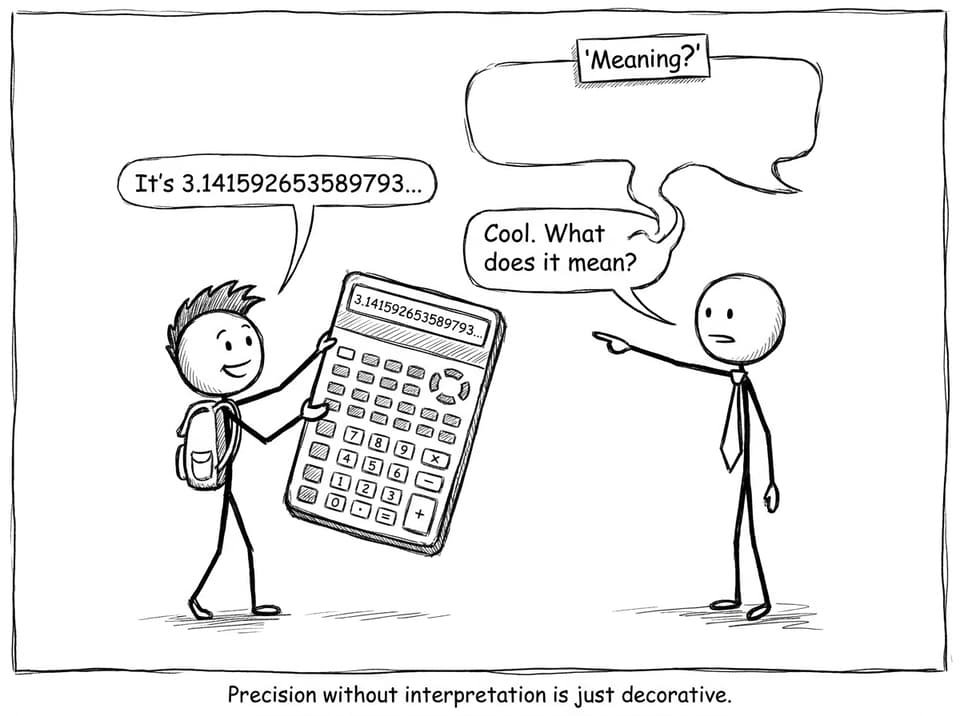
The reason is quietly philosophical: the IB is less impressed by your ability to produce beautiful numbers and more impressed by your ability to say what those numbers mean. In IB Math, precision is a tool. Interpretation is the goal.
The IB Math mindset: numbers are not the answer
In most earlier maths classes, the story ends when you get the correct value. In IB Math, the story begins there.
Examiners are looking for evidence that you can:
-
connect a result to context (units, meaning, direction)
-
judge whether a value is reasonable
-
communicate limitations (assumptions, measurement error, model fit)
-
make a cautious conclusion rather than an overconfident claim
That’s why interpretation marks can outweigh pure calculation marks, especially in Applications & Interpretation.
If you want a structured look at how Paper 2 rewards explanation and context, see Ace IB Math Applications and Interpretation Paper 2.
A quick checklist: what “interpretation” looks like on the page
When you finish any calculation in IB Math, check whether you have also done these three things:
-
Restated the result in words: “This means…”
-
Anchored it to context: include units, direction, or what changes when x increases
-
Commented on reasonableness: a one-sentence reality check
That’s the difference between a correct number and a complete answer.
Why precision alone can be misleading in IB Math
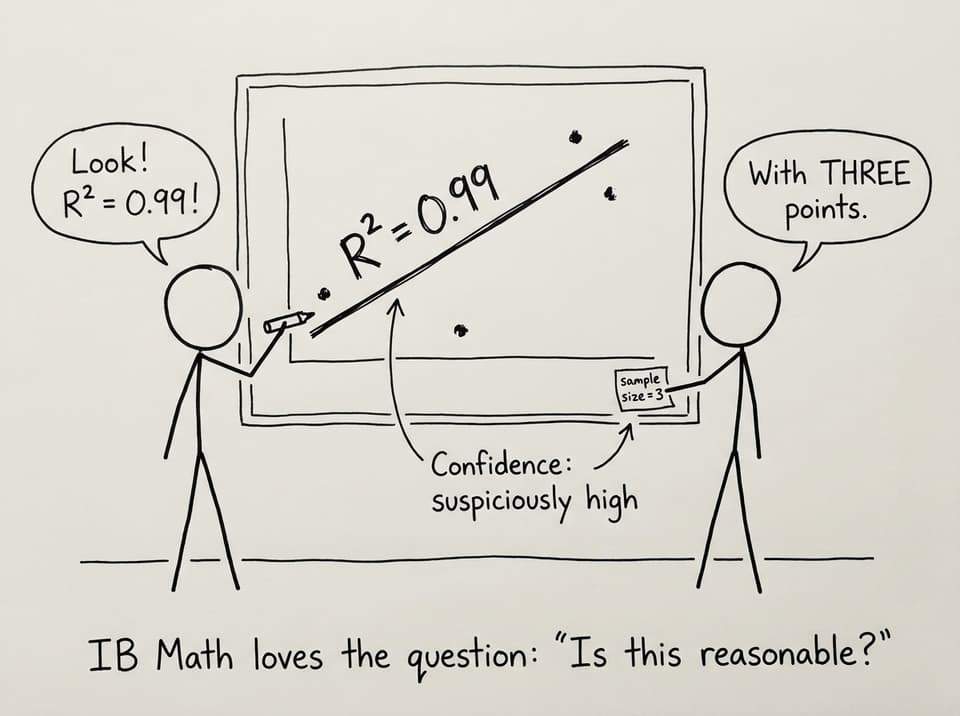
Precision feels safe because it’s crisp. But in real problems (and most IB Math modelling questions), the inputs are not crisp.
A student once told me they felt “more mathematical” writing 2.347891. But if that number comes from rounded measurements, estimates, or regression, those extra digits can be fiction.
IB wants you to notice things like:
-
Data is measured, not perfect
-
Models simplify reality
-
Technology outputs can look authoritative even when the setup is fragile
That’s why topics like bounds matter. They train you to treat stated values as approximations with hidden uncertainty. If this concept trips you up, read When Do Upper and Lower Bounds Actually Matter in IB Exams.
Where interpretation is tested most often in IB Math
Interpretation tends to show up wherever the maths touches reality. In IB Math, that’s commonly:
-
statistics (correlation, regression, hypothesis tests)
-
financial modelling (loans, depreciation, interest)
-
sequences and growth models (approximation and long-term behaviour)
-
calculus in context (rates of change, optimization meaning)
-
technology-heavy prompts (graphs, tables, GDC output)
Two internal resources that build this skill fast:
The most common way students lose marks
Most lost marks in IB Math aren’t from “bad maths.” They’re from silent pages.
Typical patterns:
-
You present a final value with no sentence explaining it
-
You round aggressively to look “clean,” but the context demands a specific accuracy
-
You ignore what the question is asking you to do (command term mismatch)
-
You skip limitations (“valid for the domain,” “assuming linearity,” “based on a small sample”)
Command terms are a major source of hidden mark loss. Train this directly with How to Decode IB Math Command Terms.
How to balance interpretation and precision (the way examiners reward)
Here’s the rule that works in almost every IB Math scenario:
-
Use appropriate accuracy (matching the data and context)
-
Then add one or two sentences that translate the result into meaning
If you’re unsure what “appropriate” looks like, RevisionDojo’s IB Mathematics Applications & Interpretation Resources and Study Notes model the expected level of wording.
And when you practise, make it exam-real: drill interpretation-heavy questions using the Functions Questionbank or Calculus Questionbank. The point is not more questions. It’s better feedback.
Conclusion: in IB Math, meaning is the final mark
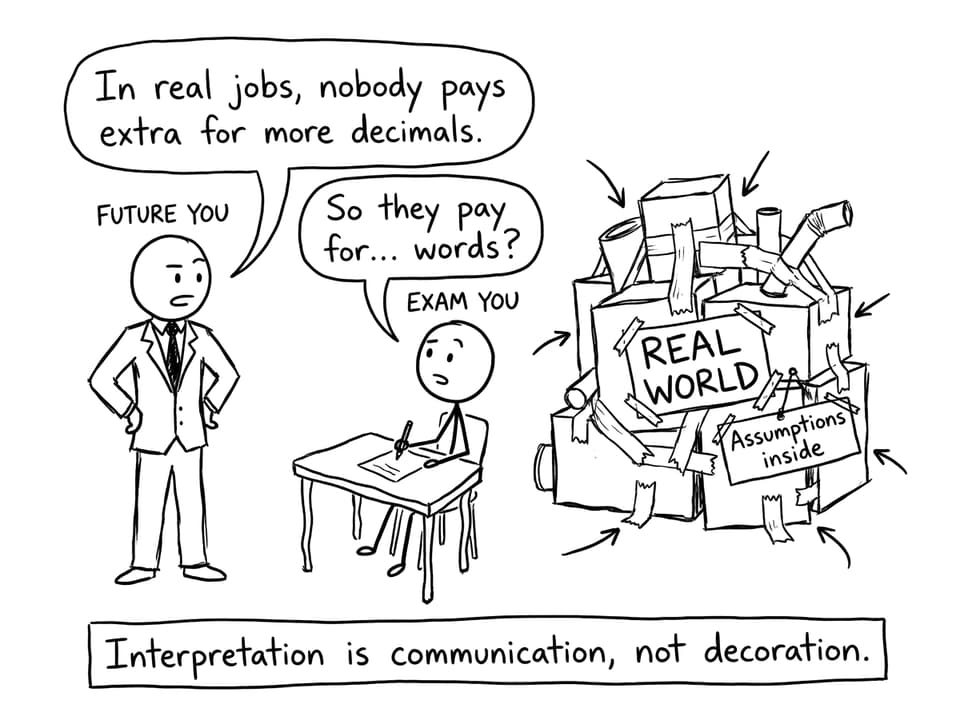
The IB cares about interpretation more than precision because that’s how mathematics works when it leaves the classroom. Decimals don’t make decisions. People do, based on what the numbers suggest.
If you want to turn correct calculations into full-mark answers, RevisionDojo is built for that exact gap: Study Notes to learn the language of interpretation, Flashcards to lock in key phrasing, AI Chat to ask “what does this mean?” without embarrassment, Grading tools to spot missing reasoning, and a focused Questionbank, Mock Exams, and Predicted Papers to practise under exam conditions. In IB Math, interpretation is not extra--it’s the difference between “right” and “complete.”