

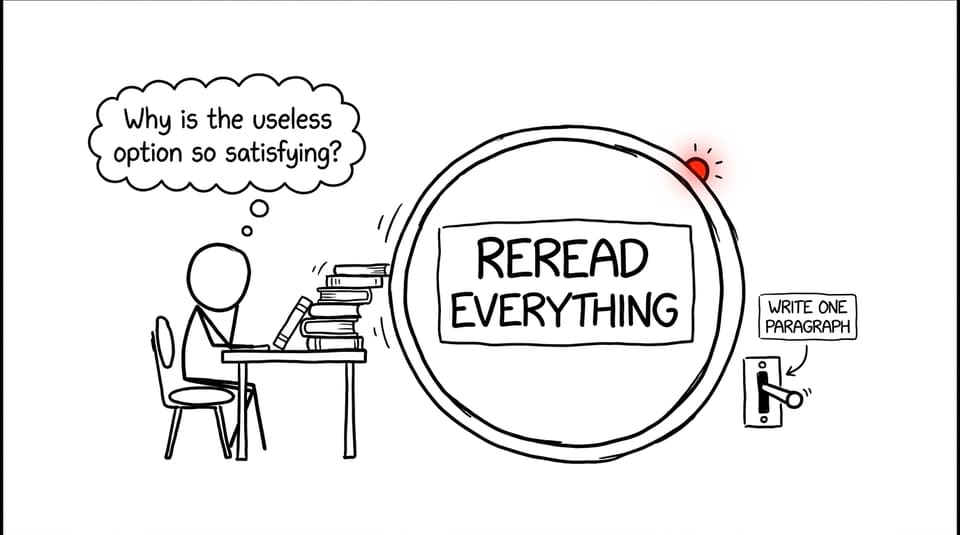
Studying English can feel strangely unmeasurable. In mathematics, you can count the questions completed. In science, you can test whether you remember a formula. In English, rereading a novel for an hour may feel productive while changing very little about the quality of your next response.
The most effective answer to how to study for MYP English Language and Literature is to practise the skills the criteria reward: analysing choices, organizing ideas, producing purposeful texts, and using language accurately. Review matters, but it should lead quickly to writing, feedback, and revision.
A practical study cycle is simple: identify one weakness, review it briefly, attempt a focused task, check the result against the relevant criterion, and rewrite the weakest part.
The MYP English revision checklist
Use this overview before planning your week:
- Check which assessment criterion your current task targets.
- Review one technique or text type at a time.
- Practise analysis with short, precise evidence.
- Write regularly instead of only reading notes.
- Include literary, non-literary, and visual texts.
- Use feedback to choose the next task.
- Complete timed work once your untimed technique is secure.
- Keep an error log containing specific actions.
The MYP English Language and Literature resource hub brings notes, lessons, Flashcards, and practice resources together, making this loop easier to maintain.
Begin with the four assessment criteria
MYP Language and Literature uses four equally weighted criteria, each with a maximum achievement level of 8. The precise descriptors develop across MYP years, so always use the task-specific rubric supplied by your teacher.
| Criterion | Skill to practise | Useful training task |
|---|---|---|
| A: Analysing | Explaining choices, effects, meaning, and connections | Analyse one quotation or visual detail |
| B: Organizing | Building a coherent, purposeful structure | Create a thesis and three topic sentences |
| C: Producing text | Making deliberate creative and stylistic choices | Write for a defined audience and purpose |
| D: Using language | Controlling vocabulary, register, grammar, and syntax | Edit one paragraph for precision and accuracy |
Read the MYP Language and Literature assessment criteria guide, highlight the criteria named on your task sheet, and translate each strand into an action. For example, “analyse the effects of choices” becomes: name the choice, select evidence, explain the audience effect, and connect it to purpose.
Use this 45-minute method today
Choose one target in five minutes
Open your latest teacher feedback and select one recurring issue, such as weak evidence, excessive summary, unclear topic sentences, limited discussion of audience, inconsistent register, or punctuation errors.
Turn it into a measurable target: “By the end of this session, I will write one paragraph that links a language choice to effect and purpose.” Avoid vague goals such as “get better at English.”
Review the skill for ten minutes
Use class materials or RevisionDojo Study Notes to refresh the relevant concept. If purpose is your weakness, review the author intention notes. If your quotations rarely support your claims, use the evidence selection notes.
Then close the notes. Write down the idea from memory or test the terminology with Flashcards. This prevents review from quietly becoming copying.
Produce something for fifteen minutes
Choose a short literary extract, advertisement, speech, article, image, or class text. Spend three minutes identifying audience, purpose, context, and one significant choice. Use the remaining time to write one analytical paragraph.
Build it through this reasoning chain:
Claimtoevidencetocreator’s choicetoaudience effecttopurpose or meaning
Identifying repetition is only the beginning. Explain what it emphasizes, how it positions the audience, and why the creator may want that response. The guide to improving MYP English analysis explores this shift from description to analysis.
Check and rewrite for fifteen minutes
Compare your paragraph with the relevant criterion. Underline the claim once, the evidence twice, and the explanation with a wavy line. If most of the paragraph is quotation or plot summary, the analysis needs more space.
Use RevisionDojo’s Grading tools or AI Chat to request diagnosis, not a replacement answer. Ask which sentence becomes descriptive, whether the evidence supports the claim, or where the connection to purpose is missing. Rewrite the weakest sentences yourself, then record one rule for next time.
Strengthen analysis without memorizing interpretations
Memorizing a teacher’s explanation may help you recall a text, but unfamiliar prompts demand adaptable reasoning. Build a bank of choices you can recognize across genres: diction, imagery, symbolism, perspective, sentence structure, contrast, tone, framing, composition, color, and layout.
For every choice, ask three questions:
- What precise detail can I cite?
- What response or understanding does it create?
- How does that effect serve the wider purpose?
Do not claim that every device has a fixed effect. Short sentences do not automatically create tension, and dark colors do not always represent evil. Meaning depends on the text, context, pattern, and audience. For multimodal tasks, the MYP visual analysis notes can help you discuss composition and perspective without merely listing features.
Practise producing text deliberately
Once a week, choose a form such as a speech, narrative opening, opinion article, diary entry, or descriptive passage. Before writing, complete this four-line plan:
- Audience: Who will receive this?
- Purpose: What should they think, feel, understand, or do?
- Form: Which conventions should make the text recognizable?
- Choices: Which two language or structural decisions will create the intended effect?
Afterward, annotate your writing. Identify where your choices are visible and explain their intended impact. If you cannot locate them, they may not have been deliberate enough. Persuasive writing practice can be supported by RevisionDojo’s rhetorical appeals notes.
Build a weekly routine you can sustain
Good MYP English Language and Literature revision techniques are small enough to repeat. A useful week might contain two analytical paragraphs, one organization drill, one creative task, and one timed response.
| Day | Focus | Session |
|---|---|---|
| Monday | Criterion A | Analyse one choice in one paragraph |
| Tuesday | Criterion D | Use Flashcards, then edit Monday’s paragraph |
| Wednesday | Criterion B | Plan a response without writing it fully |
| Thursday | Criterion C | Produce a short text for a defined audience |
| Saturday | Mixed practice | Complete a timed unseen response and rewrite one section |
Use the Questionbank for targeted prompts, Study Notes for brief repair work, and AI Chat when your reasoning needs to be challenged. Grading tools can show whether improvement is visible against the criteria. As an assessment approaches, Mock Exams and available Predicted Papers can support timed rehearsal, while the Coursework Library can help you examine structure without copying another writer’s ideas. If a weakness persists, Tutors can provide human diagnosis and accountability.
Study by creating evidence of improvement
The quiet trap in English revision is confusing familiarity with ability. A page looks recognizable, a device definition sounds obvious, and an interpretation feels clear. None of that guarantees you can produce a controlled response independently.
Finish every session with evidence: a paragraph, a plan, a revised sentence, an annotated extract, or a deliberate creative choice. Store the work with your error log and revisit the same weakness within a few days.
RevisionDojo is the ultimate IB resource for making that process coherent. Its MYP English resources connect explanation, recall, practice, feedback, timed rehearsal, models, and expert support. Improvement becomes less mysterious when every session leaves behind something you can evaluate, and something specific to improve next time.