
How to Stop Procrastinating in IB (Without Burning Out)
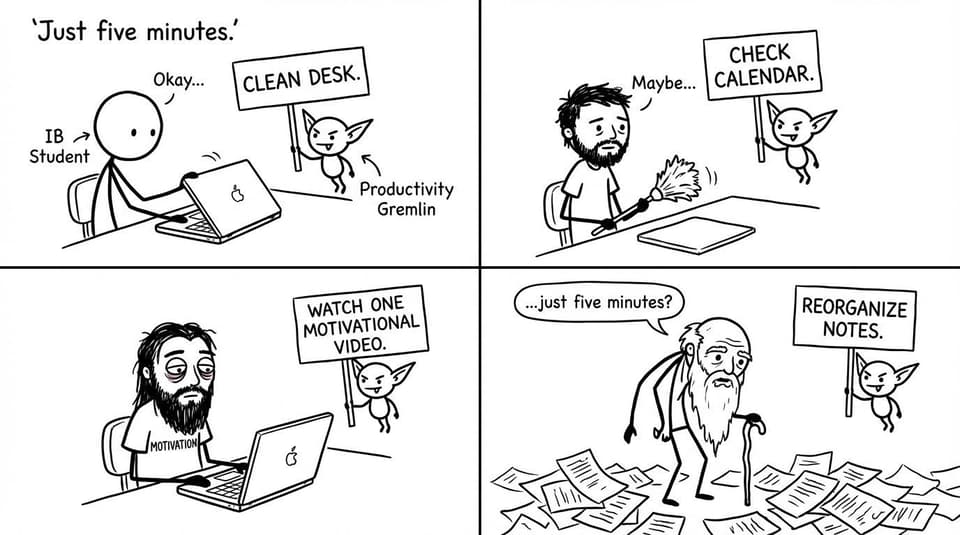
The weirdest thing about IB procrastination is how reasonable it feels in the moment.
You don't call it avoidance. You call it "resetting." You tidy your desk so your brain can breathe. You open the syllabus "just to check what's coming." You promise you'll start after you find the right playlist.
Then, suddenly, it's 11:43 pm and you're bargaining with yourself like a stressed-out economist: If I start now, I'll be tired tomorrow. If I don't start now, I'll be panicked tomorrow.
Here's the honest truth: IB is too big to be powered by motivation. It needs a system. A calm one. One that works on bad days, busy days, and days when your brain feels like it's buffering.
A quick overview checklist (save this)
If you want to stop procrastinating in IB, do these five things consistently:
- Make "starting" smaller than "finishing"
- Turn vague goals into 20-minute tasks
- Study in timed sprints (protect attention, not hours)
- Use feedback loops (practice, mark, fix, repeat)
- Build a default plan for bad days
The rest of this guide explains how to do those steps in a way that actually fits real IB life: coursework, mocks, deadlines, and that constant sense that you should be doing more.
Why IB procrastination happens (it's not laziness)
Most IB students procrastinate for three reasons, and none of them are "I don't care."
You're overwhelmed by the size of the task
"Revise Chemistry" is not a task. It's a foggy mountain range. Your brain can't see the first step, so it delays.
You're scared of getting it wrong
The IB trains you to care about precision: command terms, markbands, criteria. That can morph into perfectionism. And perfectionism often procrastinates because it would rather delay than produce something imperfect.
You're missing immediate feedback
If you reread notes for an hour, you don't feel improvement. You feel busy. Your brain learns that studying is effort without reward, so it avoids it.
That's why practice + feedback is the cure. It makes progress visible.
If you want a deeper focus framework for staying on track, pair this article with How Do You Study Efficiently for IB Without Getting Distracted?.
The "start line" rule: make IB work embarrassingly easy to begin
There's a quiet superpower in IB revision: the ability to start when you don't feel ready.
Use this rule:
Your first step must be doable in two minutes.
Not because two minutes changes your grade, but because it changes your identity. You go from "I'm procrastinating" to "I'm studying." That switch is everything.
Examples that actually work:
- Open one subtopic in your notes and write three bullet points from memory
- Do two questions from a bank, even if you get them wrong
- Make five flashcards for one definition set
If you need a ready-made place to start, open RevisionDojo's Questionbank and pick a micro-topic. Two questions. That's it. Starting is the win.
Turn "IB revision" into a menu of small, winnable tasks
Procrastination feeds on ambiguity. So your job is to remove ambiguity.
Instead of:
- "Study Math AA"
Write:
- "Paper 1: 3 functions questions (20 minutes)"
- "Review errors and make 6 flashcards (10 minutes)"
Instead of:
- "Revise History"
Write:
- "Plan one essay outline using 3 key historiography points (25 minutes)"
This is where good tools help you stop negotiating with yourself.
- Use Notes + Flashcards + Question Bank (Free) to turn each topic into a small task.
- Use Interactive IB Flashcards for short daily recall reps when you're tired.
When tasks become small, starting becomes normal.
The 25-minute contract: focus beats time in IB
Most students try to defeat IB procrastination with longer hours.
That backfires.
Long sessions increase the emotional cost of starting. Short sessions lower it.
Try this:
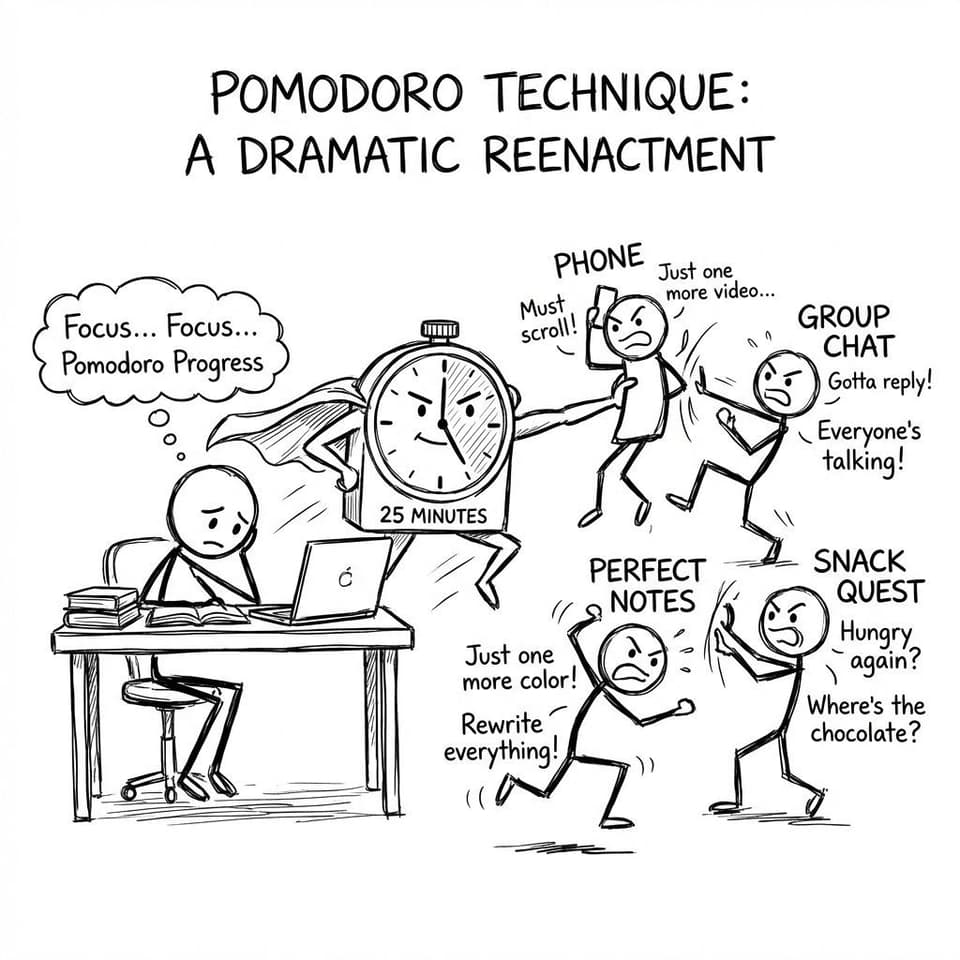
- 25 minutes work
- 5 minutes break
- Repeat 2 to 4 times
But make the 25 minutes specific. Not "study," but "answer questions on acids and bases" or "write one TOK paragraph."
If you want science-backed methods beyond Pomodoro, see 5 Proven IB Revision Hacks Backed by Science.
Use feedback loops: the fastest way to stop procrastinating in IB
Here's a small story you might recognize.
Two students both "study" for IB Biology.
- Student A rereads notes for two hours.
- Student B does 20 questions, marks them, identifies three weak subtopics, then drills those subtopics for 20 minutes.
Student B feels momentum because the work creates evidence.
That's the real antidote to procrastination: a tight feedback loop.
A simple loop you can repeat daily:
Practice
Use the Comprehensive IB Question Bank to do small sets. Keep them short.
Grade
Use RevisionDojo's AI Chat and grading tools to get instant feedback in the style of a mark scheme, then ask: "What would a top-band response include?"
Patch
Turn mistakes into flashcards or mini-notes. This is where learning locks in.
Repeat
Return two days later. Then a week later. That's how IB memory actually forms.
If coursework is the task you keep avoiding, break the fear loop by submitting a rough draft early to the IB Coursework Grader. The point isn't a perfect draft. The point is getting clear next steps.
Build a "default day" plan for IB (so you don't rely on willpower)
A plan should work even when you're not in the mood.
Here's a realistic default day for IB students during exam season:
Before school (10 minutes)
- Flashcards only (definitions, formulas, quotes)
- Use RevisionDojo Flashcards to keep it automatic
After school (45 minutes)
- 25 minutes: Questionbank set on your weakest topic
- 10 minutes: review errors, write corrections
- 10 minutes: create flashcards from mistakes
Evening (30 minutes)
- One timed mini-section or short written response
- Use Mock Exams or a predicted set to train exam behavior
If mornings are where your day either starts strong or collapses, read Morning Routines of High-Scoring Students.
Make the future feel real (so present-you stops bargaining)
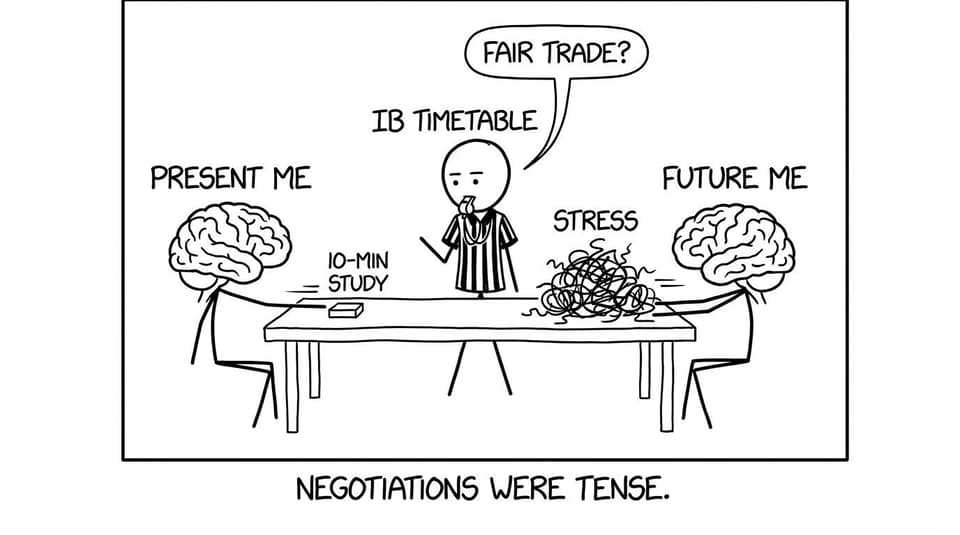
A lot of IB procrastination is a negotiation between two versions of you.
- Present You wants comfort.
- Future You wants relief.
The trick is to make Future You feel closer.
Two tactics:
Use "tomorrow-proofing"
At the end of each session, write the next step on a sticky note:
- "Tomorrow: do 10 kinetics questions"
- "Tomorrow: rewrite the conclusion paragraph"
You're not planning your life. You're removing friction.
Practice under time pressure early
When you take timed practice, your brain stops imagining the exam as a vague threat. It becomes a concrete event you can train for.
RevisionDojo helps here with Mock Exams and Predicted Papers so you can rehearse the feeling of exam conditions and build stamina.
For a full guide to simulation, see Online IB Mock Exams: Practice Anywhere, Anytime.
What to do when you've already procrastinated (the recovery protocol)
Sometimes you don't need a perfect plan. You need a comeback.
Here's a clean recovery protocol for IB students:
- Pick one subject for today
- Do one timed sprint (25 minutes)
- Mark it and identify one weakness
- Do a second sprint on that weakness
- Stop
Stopping is important. It teaches your brain that starting doesn't mean suffering for five hours.
If you're in a last-minute window and need triage, see How to Handle Last-Minute IB Revision: Strategies for Procrastinators.
Closing: stop waiting for motivation, build an IB system
The students who beat IB procrastination aren't superhuman.
They just stop treating studying like an emotional event.
They make starting tiny. They use timed sprints. They practice in ways that create feedback. They build routines that work on imperfect days.
If you want a platform that supports that system end-to-end, RevisionDojo is built for the full IB journey: Questionbank, Study Notes, Flashcards, AI Chat, Grading tools, Predicted Papers, Mock Exams, a Coursework Library, and access to Tutors when you need a human explanation.
Your next step is simple: open a topic, do two questions, and let momentum do what motivation never reliably will.