


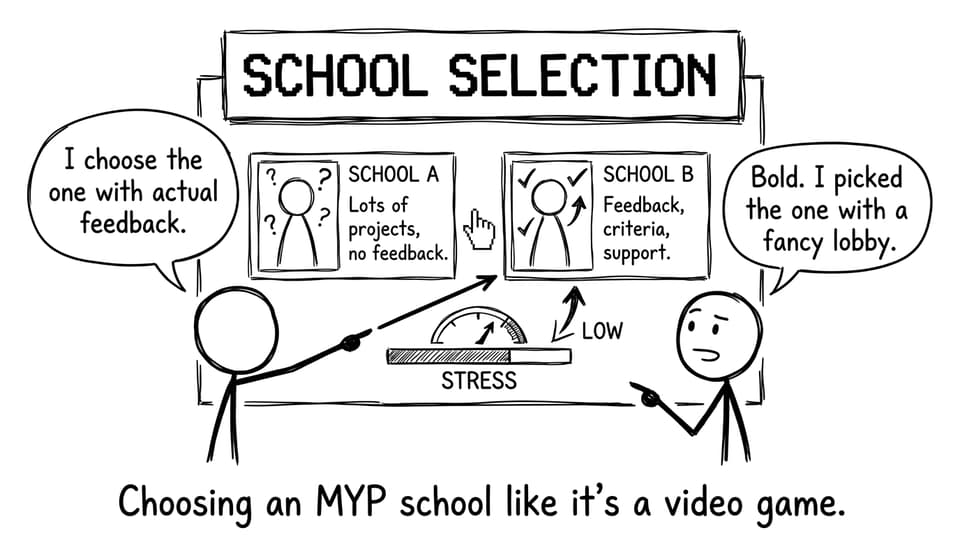
If you only visit a school once, you notice the lobby. If you stay for three years, you notice the feedback.
That’s the quiet truth behind choosing an MYP school. The International Baccalaureate Middle Years Programme is famous for inquiry, projects, and “global contexts.” But as a student preparing for exams, you eventually learn what matters more than slogans: how a school teaches you to think, how it measures your work, and whether it turns effort into improvement.
For parents, picking an MYP school can feel like buying a map for a journey they won’t personally travel. For students, it’s more immediate: this is where your habits form, where your confidence grows (or shrinks), and where “I’ll revise later” either becomes a system or a season of stress.
Quick checklist for choosing the best MYP school
Use this checklist when you’re comparing an MYP option against another school (or against another MYP school):
-
Confirm the school is officially authorized as an IB World School for the MYP.
-
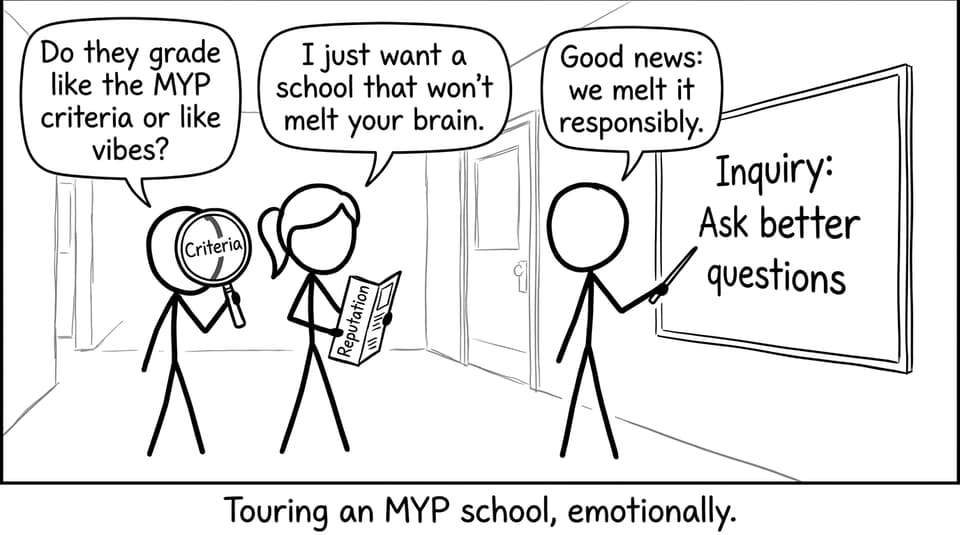
Ask how criterion-based assessment is used in everyday lessons (not just report cards).
-
Check how teachers are trained and how often they update IB practice.
-
Look for structured well-being and learning support (especially during assessment periods).
-
Observe inquiry learning in action: students talking, questioning, revising work.
-
Ask how the school prepares students for eAssessments and exam-style performance.
If you want a student-friendly view of how MYP prep should feel week to week, skim MYP Revision Guide: Study Tips for Success.
What makes an MYP school actually feel like MYP
A strong MYP school doesn’t just “cover content.” It builds the habits behind strong performance: explaining, applying, reflecting, improving. The programme is designed for ages 11-16, and its best version is concept-based and interdisciplinary. That means you’re not memorizing facts in isolation; you’re learning how ideas connect across contexts.
The simplest question to ask on a school tour is also the most revealing:
“How do students get better from one task to the next?”
In a healthy MYP environment, you’ll see:
-
teachers using criteria language as a normal part of feedback,
-
students revising work after feedback (not just receiving a grade),
-
learning goals that sound like skills (analysis, evaluation, communication), not just topics.
If you’re unsure what “good preparation” looks like beyond brochures, compare what the programme builds in Is MYP Good Preparation for University?.
How to evaluate teaching quality in an MYP school
Here’s the part people rarely say out loud: even within the MYP, teaching quality varies widely. Some schools run the framework like a living system. Others treat it like a costume they wear for accreditation.
When you’re evaluating an MYP school, look for evidence in three places.
Teacher training and shared standards
Ask how teachers stay current with IB expectations. Strong schools invest in ongoing IB training and collaborative planning. You’ll often hear about common marking meetings or moderation routines. That matters because it creates consistency: different teachers, same standard.
Examples of student work (and the feedback on it)
Don’t just ask to see a final product. Ask to see:
-
an early draft,
-
feedback aligned to criteria,
-
the improved version.
That “before and after” tells you whether the school teaches improvement or simply rewards students who already know the game.
Assessment that trains for performance
An MYP school should prepare students for exam-style thinking: time pressure, command terms, and clarity. Practice should feel like training, not surprise.
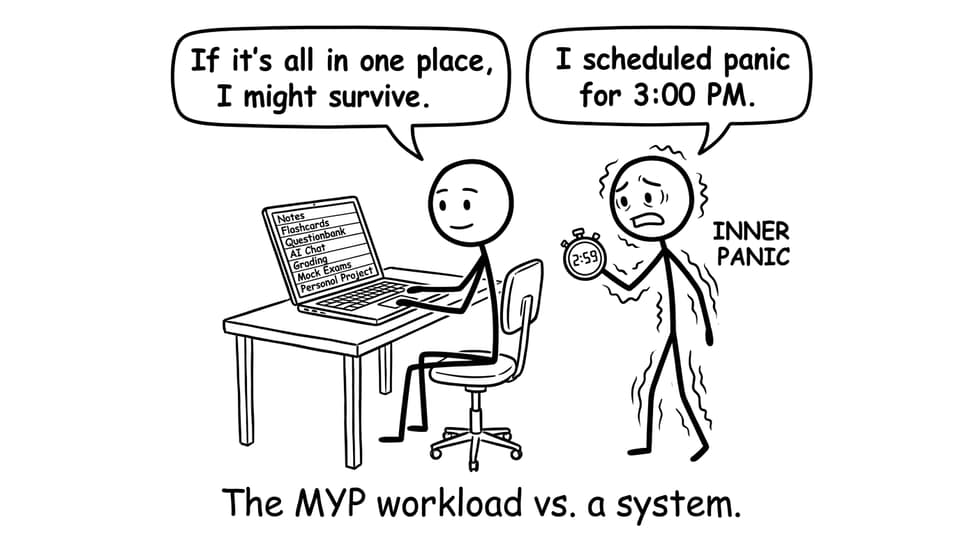
Students can strengthen that same loop outside class with RevisionDojo: start from the MYP hub, then pair targeted practice in the Questionbank feature with quick consolidation through Flashcards.
School culture: the hidden curriculum of MYP success
Every school teaches two curricula.
One is written down: units, projects, assessments.
The other is invisible: how students handle confusion, how safe it feels to be wrong, whether asking questions is admired or mocked. In the MYP, that hidden curriculum matters because inquiry only works when students aren’t punished for curiosity.
When you visit, notice small signals:
-
Do students speak like they own their learning, or like they’re surviving it?
-
Do teachers ask open questions, or rush toward “the right answer”?
-
Does the school talk about well-being as a real system or as a slogan?
If you’re a student reading this, it’s worth remembering: a supportive culture doesn’t lower standards. It raises them, because you keep showing up.
The pathway from MYP to the IB Diploma (and exams)
Even though this guide is about choosing an MYP school, many students are already thinking one step ahead: “Will this set me up for DP?” That’s a smart question. The best MYP schools teach skills that transfer directly: planning, academic honesty, structured writing, and reflection.
Ask schools how they support the transition:
-
Do they explicitly teach time management and revision routines?
-
Is there guidance for big projects, like the Personal Project?
-
Do students practice exam timing and command terms before the pressure spikes?
For a clear student plan that connects preparation to execution, see MYP eAssessments: 30-Day Study Plan That Works. And if you want Personal Project guidance that feels practical, use MYP Personal Project: The Ultimate Student Guide alongside RevisionDojo’s Personal Project exemplars.
Conclusion: choose the MYP school that builds a repeatable advantage
The best MYP school for your child is not the one with the most impressive brochure. It’s the one that turns everyday learning into a repeatable advantage: clear criteria, consistent feedback, strong teacher training, and a culture where curiosity is safe.
And if you’re an MYP student reading this with exams in mind, remember the best schools still expect you to do the hard part: show up and practice. That’s where RevisionDojo becomes your quiet edge. Use the MYP hub to orient yourself, drill weak topics with the Questionbank, lock in memory with Flashcards, and pressure-test your readiness with structured practice plans like How to Study for IB Mocks (Without Burning Out).
Choose your environment carefully. Then build your system. The MYP rewards students who do both.