




A predicted-grades report can feel strangely final. It arrives as a small collection of numbers, yet those numbers seem to carry the weight of university choices, exam results, and years of work.
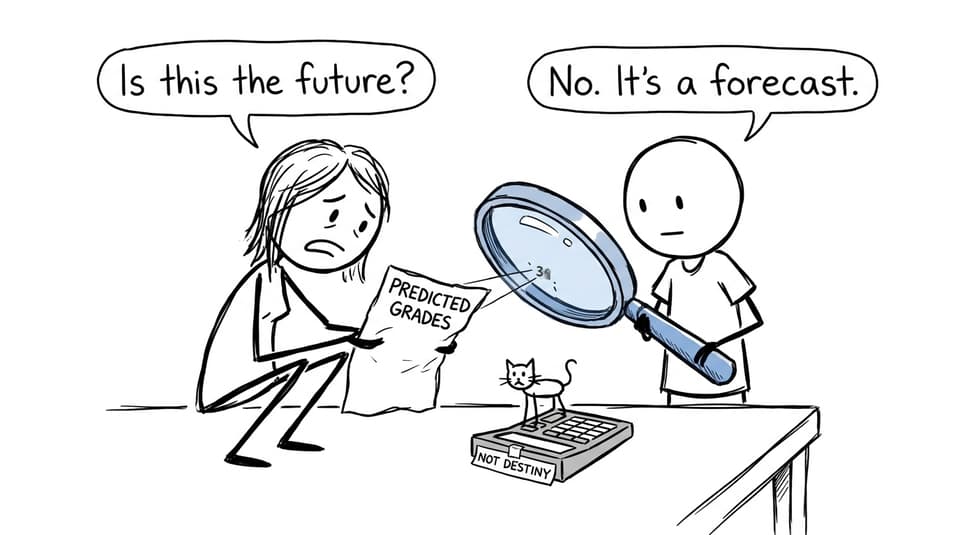
The reassuring truth is simpler: predicted grades are informed forecasts, not final IB results. To read them properly, look at four things: each subject grade, the Higher Level grades, the predicted core points, and the gap between the prediction and any university requirements. Then ask the school what evidence informed the forecast and what your child can still improve before the final examinations.
That is the short answer to how to read predicted grades. The deeper answer is that the report should be treated as a map. It shows where your child appears to be heading under current conditions. It does not decide where they must arrive.
Your predicted-grades checklist
Before reacting to the total, work through this order:
- Confirm that all six IB subjects are listed correctly, including HL and SL designations.
- Read each subject prediction on the 1-to-7 scale.
- Add the six subject grades to obtain the subject total out of 42.
- Check the predicted Theory of Knowledge and Extended Essay outcomes, which can contribute up to three core points.
- Confirm whether the reported total includes those core points.
- Compare relevant HL grades and the overall total with exact university conditions.
- Ask when the prediction was produced and what evidence the school used.
- Identify one or two subjects where focused improvement would make the greatest difference.
For a fuller explanation of the scoring structure, see RevisionDojo's guide to the IB grading system from 1 to 7 and 45.
What an IB predicted grade actually means
The International Baccalaureate defines a predicted grade as a teacher's prediction of the grade a candidate is expected to achieve, based on evidence of the student's work and the teacher's knowledge of IB standards. Predictions are also required for Theory of Knowledge and the Extended Essay.
This distinction matters. The prediction is not a percentage, a permanent label, or a grade awarded directly by the IB. It is a professional judgment made before every final assessment component has been completed and externally evaluated.
Schools may consider mock examinations, classroom assessments, Internal Assessment work, coursework, progress over time, and subject-specific performance. However, there is no single public formula that every school must apply in exactly the same way. Your school's written policy and IB coordinator are therefore the best sources for understanding how a particular report was produced.
Parents should also check which kind of prediction they are viewing. A school may issue an early working forecast for planning discussions and a later prediction for university applications or formal IB processes. The terminology and sharing policy can vary, so ask whether the figure is provisional, application-facing, or final within the school's own process. RevisionDojo's guide to when and how IB predicted grades work provides useful context.
How to read predicted grades line by line
Start with the six subject grades
Each Diploma Programme subject is graded from 1 to 7, with 7 being the highest. HL and SL subjects contribute equally to the numerical total: a 6 at SL adds six points, just as a 6 at HL does. The six grades can therefore contribute up to 42 points.
Do not translate a 5 or 6 into a familiar letter grade without checking an official equivalency used by the relevant institution. IB grades describe achievement against IB standards, and simplistic conversions can mislead.
Instead, look for the pattern. Is one subject significantly below the others? Are the HL subjects strong enough for the intended degree? Has a recent improvement not yet appeared in the report? A total can hide these questions.
Add the core points correctly
Theory of Knowledge and the Extended Essay are graded from A to E. Together, they can contribute up to three additional points through the IB core matrix. Creativity, Activity, Service is not awarded points, but completing CAS is a requirement for receiving the diploma.
The arithmetic is:
| Part of the prediction | Maximum contribution |
|---|---|
| Six subjects | 42 points |
| TOK and Extended Essay | 3 points |
| Overall Diploma total | 45 points |
Some reports display the subject total out of 42 before showing core points separately. Others provide a combined total out of 45. Never assume which one you are reading. A difference of two points may be nothing more than two different reporting formats.
The RevisionDojo IB Grade Calculator can help families model the total, but its output remains an estimate. Official results depend on assessed work, examinations, moderation, and completion of all Diploma requirements.
Check diploma conditions, not only the total
The IB Diploma normally requires at least 24 total points, but reaching 24 is not sufficient by itself. The IB also publishes minimum conditions covering subject grades, combined HL and SL points, TOK, the Extended Essay, and CAS completion.
This is why a parent should avoid reading the report as a single score. A forecast above 24 can still reveal a risk in a particular condition. If any prediction is very low, or if the HL and SL subtotals are close to the minimum requirements, ask the coordinator to explain the position rather than trying to infer it alone.
Compare the forecast with university requirements
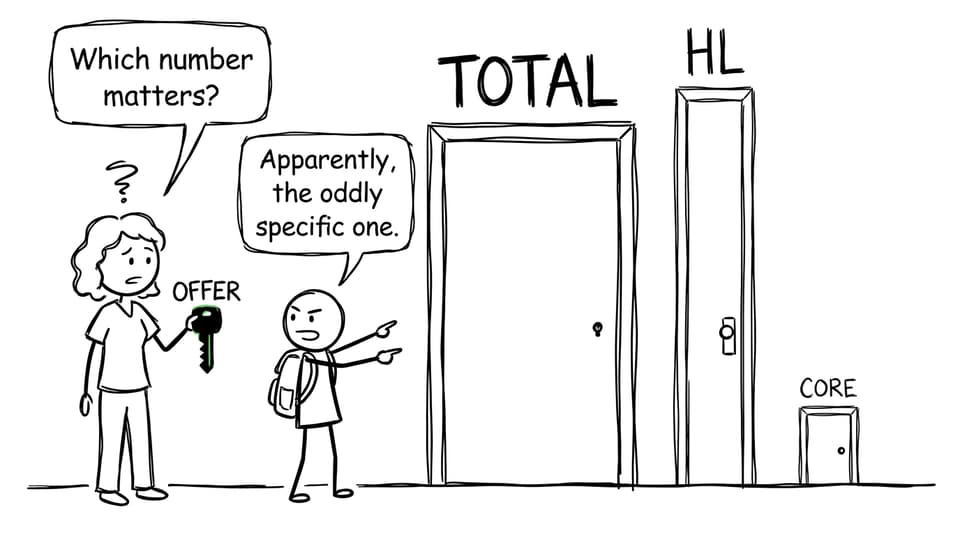
The most common mistake in an IB parent guide is comparing only the predicted total with a university's headline number. Universities may consider several separate elements:
- the overall Diploma score;
- grades across the three HL subjects;
- a particular HL subject required for the course;
- successful completion of the full Diploma;
- other admissions evidence required by the institution.
Imagine a clearly hypothetical offer requiring 36 points overall, with 6 in HL Mathematics. A prediction of 37 may look comfortably above the requirement, but a predicted 5 in HL Mathematics would still leave a subject-specific gap. Conversely, a lower total does not mean every part of the academic profile is weak.
UCAS explains that institutions use predicted grades alongside other application information and may use them differently. Achieved results are considered later when final decisions are made. Families should therefore copy the current requirements directly from each university's official course page and compare them line by line.
For more detail, read how predicted grades affect conditional offers and what happens when an IB university offer depends on final results.
Questions to ask the school before drawing conclusions
A useful conversation is specific and calm. Instead of asking, "Why is this grade so low?", try:
- What evidence contributed most to this prediction?
- Is this a working forecast or the grade used for applications?
- Which assessment criteria are currently limiting the grade?
- Has recent progress been included?
- What would stronger performance look like in the next assessed task?
- Does the school have a review process, and what evidence would it require?
Policies on sharing and reviewing predictions differ among schools. Avoid promising your child that a grade will be changed. The better aim is to understand the evidence, correct any factual errors, and leave the meeting with a measurable plan.
Predicted grades can make students feel as though adults are discussing their future over their heads. Include your child in the conversation. They often know whether the issue is missing knowledge, timing, command terms, inconsistent revision, or unfinished coursework.
What to do when predicted grades look low
A low forecast deserves attention, but panic is rarely informative. Begin by separating the problem into three categories.
First, check accuracy. Confirm subjects, levels, totals, core points, and whether the correct assessment evidence was considered.
Second, check university fit. Compare the prediction with a balanced list of current course requirements. Include realistic options as well as ambitious ones. A forecast below one course threshold is not a verdict on the student's entire university future.
Third, close the performance gap. Ask each relevant teacher for the two or three most important weaknesses. Convert broad advice such as "improve analysis" into observable actions: write clearer claims, use evidence more precisely, answer the command term, or complete timed responses within the allocated period.
Revision should then follow a diagnostic loop:
- Attempt exam-style questions under appropriate conditions.
- Mark the work and classify each lost mark.
- Review only the underlying topic or skill.
- attempt a similar question again.
- Track whether the error disappears.
RevisionDojo's guide to studying for IB exams step by step and its advice on preparing for IB mocks without burning out can help turn that loop into a sustainable routine.
How parents can support improvement without taking control
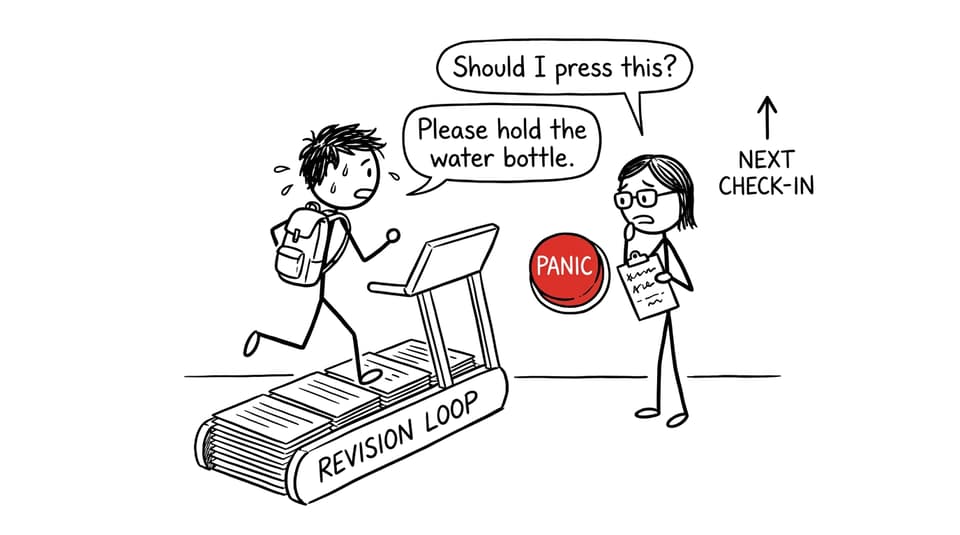
The parent's most useful role is not to become another examiner. It is to help make consistent preparation possible.
Agree on one weekly check-in rather than asking about grades every evening. Let your child identify the priority subjects. Help protect sleep, a workable study space, and reasonable boundaries around distractions. Ask what support would remove friction, then allow the student to own the work.
If a predicted grade looks low, RevisionDojo provides a concrete alternative to waiting and hoping. Students can diagnose weaknesses with the Questionbank, rebuild understanding through Study Notes, and strengthen recall using Flashcards. AI Chat can clarify a stubborn concept, while Grading tools help students examine how their responses align with expectations.
As confidence improves, Predicted Papers and Mock Exams provide timed practice. The Coursework Library can help students understand the qualities of strong academic work, while Tutors offer focused human guidance when a weakness is difficult to diagnose alone. The RevisionDojo approach to smarter IB exam preparation brings these tools into one deliberate cycle.
Read the forecast, then act on it
Predicted grades matter because they can shape application choices and highlight academic risk. But their real value is not that they tell the future. It is that they make the present more visible.
Read the subject pattern before the total. Check HL requirements before assuming an offer is within reach. Clarify the evidence with the school. Then turn every meaningful gap into a small, testable revision goal.
A forecast becomes frightening when it feels fixed. Once it becomes a plan, it becomes useful. RevisionDojo helps your child make that shift with targeted practice, clear feedback, and the complete set of IB resources needed to move toward final examinations with purpose rather than hope alone.