
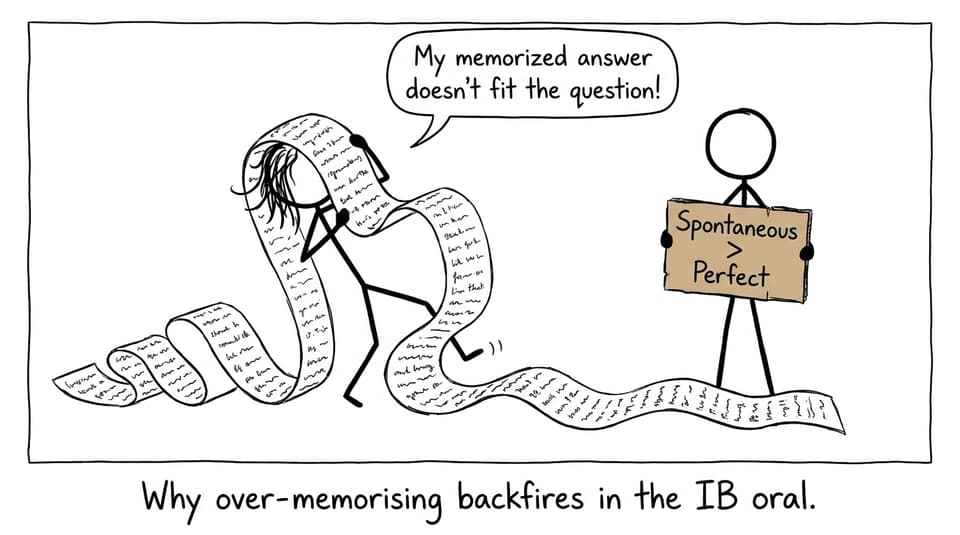
The night before my first serious mock, I tried to rehearse my “perfect” Chinese. I had lines that sounded advanced, transitions that felt elegant, even a neat ending.
Then my teacher asked one follow-up question.
My script didn’t break dramatically. It just… didn’t fit. And in that small mismatch is the real lesson of IB Languages orals: the students who score highest aren’t the ones with the fanciest memorised paragraphs. They’re the ones who can stay calm, think on their feet, and keep building meaning when the conversation turns.
This guide shows you how to prepare for the IB Chinese B Individual Oral (IO) with structure, flexibility, and realistic practice. If you treat the IO like a skill you train (not a performance you survive), it becomes one of the more controllable parts of IB Languages.
Quick checklist for the IB Chinese B Individual Oral
Keep this list somewhere visible while you revise IB Languages speaking:
-
Weighting: 25% of your final grade
-
Total speaking time: 12-15 minutes
-
Core flow: stimulus presentation → follow-up discussion → general conversation
-
Every idea must connect to one of the five prescribed themes
-
You are assessed on: language, message, and interactive skills
-
Your best daily habit: 10 minutes of describing + analysing one image
For a bigger resource stack (not just oral), see Best Resources for IB Chinese B Students.
Understand the format (so your nerves shrink)
The IO feels intense partly because it’s timed and recorded, and partly because it’s one of the only moments in IB Languages where you can’t hide behind drafting.
Here’s what you’re training for:
The stimulus presentation (3-4 minutes)
You describe and interpret a visual stimulus linked to a prescribed theme. Strong presentations move in layers:
-
What you literally see (clear, efficient description)
-
What it suggests (interpretation)
-
Why it matters (theme + cultural context)
-
What you think (a controlled personal response)
The follow-up discussion (4-5 minutes)
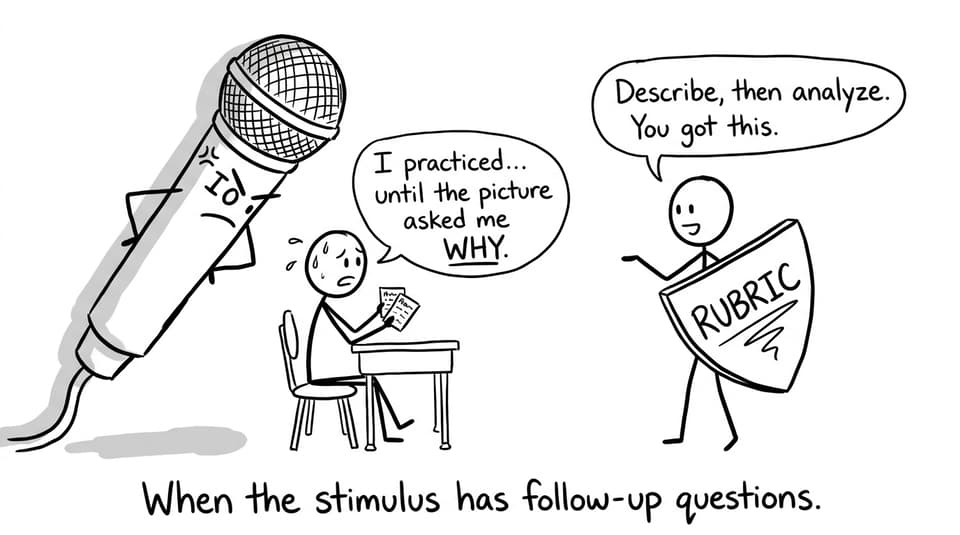
The teacher/examiner asks questions based on what you said. This is where many marks are won in IB Languages: you show you can extend ideas, clarify, compare, and bring in examples.
The general conversation (5-6 minutes)
The conversation shifts to other themes. This section rewards range and spontaneity: can you keep talking thoughtfully when the topic changes?
If you want the broader exam map across Language B, read IB Language B Exams: Format, Timing, Strategy.
What the examiner is really listening for
In IB Languages, oral marks rarely disappear because of one wrong word. They disappear because the student stops building meaning.
Criterion A: Language
Accuracy, fluency, vocabulary range, grammar variety, pronunciation and clarity. “Range” doesn’t mean obscure words; it means you can express the same idea in more than one way.
Criterion B: Message
Relevance, clarity, and depth. Your answer should develop, not just label. The best speakers constantly explain cause, effect, and significance.
Criterion C: Interactive skills
How naturally you handle questions, maintain the exchange, and repair communication. This is where smart fillers and “repair phrases” save scores.
For common pitfalls (and fixes), keep IB Chinese B Oral Exam: Common Mistakes and How to Avoid Them open during practice.
The IB Languages method: prepare tools, not scripts
A memorised speech is comforting until the examiner nudges the conversation 5 degrees to the left. Then it becomes a trap.
Instead, build a “toolkit” you can reuse across stimuli and themes:
A simple presentation frame you can repeat
Try this rhythm:
-
Scene: What is happening? Who is involved?
-
Message: What is the photo/poster suggesting or criticising?
-
Theme link: Which prescribed theme fits best, and why?
-
Culture + global angle: Where do you see this in Chinese-speaking contexts, and what wider issue does it connect to?
-
Personal reflection: What do you think, and what example can you give?
This structure keeps your IO coherent even when your vocabulary isn’t perfect, which is exactly what strong IB Languages strategy looks like.
Use PEE to expand answers under pressure
When you’re asked a question, avoid stopping at one sentence.
-
Point: answer directly
-
Evidence: give an example (personal, school, news, social media)
-
Explain: why it matters, consequences, comparison
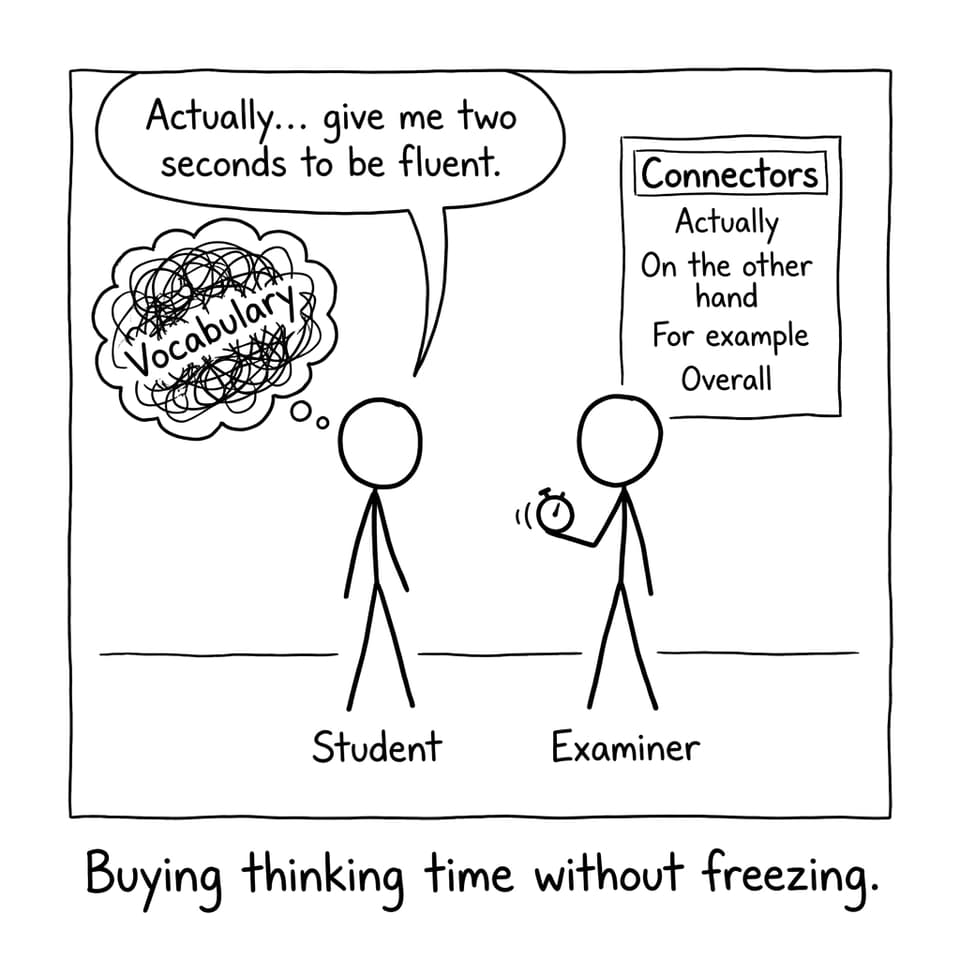
Learn “thinking time” language (so silence disappears)
In Mandarin, it’s normal to pause thoughtfully, but in an exam silence feels louder than it is. Keep a short list of phrases that buy you time while sounding natural:
-
我觉得…
-
其实…
-
从另一个角度来看…
-
更具体一点说…
-
总的来说…
For speaking development routines, use How to Improve Speaking in IB Chinese B.
Train theme fluency (the fastest way to sound “advanced”)
Most students revise vocabulary as single words. High scorers in IB Languages revise vocabulary as theme-ready ideas.
Start by mastering the five prescribed themes, then attach “mini examples” to each.
Use this overview: The Five Core Themes of IB Chinese B Explained.
A practical trick: build one flexible example per theme that you can adapt.
-
Identities: healthy living, family expectations, social media image
-
Experiences: travel, school life, volunteering, sports
-
Human ingenuity: AI tools, online learning, digital privacy
-
Social organization: education pressure, community rules, public services
-
Sharing the planet: recycling habits, climate policy, consumer choices
On RevisionDojo, you can turn these into Flashcards and drill them with AI Chat so follow-up questions feel less unpredictable.
A 10-day practice plan that actually changes your score
This plan is short on purpose. IB Languages improves through repetition, not heroic weekends.
Days 1-3: stimulus reps
-
Pick one random image daily
-
Speak for 2 minutes describing + 2 minutes interpreting
-
Add one theme link and one cultural reference
Days 4-6: discussion reps
-
Ask a friend to be examiner (or use AI Chat)
-
Do 6 follow-up questions per stimulus
-
Force yourself to answer with PEE every time
For peer setups, follow IB Chinese B Oral Exam: How to Practice with Peers.
Days 7-9: full IO simulations
-
Run a timed 12-15 minute simulation
-
Record it
-
Note three recurring issues (vocab gaps, grammar pattern, fillers, pacing)
Day 10: tighten and repeat
Repeat a simulation using the same theme but a new stimulus. The goal isn’t novelty. It’s smoother control.
For a wider set of oral-focused posts, browse IB Languages Posts.
How RevisionDojo supports IB Languages oral prep
When students say “I don’t know how to practise speaking,” they usually mean: “I can’t see what good looks like.” RevisionDojo fixes that.
-
Use the Questionbank to practise theme-based prompts that force expansion: start at Questionbank
-
Build your Chinese B workflow from one hub: IB Chinese B Resources
-
Create fast vocab loops with Flashcards, then pressure-test them with AI Chat follow-ups
-
Run realistic oral routines alongside Study Notes so your ideas stay syllabus-aligned
-
When exams get close, use Mock Exams and Predicted Papers to rehearse timing and stress management (without turning practice into panic)
-
If you need targeted help, RevisionDojo Tutors can diagnose the exact habit that’s capping your oral score
Closing: make the IO predictable
The IB Chinese B Individual Oral feels like a spotlight. But preparation turns that spotlight into a desk lamp: still bright, just no longer frightening.
If you want to improve faster, build your IB Languages oral routine on RevisionDojo: practise with the Questionbank, lock in key phrases with Flashcards, rehearse follow-ups with AI Chat, and run full simulations with Mock Exams and Predicted Papers. Then walk into the IO knowing you don’t need a perfect script. You need a reliable voice.