

If you have ever sat down to practice IB Math and thought, “I’ll just do a bunch of questions,” you have already met the trap.
It feels productive. Pages fill up. Time passes. But on exam day, the same question style shows up with slightly different wording and your brain freezes anyway.
Strategic IB question practice is the quiet difference between “I’ve seen this before” and “I know what to do next.” It is not about doing more problems. It is about building a repeatable loop: choose the right questions, practice them the right way, and review them until the mistake stops being yours.
RevisionDojo is built for exactly that loop: Questionbank, Study Notes, Flashcards, AI Chat, Mock Exams, Predicted Papers, Grading tools, a Coursework Library, and Tutors when you want a human to check your thinking.
A quick checklist for strategic IB Math practice
Before you start your next IB session, confirm these five things:
-
You know your course and level (AA or AI, SL or HL).
-
You can name your weakest two topics right now.
-
You have a place to record mistakes (an error log).
-
You practice both untimed (learning) and timed (performance).
-
You review and reattempt questions, not just mark and move on.
If you want an all-in-one workflow that supports this, start at the main RevisionDojo home page and build from there.
Why strategic IB practice beats doing random questions
Random practice gives you comfort. Strategic IB practice gives you control.
In the IB exams, marks are not awarded for “having tried lots of questions before.” They are awarded for structured working, correct method, and clear communication under time pressure.
When your practice is strategic, three things change:
-
You start recognizing recurring question frameworks (the exam is more patterned than it looks).
-
You reduce avoidable errors because your review process catches them early.
-
You get faster, because speed is usually a byproduct of familiarity and clean method.
This is why RevisionDojo’s How to Use the Questionbank for Targeted Math Revision matters: it trains you to practice in a way the exam rewards.
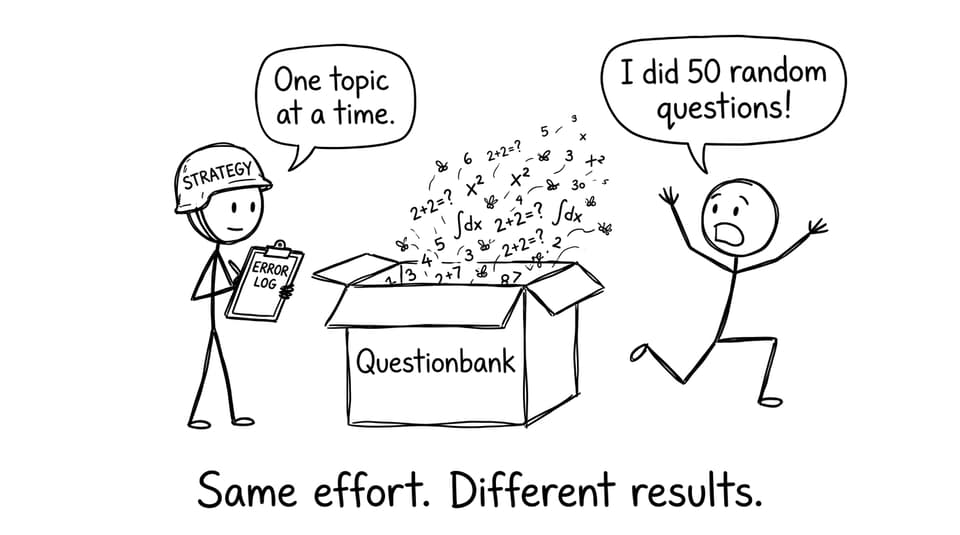
Start with topic-based drilling (then earn the right to mix)
The fastest way to improve your IB Math score is usually boring: stay in one topic long enough that your mistakes become predictable.
Pick one topic block and stay there for 30--45 minutes. For example:
-
Calculus
-
Functions
-
Geometry and trigonometry
-
Statistics and probability
On RevisionDojo, you can go straight into a topic-specific Questionbank and keep your practice clean:
Once you can answer most medium questions in that topic without “blank-page time,” then mix topics. Mixing too early is like scrimmaging before you learn how to pass.
Use the Learn --> Apply --> Review loop (every time)
This loop is the backbone of strategic IB prep.
Learn: patch the specific gap
Do not reread an entire chapter. Patch exactly what the question exposed.
Use targeted resources like:
-
Subject hubs like IB Math AA
Then lock the key ideas into memory with RevisionDojo Flashcards. In IB Math, forgetting a definition or condition is often the real reason a method collapses.
Apply: practice the same skill in multiple disguises
Do a small set of questions that all test the same underlying move (for example, chain rule setup, regression interpretation, or trig identity manipulation). This is where the Questionbank earns its keep.
If you get stuck, use RevisionDojo’s AI Chat as a tutor-style tool: ask it to identify the step you are missing, or to explain why the markscheme uses a particular line of reasoning.
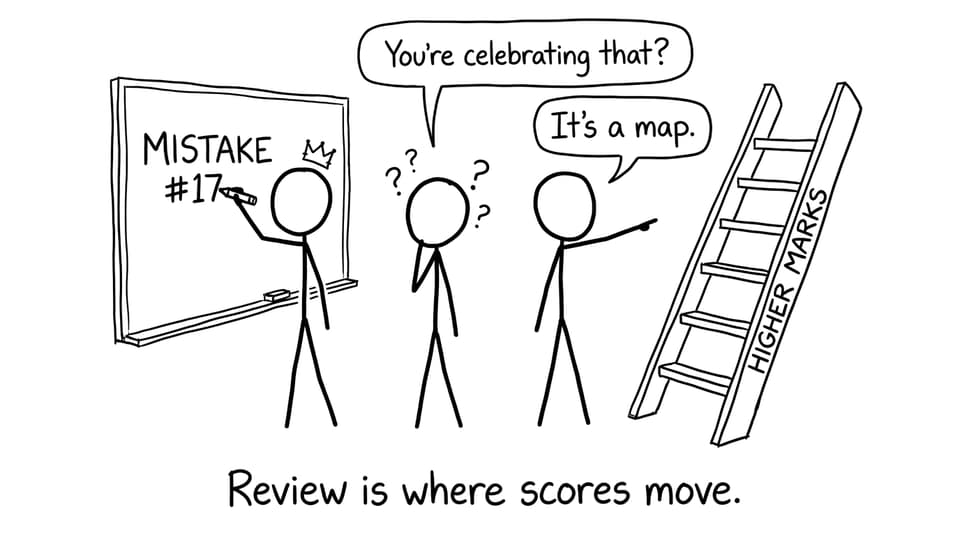
Review: turn each mistake into a rule
Your goal is not to “know the answer.” Your goal is to understand why you missed it.
Write one sentence after each mistake:
-
“Next time I will define variables before substituting.”
-
“Next time I will check domain restrictions before solving.”
-
“Next time I will write the interpretation sentence, not just the value.”
That single sentence is how IB practice becomes exam performance.
Train pattern recognition (because IB questions rhyme)
One of the most underrated IB skills is recognizing what a question is really asking.
Exams recycle structures:
-
A calculus question may look new, but it often tests the same setup steps.
-
A statistics question often pairs calculation with interpretation.
-
A geometry question often hides multiple formulas behind one diagram.
To practice this strategically, do “families” of questions back-to-back. After each one, write the trigger you noticed: a phrase, a diagram cue, a command term.
If you want a structured way to notice repeats, use How to Use Past Questions to Predict IB Math Topics (the point is not prophecy, it is pattern literacy).
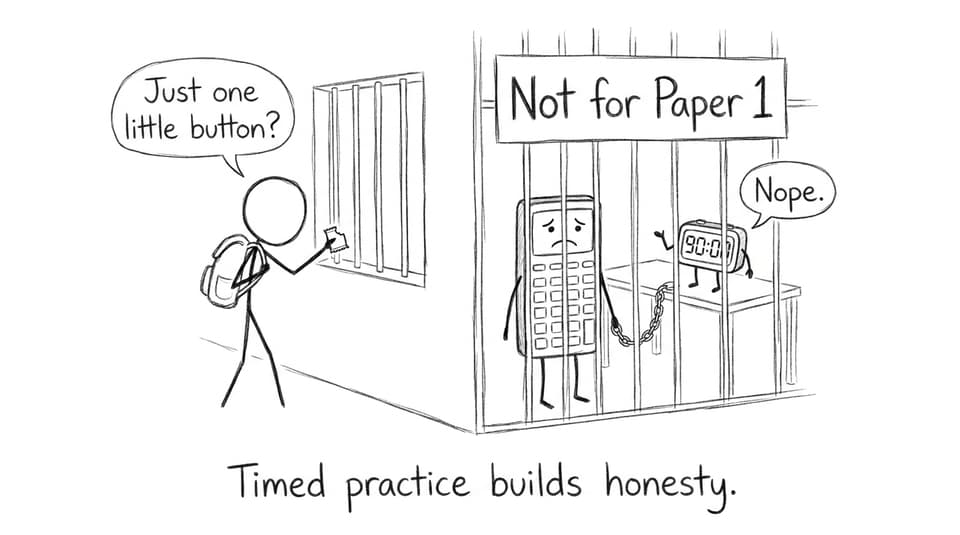
Add timed practice early (but in small, honest doses)
Timed work is where many IB students discover the truth: the issue is not always math, it is time and decision-making.
Start small:
-
15--25 minutes timed on one topic
-
review immediately
-
redo the hardest 2 questions untimed
Then scale up to full exam-style blocks using RevisionDojo’s Mock Exams and Predicted Papers (for realism and stamina) and its Grading tools (to see where method marks leak away).
A helpful companion piece is The Ultimate IB Math Study Routine for Busy Students, because time is usually the real constraint.
Track performance like an experiment
Strategic IB practice is basically this mindset: “What caused the error?” not “Why am I bad at this?”
After each session, record:
-
Accuracy by topic
-
Time per question (roughly)
-
Error type (concept, algebra, interpretation, misread, time)
RevisionDojo’s Questionbank analytics make this easier by showing where you lose marks repeatedly. Then you can build your next session around evidence, not vibes.
Combine questions with flashcards, notes, and feedback
When a question hurts, it is trying to teach you something specific. Capture it.
-
Put the method into Study Notes in your own words.
-
Put the fragile detail into Flashcards (one idea per card).
-
Use AI Chat to explain the markscheme logic, not just the final steps.
-
If your progress stalls, use Tutors to diagnose the deeper issue (often it is not content, it is approach).
And if coursework stress is stealing revision time, the Coursework Library plus Grading tools can reduce the mental load so you can return to IB exam practice with more focus.
A closing plan you can run this week
Strategic IB Math practice is not a personality trait. It is a system.
For the next seven days, run this loop:
-
10 minutes: Flashcards (keep formulas and conditions alive)
-
35--45 minutes: Questionbank on one topic
-
10 minutes: error log + 2 question reattempts
-
once this week: a timed block using Mock Exams or Predicted Papers
If you want one place where that entire IB workflow lives--practice, review, feedback, and realistic exam prep--use RevisionDojo. Start with the Questionbank, build your error log, and let the data tell you what to do next.