

The moment you realize “I know this” isn’t enough
In IB Math, there’s a specific kind of frustration: you understand the idea, you can solve the problem, but the marks slip away because your definition is fuzzy. You write something like “a function is one-to-one when it doesn’t repeat outputs,” and your brain insists that’s basically right. But on an IB paper, “basically” is expensive.
Definitions and theorems are the language the examiner uses to decide whether you’re thinking precisely. The good news: memorizing them isn’t about forcing your brain to store paragraphs. It’s about building a system that makes retrieval automatic.
Quick checklist: your definition-and-theorem memory system
If you want a simple IB-friendly setup, use this checklist:
-
Collect the required definitions and theorems from your course (AA or AI, SL or HL).
-
Confirm you understand each one conceptually before memorizing.
-
Split long statements into “must-say” keywords and supporting phrases.
-
Turn each item into a tight active-recall prompt.
-
Use spaced repetition daily (short sessions beat long ones).
-
Apply the definition/theorem in exam-style questions within 24 hours.
RevisionDojo is built for this workflow: Study Notes to understand, Flashcards to remember, Questionbank to apply, and AI Chat to fix misunderstandings instantly.
Why memorizing matters in IB Math (even if you understand)
The IB rewards accuracy because math is a discipline of exact claims. A definition isn’t a vibe; it’s a contract. A theorem isn’t a hint; it’s a tool with conditions.
When you memorize definitions and theorems well, you:
-
write solutions with cleaner logic and fewer “hand-wavy” leaps,
-
spot which method fits faster (because you recognize conditions),
-
earn straightforward marks on “state/define/show” style prompts,
-
protect yourself under stress, when intuition gets noisy.
To keep your revision aligned with your course, start at the Math AA hub: IB Mathematics Analysis and Approaches Resources.
IB Step 1: Understand first, then memorize the exact language
If you try to memorize before understanding, you’ll do what many IB students do: store a sentence-shaped blur. It feels familiar, but it won’t come out clean under pressure.
A better sequence:
-
Translate the statement into plain language.
-
Identify the conditions (the “if” part) and the conclusion (the “then” part).
-
Test it with one example and one non-example.
-
Only then learn the examiner-ready wording.
This is where RevisionDojo’s explanations help: read the relevant section in Mathematics Analysis and Approaches (AA) Notes, then convert the key line into a flashcard.
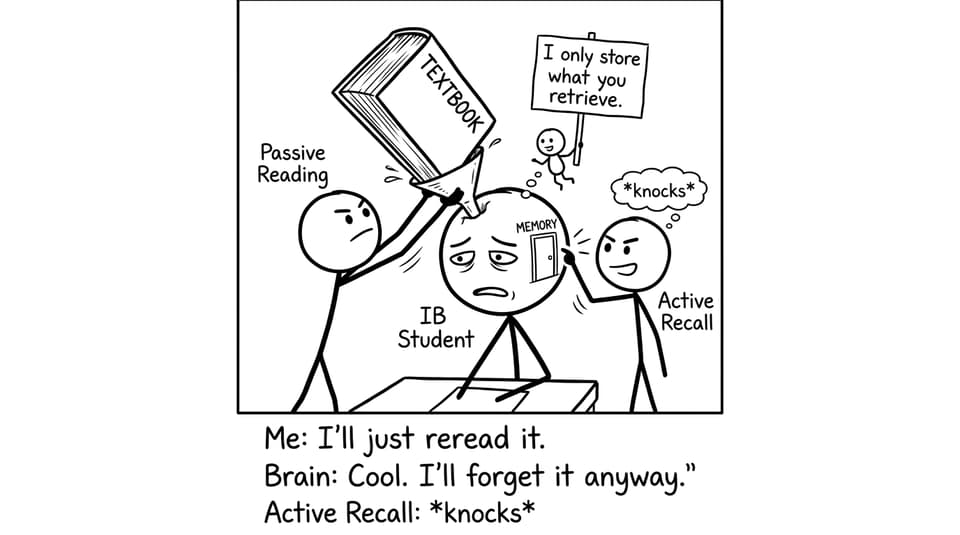
IB Step 2: Make flashcards that force retrieval (not recognition)
A flashcard is only as good as the question on the front. If the front is vague, you’ll recall vaguely. If the front is precise, you’ll practice precision.
Try this structure:
-
Front: “State the definition of a one-to-one (injective) function.”
-
Back: The formal definition, plus one keyword line: “No two different inputs share the same output.”
Or for a theorem:
-
Front: “State the Fundamental Theorem of Calculus (linking derivative and definite integral).”
-
Back: The clean statement, and one micro-example.
Use RevisionDojo’s built-in decks or create your own in: IB Flashcards with Spaced Repetition (SRS).
IB Step 3: Chunk theorems into “keywords you must say”
Many IB definitions and theorems are long because they’re careful. Your job is to find the bones.
Here’s a fast method:
-
Circle quantifiers: “for all,” “there exists,” “unique.”
-
Underline conditions: continuity, differentiability, domain restrictions.
-
Box the result: what the theorem guarantees.
Then create a two-layer recall:
-
Layer 1: the “keywords you must say” list.
-
Layer 2: the full formal sentence.
When you practise, you can grade yourself: did you include every boxed/circled item? That’s how you train exam-ready phrasing for IB marking.
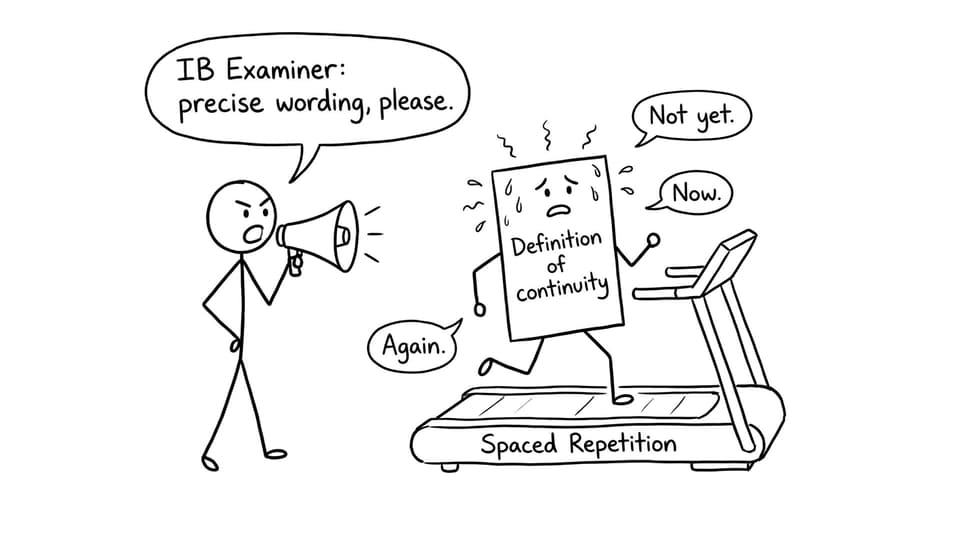
IB Step 4: Use spaced repetition daily, but keep sessions tiny
Consistency beats intensity in IB math memory work. Ten minutes daily compounds quickly because you’re training retrieval, not rereading.
A simple schedule that works:
-
Daily (8-12 min): Flashcards, hardest-first.
-
Every 3 days (10 min): Shuffle review: mixed topics.
-
Weekly (20 min): “Write-out test” from a blank page.
If you want a structured explanation of why this works, read: Spaced Repetition for IB: Scientific Study Method.
IB Step 5: Pair every definition with a one-line example
Definitions stick when your brain knows where they live.
For each definition/theorem, add one line that anchors it:
-
“Continuous at a point” means “Graph has no jump/tear at x=a, and limit matches f(a).”
-
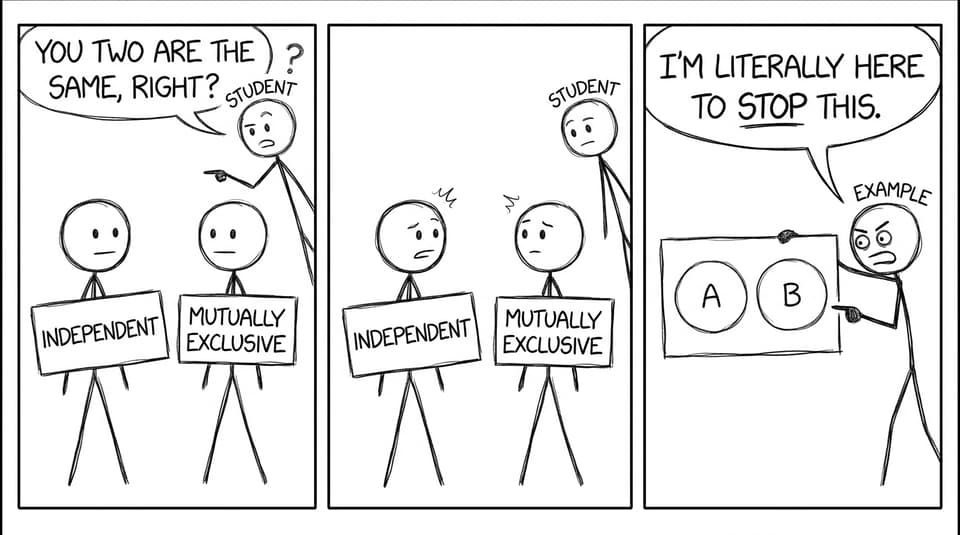
“Independent events” means “Knowing A happened doesn’t change probability of B.”
-
“Dot product” means “Connects algebra to angle using cos(θ).”
When you revise vectors, you can anchor this with topic notes like: Notes for AHL 3.13: Scalar and vector products - IB.
IB Step 6: Apply immediately using exam-style questions
Memorization becomes reliable when you use the definition/theorem the same day. That’s what makes recall “sticky” for IB exams.
A strong loop looks like this:
-
Learn the definition in Flashcards.
-
Read the surrounding explanation in Study Notes.
-
Do 5-10 targeted problems in the Questionbank.
-
Ask AI Chat to correct your phrasing if you miss keywords.
For example, if you’re revising calculus, go straight to: IB Mathematics Analysis and Approaches Topic Calculus Questionbank.
For a broader strategy on practice targeting, see: How to Use the Questionbank for Targeted Math Revision.
A short “definition drill” routine for busy IB weeks
When CAS, IAs, and deadlines pile up, your IB study plan needs to survive real life.
Try this 15-minute routine:
-
3 minutes: Review 10 flashcards (definitions only).
-
7 minutes: Do 2 short questions that force you to state a definition before solving.
-
5 minutes: Write one definition and one theorem from memory, then check.
If you need a realistic weekly structure, borrow from: The Ultimate IB Math Study Routine for Busy Students and Best Study Schedule For IB Math Exams.
Closing: make IB precision feel automatic
The quiet secret of strong IB mathematicians isn’t that they “just remember” everything. It’s that they’ve rehearsed retrieval so often that the correct definition comes out before doubt does.
If you want that calm on exam day, build the loop: understand with RevisionDojo Study Notes, memorize with Flashcards, apply with the Questionbank, clarify with AI Chat, then rehearse under pressure with Mock Exams and Predicted Papers.
Start with your course hub, then build your first deck today: IB Mathematics Analysis and Approaches Resources and IB Flashcards with Spaced Repetition (SRS).