
In the last 12 minutes of an IB Math exam, the room changes.
Pens move faster. Pages flip louder. Someone sighs like they just discovered time is, in fact, real.
What’s strange is that most students don’t run out of math. They run out of minutes. And in IB Math, minutes are marks. If you’ve ever left a question half-finished thinking “I knew this,” you’ve already met the real enemy: unmanaged time.
This guide will help you master time management in IB Math exams with a strategy you can train, measure, and repeat. We’ll keep it practical, with a pacing blueprint you can run inside Exam Mode, plus a feedback loop using RevisionDojo’s Questionbank, Flashcards, AI Chat, grading tools, predicted papers, mock exams, study notes, and even tutors when you need a human to spot patterns you can’t.
The IB Math time-management checklist
If you want the short version first, use this before every timed attempt:
-
Set a time budget (minutes per mark) for the IB paper you’re sitting.
-
Do a 60-second scan and choose your opening questions.
-
Work in “time boxes” per question (with a clear move-on rule).
-
Use two checkpoint times to verify you’re on track.
-
Review using data: time spent, marks earned, mistake type.
To make this automatic, run your practice in RevisionDojo Exam Mode and pair it with targeted drills from the IB Math AA hub.
Build your time budget (and stop guessing)
A calm IB student usually has one quiet advantage: they know their time budget before the first line of working.
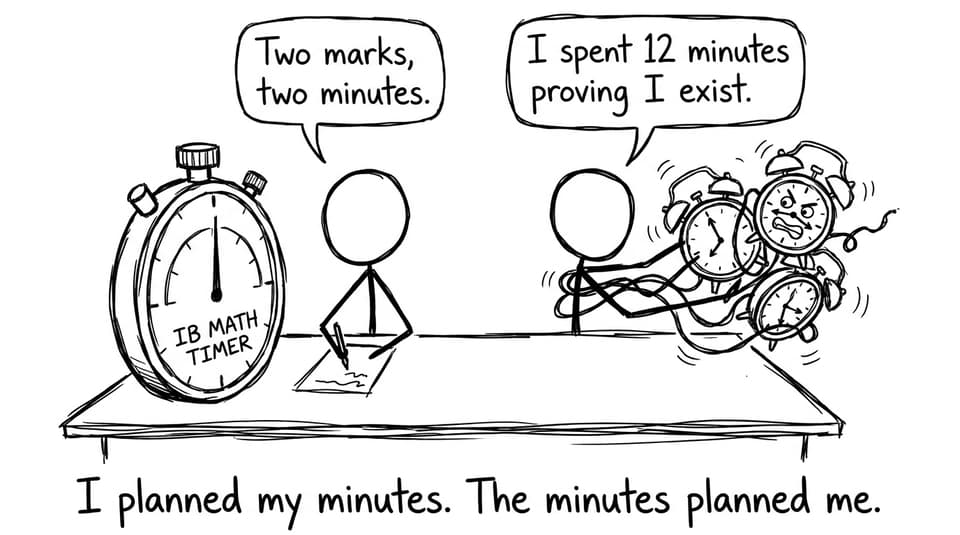
A useful rule is minutes per mark.
-
SL Paper 1 and Paper 2: 90 minutes for 80 marks (about 1.1 min per mark)
-
HL Paper 1 and Paper 2: 120 minutes for 100 marks (about 1.2 min per mark)
So a 6-mark question shouldn’t become a 14-minute documentary about your suffering.
The goal isn’t to obey these numbers perfectly. The goal is to internalize them so your pacing feels normal under pressure. Practising that feeling is exactly what Exam Mode is for: timed conditions, realistic structure, and immediate feedback.
A simple conversion you can write at the top of the paper
-
2 marks: ~2-3 minutes
-
4 marks: ~5 minutes
-
6 marks: ~7 minutes
-
10 marks: ~12 minutes
That tiny map keeps your brain from bargaining with time.
Start with questions that buy you momentum
Many IB students do this without noticing: they start with the hardest question to “get it out of the way.” It feels brave. It’s usually expensive.
Instead, open with familiar, medium-difficulty questions. You’re not avoiding difficulty; you’re investing in rhythm. Early marks settle the nervous system. They also protect you from the worst time-management trap: spending 12 minutes to earn 0 marks.
To train this, build a warm-up set from RevisionDojo’s Questionbank and keep it consistent. For AA students, a focused option is the AA Calculus Questionbank. You can also rotate in AI skills through topic banks like AI Number and Algebra Questionbank.
Use a pacing plan you can actually follow
A pacing plan only works if it’s simple enough to remember when your mind is loud.
Here’s one that fits most IB Math papers:
-
Opening minute: scan and circle “quick wins.”
-
First 60-70% of time: collect marks from medium questions first.
-
Final 20-30%: return to the hardest questions and any blanks.
The hidden benefit: you stop treating the paper like a straight line. It’s more like a loop. You’re allowed to come back.
Train “move on” as a skill, not a personality trait
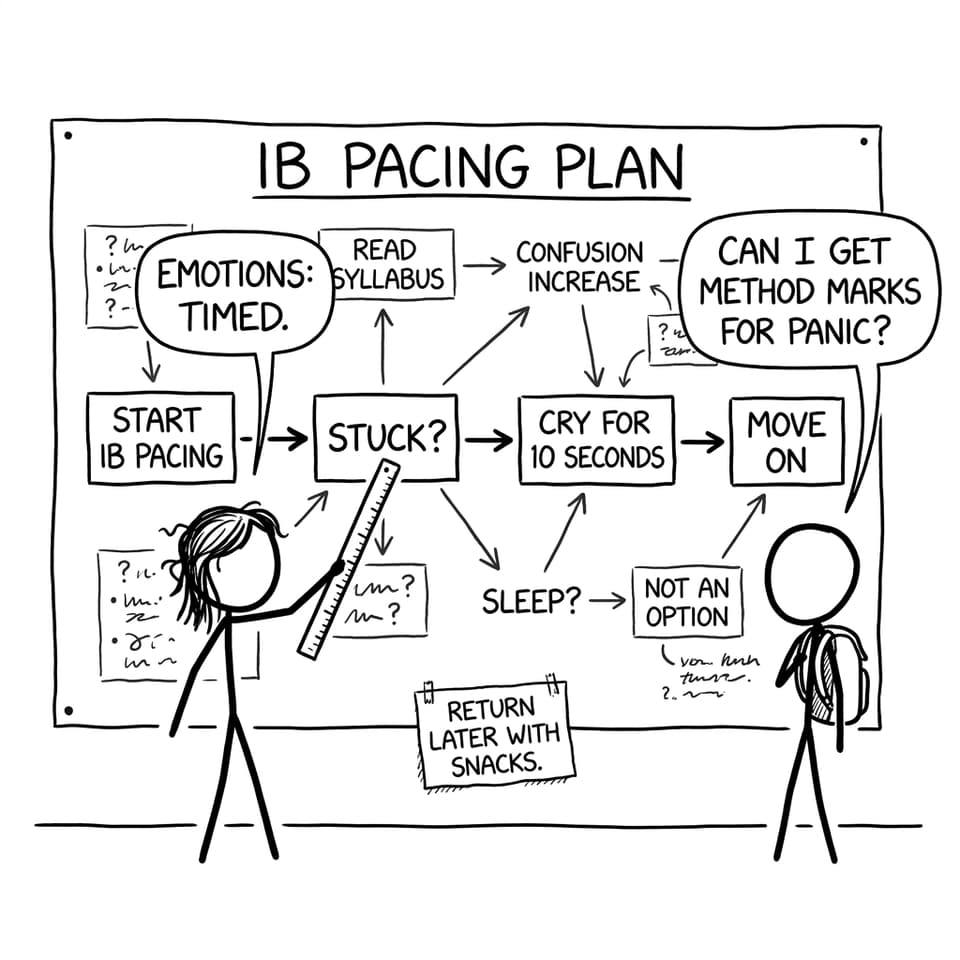
The toughest time-management decision in IB Math is not “Can I solve this?” It’s “Should I keep trying right now?”
Use a rule:
- If you’re stuck for ~90 seconds with no progress, write one useful line (a diagram, a formula, a definition, a first step), then move on.
That one line matters. In IB marking, method marks often live inside those first sensible steps. Then, when you return later, you restart with momentum instead of confusion.
To practise this deliberately, do timed mini-sessions and force the move-on rule. If you need a routine that makes this sustainable alongside other subjects, use The Ultimate IB Math Study Routine for Busy Students.
Use checkpoint timing to catch drift early
Most timing collapses happen quietly. You don’t notice you’re behind until it’s too late.
Add two checkpoints to every IB Math paper:
-
Paper 1 (90 min): check around 25 minutes and 50 minutes
-
Paper 2 (120 min): check around 30 minutes and 75 minutes
At each checkpoint, ask:
-
Am I roughly earning marks at the rate I planned?
-
Did one question steal time without paying it back?
-
What’s the next “smart” mark to chase?
RevisionDojo practice makes this easier because you can simulate full timing with Exam Mode and then review your pacing like a pattern, not a feeling.
Save time with cleaner working (without losing marks)
In IB Math, fast writing is rarely the win. Clean writing is.
A few habits that save minutes while protecting method marks:
-
Use consistent notation so you don’t re-explain yourself.
-
Keep algebra steps readable (tiny leaps create rework).
-
Write the “reason line” only when it earns marks (for example, stating an identity, a theorem, or a substitution).
When you’re unsure what earns marks, train with feedback. RevisionDojo’s Grading tools and Jojo AI-style feedback inside Exam Mode help you see what the markscheme rewards, so you stop spending time on decoration.
If you find that your issue is more “I know it, but I can’t perform under time,” this companion piece helps: How to Transition from Understanding to Exam Performance in IB Math.
Make timing data your coach
The fastest improvement comes from treating timing like data, not drama.
After every timed attempt, record three numbers:
-
Time spent per question
-
Marks earned
-
Mistake type (concept gap, method gap, careless, time panic)
Then fix only one pattern at a time.
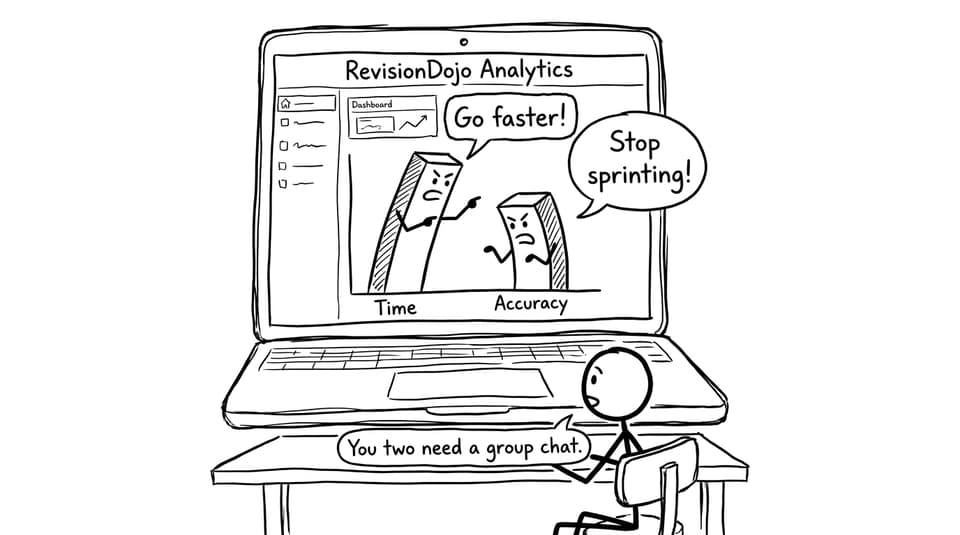
RevisionDojo is built for this loop: practise in the Questionbank, simulate in Exam Mode, review with analytics, then lock the fix with Flashcards. If formulas are slowing you down, use the system directly: How to Use RevisionDojo Flashcards for Formula Mastery and the broader IB Flashcards with Spaced Repetition.
Build endurance the same way you build speed
Speed without stamina collapses in the final third of an IB paper.
Try this three-week ramp:
-
Week 1: 30-45 minute timed blocks
-
Week 2: 60-75 minute blocks
-
Week 3: full-paper timing
Add realism once a week by sitting a full mock-style session. If you want a guided workflow, use How to Use RevisionDojo to Prepare for IB Math Mock Exams. For broader exam rehearsal across subjects, RevisionDojo’s IB Predicted Papers can help you practise timing and decision-making in a full-paper format.
Closing: make IB time management your unfair advantage
Time management in IB Math isn’t a personality trait. It’s trained behavior: budgets, checkpoints, move-on rules, and review loops.
If you want the simplest path, build your routine around one platform that connects everything: targeted practice in the Questionbank, full simulations in Exam Mode, recall reinforcement with Flashcards, quick clarification through AI Chat, deeper feedback with grading tools, predicted papers and mock exams for realism, and tutors when you want a human to tighten your method.
Run one timed session this week. Not to “see how it goes,” but to measure it. That’s how IB Math time management stops being advice and becomes a skill you own.