


IB Math IA Time Management: Finish Calm, Not Rushed
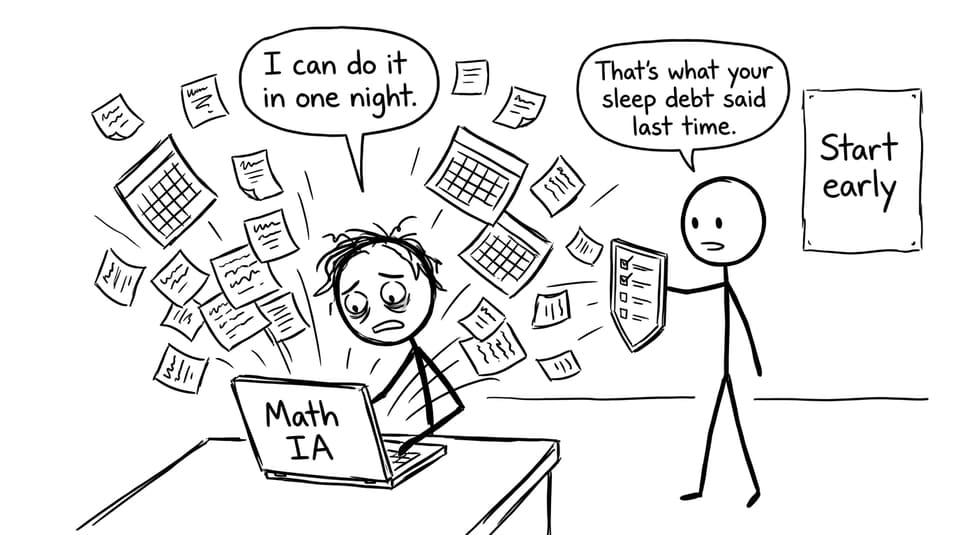
You can usually tell, within the first page, whether an IB Math IA was written in a steady rhythm or in a late-night sprint.
The rushed ones sound like someone narrating while running: definitions are half-explained, graphs are unlabeled, reflection is thin, and the ending arrives like a train door slamming shut.
The calm ones read differently. They have space. They show choices. They admit limits. They revise.
That difference is rarely “talent.” In IB, it’s almost always time management.
A quick IB Math IA time management checklist
Before you do any serious writing, make sure your IB plan includes:
-
A realistic end date (your actual school deadline, not the date you wish you had)
-
6-8 project stages with mini-deadlines
-
A weekly “Math IA slot” you protect like a class period
-
A buffer week for feedback and revision
-
A final day for presentation checks (formatting, labels, citations)
If you want a rubric-aligned overview first, start with IB IA Guides: Internal Assessment Structure, Rubrics & Tools. It’s the fastest way to stop guessing what matters in an IB submission.
Why IB students underestimate the Math IA
The IB Math IA feels small because it’s not an exam paper. There’s no invigilator. No countdown clock. No immediate penalty for going off-task.
But that freedom is exactly why time slips.
A Math IA is really several different jobs hiding inside one document: choosing a question, gathering data, doing math, explaining the math, reflecting on decisions, and presenting it all cleanly. Each job needs a different kind of brain.
So the best IB time management move is simple: plan for context switching. Don’t assume one long session can do everything.
If you’re still deciding between course directions, these hubs can help you orient quickly: IB Mathematics Analysis and Approaches Resources and IB Math AI Internal Assessment: Step-by-Step Guide.
Build a timeline that matches how IAs actually happen
Most schools give roughly 6-8 weeks for an IA window. The trick is not filling those weeks with vague intentions like “work on analysis.” Instead, give each week a single deliverable.
A practical IB timeline looks like this:
Topic and aim (Week 1)
Choose something you can measure and model. You’re not picking “a cool idea.” You’re picking a question you can finish.
If you want a structure-first approach, skim All #IA Posts to see common patterns across strong IAs.
Data collection or setup (Week 2)
Collect your dataset, define variables, decide tools, and document sources. The IB loves clarity here because it makes your later math credible.
For a data-heavy IA, use How to Use RevisionDojo to Prepare for IB Math IA Data Analysis as your “did I miss anything obvious?” check.
First mathematical development (Week 3)
Do the initial calculations, build the model, create early graphs. This week is about producing raw math, not writing perfect paragraphs.
Analysis and interpretation (Week 4)
Now you turn results into meaning. You test assumptions. You compare models. You explain why your approach makes sense.
Reflection and evaluation (Week 5)
Most IB students leave reflection until the end, which makes it generic. Instead, write reflection while your decisions are fresh: why you chose a method, what surprised you, what you’d improve.
Editing, presentation, and submission readiness (Week 6)
This is where your grade quietly rises: consistent notation, labeled figures, readable screenshots, clean citations, and trimmed fluff.
For broader scheduling habits that support this timeline, borrow ideas from Time Management in IB: Tools and Techniques That Actually Work and Best Time Management Techniques for IB Students in 2025.
Use milestones that force progress (not motivation)
Motivation is unreliable in IB season. Milestones are calmer.
Try milestones that produce something visible:
-
“One-page outline with section headings + aim”
-
“Dataset cleaned, with units and variable definitions”
-
“Two graphs, properly labeled, with a short caption each”
-
“Model 1 explained in words, with parameters defined”
-
“Reflection paragraph answering: what did I choose, and what did I sacrifice?”
RevisionDojo makes this easier because you can pair your IA milestones with daily IB revision using the Questionbank, Study Notes, Flashcards, and AI Chat. That combination matters: IA work improves when your underlying math feels automatic.
The 25/5 rule: Pomodoro for IA writing that doesn’t drift
Long sessions invite wandering. Short sessions invite finishing.
Use the Pomodoro method for your IB Math IA:
-
25 minutes: one micro-task (one graph, one paragraph, one calculation chain)
-
5 minutes: step away
-
After 4 cycles: longer break
This stops the common IA trap: spending 90 minutes “working” but only producing three messy sentences.

If you want a full Pomodoro setup for IB math, use How to Revise for IB Math Using the Pomodoro Technique.
Allocate your time like the rubric will
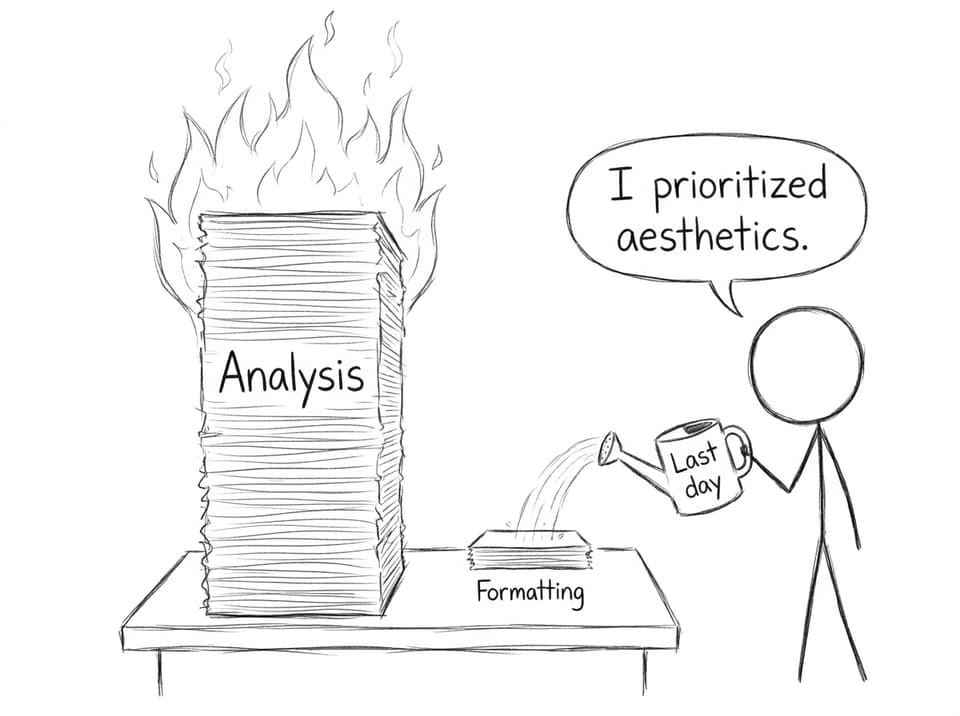
A simple way to manage IB time is proportional effort. Many students over-invest in the introduction and under-invest in analysis and reflection.
A balanced split for an IB Math IA often looks like:
-
Introduction + aim: ~10%
-
Mathematical process + analysis: ~60%
-
Reflection + evaluation: ~20%
-
Formatting + final checks: ~10%
That doesn’t mean the intro is unimportant. It means the IB reward is usually in your math choices, your communication, and your reflection on limitations.
Don’t separate “doing math” from “writing the IA”
Here’s a quiet time management truth: the fastest IA is the one you explain while you solve.
After each chunk of math, immediately write:
-
what you did,
-
why you did it,
-
what the result suggests,
-
and what could go wrong.
In IB terms, that’s mathematical communication plus reflection happening in real time.
When students delay writing, they spend hours later trying to reconstruct thinking they no longer remember. RevisionDojo’s Study Notes and AI Chat are useful here: you can sanity-check explanations, tighten definitions, and keep your narrative mathematically precise without losing your own voice.
Finish your IB Math IA with room to breathe
The goal isn’t to “work harder.” It’s to remove the last-minute chaos that makes good IB students submit work they didn’t mean to write.
Build the timeline. Protect the milestones. Use Pomodoro focus blocks. Leave time for revision.
When you’re ready to turn planning into momentum, use RevisionDojo as your home base: Study Notes for concepts, Flashcards for recall, Questionbank for skill-building, AI Chat for clarity, Grading tools to tighten writing, Predicted Papers and Mock Exams for exam pacing, a Coursework Library for examples, and Tutors when you want a human to challenge your decisions.
Your IB Math IA doesn’t need a heroic final night. It needs a steady month.