


If you have ever opened your IB Math IA draft and felt like it is secretly four mini-projects wearing one cover page, you are not alone. A page of algebra. A page of statistics. A graph that looks convincing. Then a sudden calculus section that arrives like an uninvited guest.
In the IB, that disjointed feeling is often the difference between “I did a lot of math” and “I built an investigation.” Examiners reward the second. And the fastest way to get there is learning how to link mathematical concepts across topics so your IA reads like one coherent argument.
This guide shows you how to create those links on purpose, not by accident, so your IB Math IA feels unified, rigorous, and easy to follow.
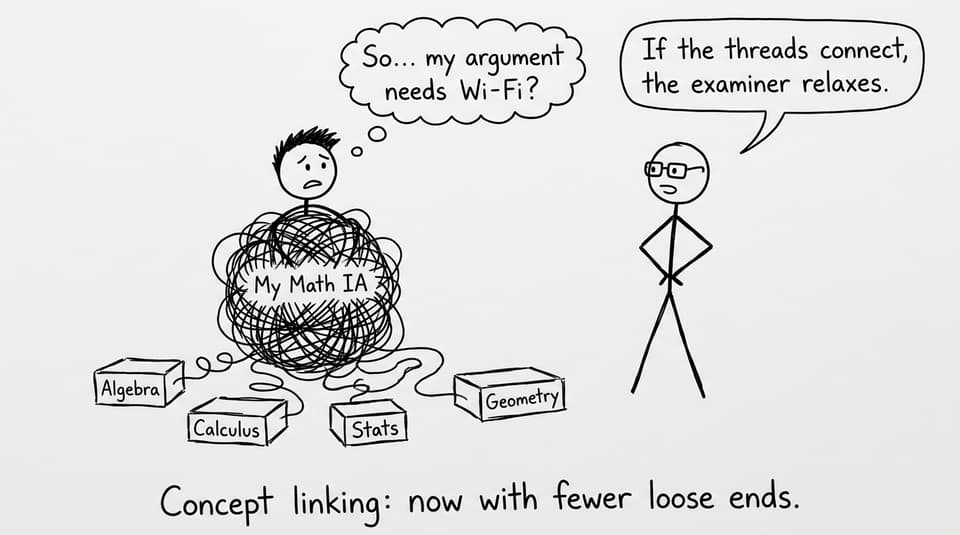
A quick checklist for linking concepts (save this)
Use this before you write a new section in your IB Math IA:
-
Can I name two syllabus areas I am genuinely using (not just mentioning)?
-
Does the second concept solve a problem the first concept cannot?
-
Have I written a 1-2 sentence bridge explaining why I am switching methods?
-
Did I keep notation consistent (variables, units, domains, assumptions)?
-
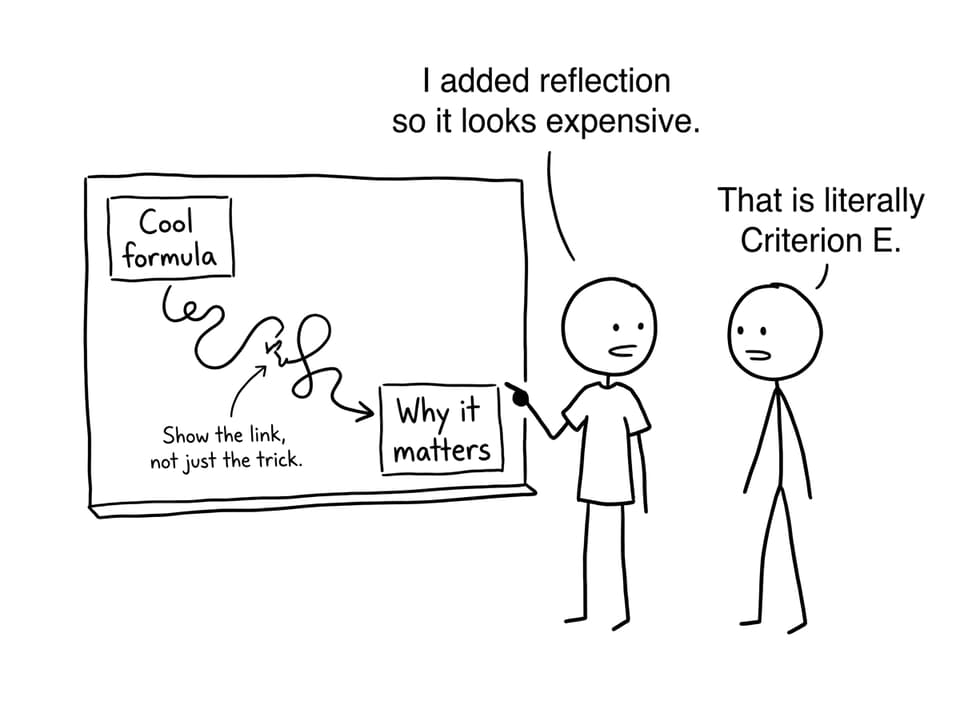
Did I reflect on what the connection reveals (not just what it computes)?
When you want a full structure map, pair this with How to Structure Your IB Math IA Logically.
Why linking concepts signals real IB-level understanding
A strong IB Math IA is not graded like a worksheet. It is graded like a small piece of mathematical writing. That means the marker is tracking your thinking: how you choose tools, justify decisions, interpret results, and evaluate limitations.
Linking concepts across topics does three important things:
-
It shows depth: you can approach one question through multiple lenses.
-
It shows control: you know which method belongs where.
-
It improves communication: the reader sees one storyline, not scattered techniques.
If you are still shaping your exploration question, browsing The Best IB Math IA Topics for 2025 can help you choose topics where linking naturally happens.
Start with a “pairing” that actually fits your aim
The easiest links in an IB Math IA happen when your topic creates a genuine need for a second tool. Here are pairings that often work because each method covers a different weakness.
Modeling + calculus (to optimize)
You build a model (function) from data or assumptions, then use differentiation to find maxima/minima or rates.
Example storyline: “A function describes the relationship. Calculus identifies the best-case outcome.”
Skill refreshers can come from IB Mathematics Analysis and Approaches Resources and targeted practice like the IB Math AA Calculus Questionbank.
Statistics + algebra (to validate)
Regression gives an empirical model; algebra helps you interpret parameters and test reasonableness.
Example storyline: “The data suggests a form. Algebra explains what the parameters mean in context.”
Geometry + probability (to model space)
A geometric diagram defines the sample space; probability formalizes the outcomes.
Example storyline: “Geometry defines what is possible. Probability quantifies how likely.”
The key is that your IB Math IA pairing must feel like cause and effect: method A creates a question that method B answers.
Write the bridge sentence before you do the next page of math
Most weak links are not mathematical. They are literary. The reader is not told why the method changes.
Before you introduce a new concept in your IB draft, write a short “handoff.” It should do two jobs:
-
Identify the limitation of the current approach
-
State what the next approach will unlock
A template you can adapt:
“While ____ models/describes ____, it does not allow me to ____. To address this, I will use ____ to ____.”
If your introduction itself is still shaky, use Write a Perfect Introduction for Your IB Math IA to set up the whole chain of reasoning early.
Use one concept to check another (the “two flashlights” method)
A surprisingly persuasive move in an IB Math IA is not doing harder math. It is doing confirming math.
Think of it like using two flashlights from different angles to see the same object. If both beams land in the same place, your argument feels stable.
Ways to validate across topics:
-
Graphical vs algebraic: solve for intersections algebraically, then confirm with a graph and discuss discrepancies.
-
Regression vs theory: fit a curve statistically, then derive a theoretical form and compare parameters.
-
Numerical vs analytic: approximate with technology, then justify with symbolic steps.
RevisionDojo supports this workflow naturally: use Study Notes to relearn the method, Flashcards for quick retrieval, then the Questionbank to pressure-test it under exam-style conditions. If you are revising broadly alongside IA work, How to Review Each IB Math Topic in 15 Minutes is a useful routine.
Make your links visible with a small concept map
You do not need a fancy diagram. A simple box-and-arrow map can dramatically improve readability in an IB Math IA.
Try this:
-
Box 1: Define variables + assumptions
-
Box 2: Model choice (function/regression/distribution)
-
Box 3: Transformation (linearization/logs/standardization)
-
Box 4: Calculus or optimization (if relevant)
-
Box 5: Evaluation (limitations, sensitivity, alternative models)
The map forces you to justify the sequence. It also prevents the most common IB mistake: adding a topic “because it looks advanced.”
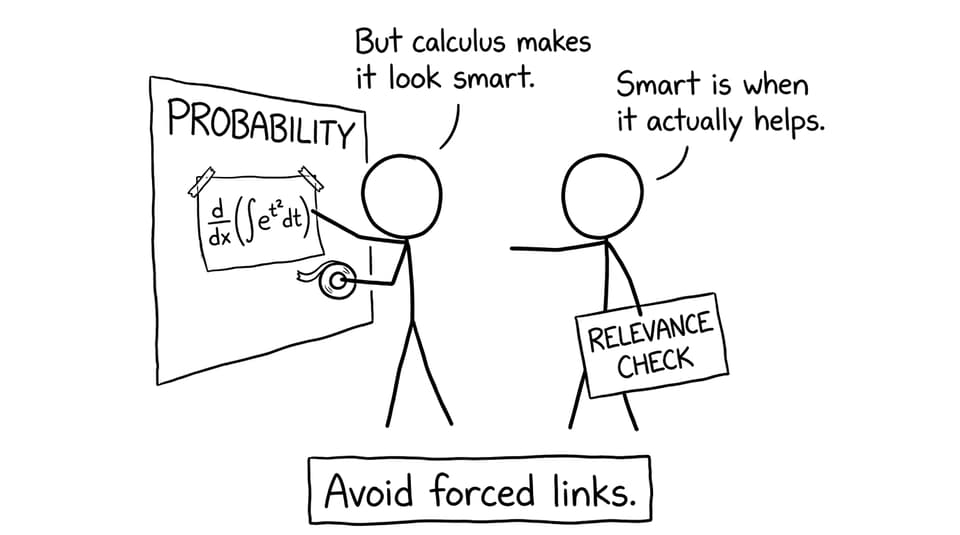
Avoid forced links (examiners can smell them)
In every IB cohort, someone adds calculus to a statistics investigation for vibes. The marker will not be impressed. They will ask: what did this add?
A link is forced when:
-
the second method does not change your conclusion
-
you cannot explain the transition in plain language
-
you added it after finishing, instead of needing it during the investigation
When you want a sanity check, follow the rubric-driven process in How to Write a Top-Scoring Math IA (2025 Guide) and, if you want external feedback on alignment, use RevisionDojo’s Grading tools like the IB Maths AI IA Grader.
Closing: make your IB Math IA feel like one story
The best IB Math IA is not the one with the most techniques. It is the one where every technique feels inevitable: algebra leads to a model, the model invites statistics, the statistics raises a question, calculus answers it, and reflection ties the whole chain back to your aim.
If you want to build that kind of connected investigation, RevisionDojo is designed for the full loop: Study Notes to learn, Flashcards to remember, the Questionbank to practice, AI Chat to unblock your writing, Grading tools to stay rubric-aligned, and exemplars inside the Coursework Library to calibrate what “good” looks like.
Keep it coherent. Keep it honest. And make the links do real work; that is what IB rewards.