

If you have ever stared at a blank page titled Introduction and felt oddly judged by the cursor, you are not alone. In IB Math, your Internal Assessment is one of the few places where the examiner meets your thinking before they meet your mathematics. And that first meeting matters. A strong introduction does not try to impress with complexity. It quietly proves you have a clear direction, a reason for exploring it, and a plan you can actually execute.
In other words: a great IB Math IA introduction is not a warm-up. It is the steering wheel.
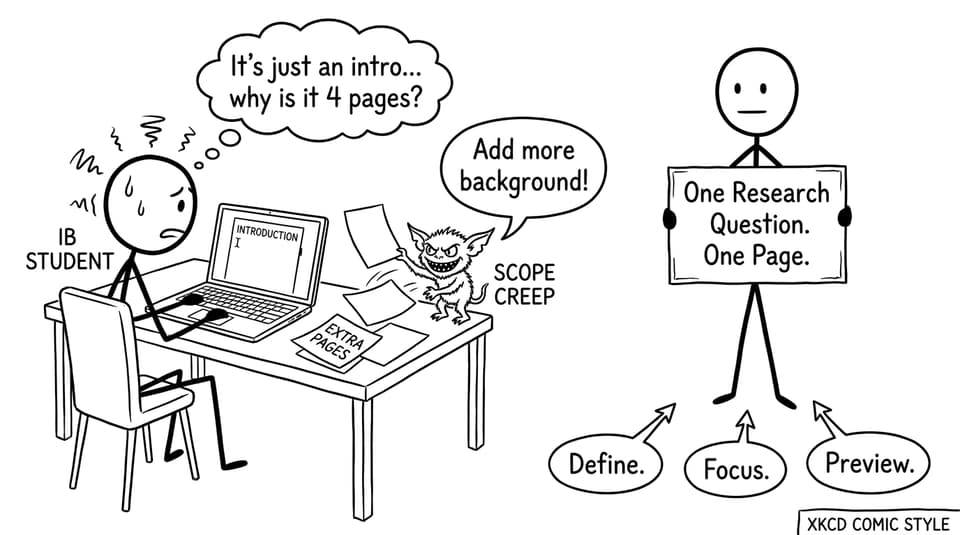
Quick checklist for a high-scoring IB Math IA introduction
Before you move into your calculations, make sure your IB Math IA introduction includes:
-
A hook that makes your exploration feel purposeful (not random)
-
A short personal rationale that signals genuine engagement
-
Just enough background to orient a reader who is not inside your head
-
A focused research question (RQ) you can answer within the IA scope
-
A brief preview of your mathematical approach (methods, tools, data)
If you want model structures to compare against, skim How to Structure the IB Math IA for Maximum Clarity and keep it open while drafting.
Why the IB Math IA introduction earns marks (even before the math starts)
Examiners do not award points for enthusiasm, but they do reward control. In IB Math, your introduction signals that control by making your exploration easy to follow. When you frame the aim clearly, your mathematical communication becomes smoother and your personal engagement becomes believable instead of performative.
It also prevents the most common IA problem: writing yourself into a corner. A tight introduction forces you to choose a manageable question and a sensible method early, which makes the rest of the report far easier to execute.
For an examiner-focused lens, it helps to read IA Introduction Structure: A Step-by-Step Guide and borrow its “map” mindset.
Five key elements of a top-mark IB Math IA introduction
Start with a hook that earns attention (not drama)
A hook is not a gimmick. In IB Math, the best hooks do one job: they show the question lives somewhere real. That “real” can be a hobby, a pattern you noticed, a dataset you can access, or a practical decision someone might make.
Try openings like:
-
A small observation that leads naturally to modelling
-
A contradiction you want to resolve (two methods give different predictions)
-
A surprising pattern in data you collected
Keep it short. Your goal is curiosity plus direction.
Show personal motivation in one clean paragraph
Personal engagement is strongest when it is specific and restrained. One paragraph is enough to explain why you chose this investigation and why it matters to you.
A reliable template:
-
“I noticed/experienced X…”
-
“This made me wonder Y…”
-
“So I chose to investigate Z using mathematics.”
If you are still choosing a topic, scan IB Math IA Ideas (AA & AI) or High-Scoring Math IA Ideas and pick something with clear variables and accessible data.
Provide only the background the reader truly needs
Background is where many IB Math IAs quietly lose clarity. The introduction is not your full theory chapter. It is the minimum context that prevents confusion.
A good rule: define terms you will use immediately, and postpone heavy derivations until your mathematical development. If you mention logarithmic scales, define them. If you reference regression, state what you will regress and why.
RevisionDojo helps here because you can quickly refresh definitions with IB Mathematics Analysis and Approaches Resources or IB Mathematics Applications & Interpretation Resources before you write.
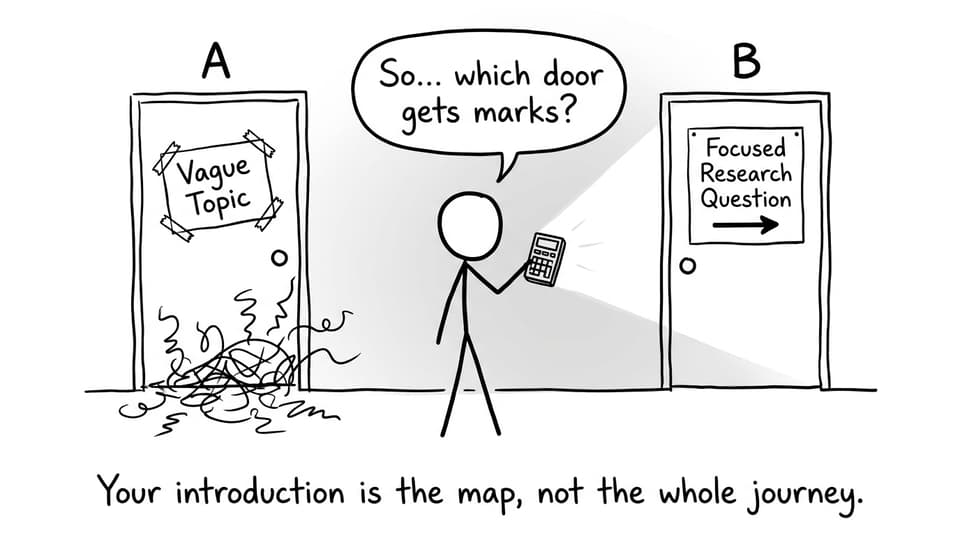
State a focused research question that you can actually answer
Your research question should be:
-
Specific (variables clearly named)
-
Mathematical (not just descriptive)
-
Manageable (fits 12-20 pages without rushing)
Examples of stronger framing:
-
“To what extent does a quadratic model predict ___ as ___ changes?”
-
“How accurately does ___ distribution model ___ in this dataset?”
A fast test: if you cannot imagine what your graphs/tables will look like, the question is likely too vague.
Preview your mathematical approach like a promise you will keep
End the introduction by telling the examiner what is coming. Mention the tools you plan to use (e.g., optimisation, calculus, regression, probability), what data you will use, and how you will judge success (error measures, residuals, comparison between models).
If you want to tighten your skills before committing to a method, build targeted practice using How to Use the Questionbank for Targeted Math Revision. That practice often reveals whether your chosen method is realistic for your level.

Common introduction mistakes (and the quick fix)
-
Mistake: Writing a “topic overview” instead of an investigation setup
Fix: Add an explicit aim, RQ, and method preview. -
Mistake: Too much theory too soon
Fix: Define only what you use immediately; move the rest to development. -
Mistake: RQ is broad (“explore the golden ratio in nature”)
Fix: Choose one dataset, one measurable variable, one model.
Closing: write the intro that makes the rest easier
A high-mark IB Math IA introduction is calm. It does not try to win the whole grade in the first paragraph. It simply proves you are investigating a real question, for a real reason, with a method that fits.
When you are ready to draft, use RevisionDojo as your support system: explore exemplars and guidance via IB IA Guides, strengthen your technique with the Questionbank, lock in memory with Flashcards, and sanity-check your plan with AI Chat and grading tools. The goal is not just to write a nicer opening. It is to build an IB Math IA that feels inevitable from the first line to the last.