

Math revision usually turns boring in a specific moment.
It’s not when you first open your notebook. It’s five minutes later, when you realize you’re reading the same explanation of integration for the third time, and nothing in your brain feels more certain. The work is technically happening, but you aren’t.
If you’re an IB student preparing for exams, that moment matters. Because what decides your final results often isn’t raw intelligence. It’s whether you can keep showing up when the novelty wears off.
This guide is about doing exactly that: keeping IB Math revision fun and engaging without turning it into a distraction. You’ll use simple “game mechanics” (quests, streaks, levels, challenges) and pair them with RevisionDojo’s tools so your study sessions feel lighter while your understanding gets heavier.
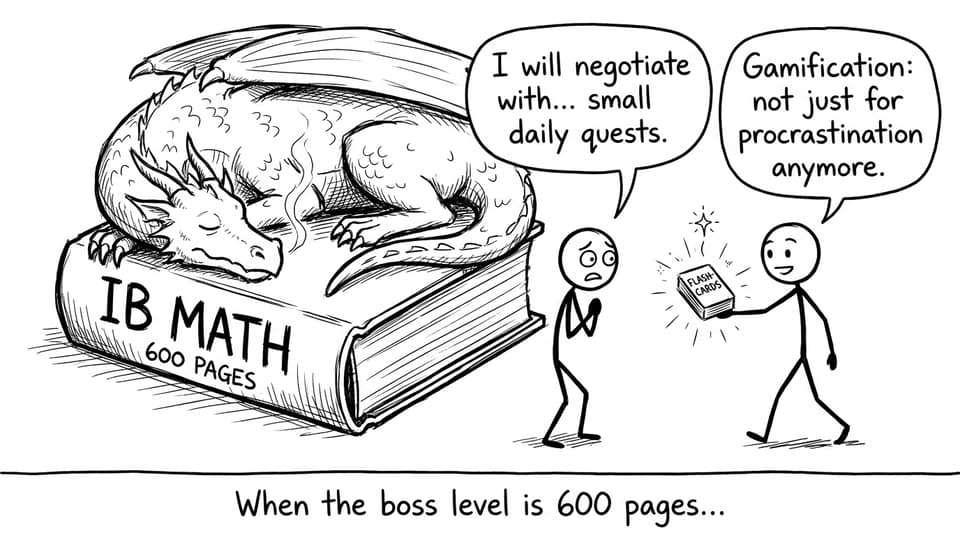
Quick checklist: make IB math revision fun (and still serious)
Use this as your reset when motivation dips:
-
Pick one micro-topic (15--25 minutes max).
-
Do active recall first (Flashcards), not rereading.
-
Add a constraint (timer, streak, or accuracy goal).
-
Finish with exam-style questions (Questionbank).
-
Review mistakes and convert 1--3 into new Flashcards.
-
Track progress weekly and adjust your “quests.”
If you want the system already built, start with IB Flashcards with Spaced Repetition (SRS) and stack it with a short Questionbank set.
Why “fun” works in IB math revision
Fun is not the point. Engagement is.
When revision feels like a loop you can complete, your brain gets a small reward: “I did the thing.” That reward makes it easier to repeat tomorrow. And in IB Math, repetition with feedback is basically the whole game.
The trap is passive revision. It feels safe because you’re not risking being wrong. But being wrong (quickly, often, and with correction) is how you build exam-ready confidence.
That’s why RevisionDojo’s ecosystem works so well for IB students: you can learn a concept in Study Notes, test recall with Flashcards, apply it in the Questionbank, then use AI Chat and Grading tools to understand exactly where marks were won or lost.
Explore the subject hub that matches your course:
Turn revision into “quests,” not chores (IB-friendly gamification)
A quest is a task with a clear finish line.
“Revise calculus” is endless. “Solve 12 calculus questions on chain rule, then correct every error” is a quest. The second one is oddly satisfying because it ends.
To build quests, combine two ingredients:
Use Flashcards as your daily “login reward”
For IB math revision, Flashcards are perfect for:
-
definitions (domain, range, continuity)
-
formula recall (standard results, probability rules)
-
“why” explanations (what a derivative means, what a p-value suggests)
Start here: How to Use RevisionDojo Flashcards for Formula Mastery. Then make it consistent with 10 minutes daily.
If you’re working on structure-heavy memory like IA methods, browse: Flashcards for Internal Assessment (IA) - IB - RevisionDojo.
Use Questionbank sets as “boss fights”
After recall, you need application. That’s where most IB marks live: method, clarity, and choosing the right approach under time pressure.
Try targeted practice using:
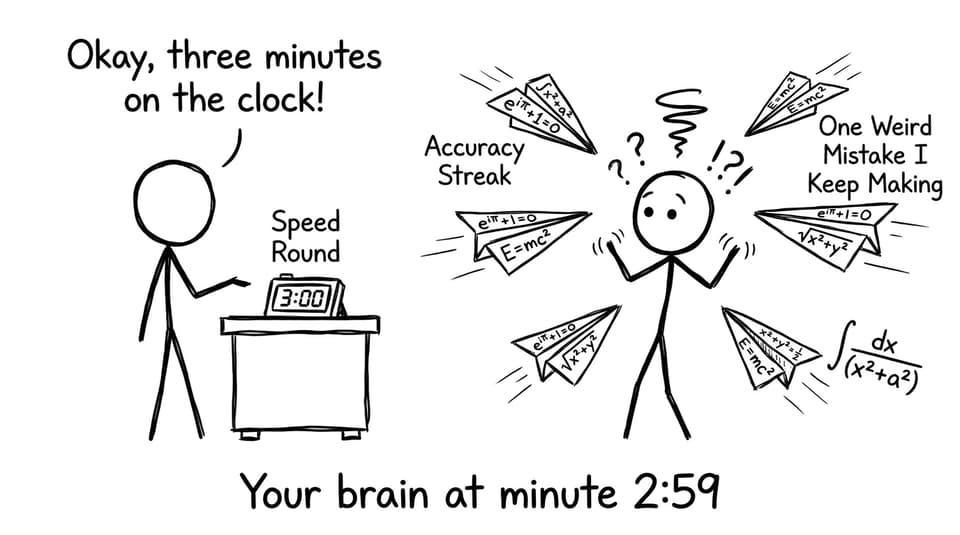
Make it game-like by setting rules:
-
15 questions, stop at 25 minutes no matter what.
-
Record your “accuracy streak” (how many correct in a row).
-
Replay only the question types you missed.
Keep IB math revision engaging with variety that still compounds
Variety isn’t about jumping topics randomly. It’s about rotating modes so your brain doesn’t go numb.
Mix three modes in one week
Mode 1: Build clarity (Notes)
When you’re stuck, you don’t need more questions. You need a clearer picture.
Use structured note methods from Effective Note-Taking Strategies for IB Math Students, then check a tight reference like the IB Mathematics Analysis and Approaches Data Booklet.
Mode 2: Build recall (Flashcards)
Make definitions and formulas automatic with How to Use Flashcards to Learn IB Math Definitions.
Mode 3: Build performance (timed sets)
Once a week, simulate pressure so exam day isn’t your first time feeling it.
If you’re running full practice sessions, use Online IB Mock Exams: Practice Anywhere, Anytime and treat it like a rehearsal, not a judgement.
Mini-games you can play during IB math revision
These are small, repeatable challenges that keep momentum without sacrificing rigor:
The “Three Lives” game
-
You get 3 total mistakes.
-
After mistake #3, you must stop and use AI Chat to explain the concept back to you.
-
Then you redo 3 similar problems.
The “Explain it to Future Me” card
After a Questionbank set, create one Flashcard:
-
Front: “The mistake I keep making in trig substitution is…”
-
Back: a 3-step checklist.
This is where RevisionDojo’s Flashcards shine, because the deck becomes your personal error-proofing system.
The “Level Up” rule
You’re not allowed to attempt harder questions until you hit:
- 80% accuracy on easy/medium, two sessions in a row
This is especially useful in IB topics where shaky basics ruin advanced questions.
For planning the order so it feels like a campaign, use How to Study IB Math Topics in the Right Order.

Common mistakes that make IB revision feel dull
-
Chasing novelty instead of mastery. New resources feel productive, but repetition with feedback is what moves marks.
-
Doing long sessions to “make up for guilt.” A 15-minute daily streak beats a 3-hour weekend collapse.
-
Only doing what you’re good at. Fun is easiest in strengths, but score gains are often in weak topics.
-
Ignoring feedback loops. Without correction (AI Chat, solutions, Grading tools, Tutors), practice becomes random effort.
RevisionDojo is built to prevent these traps by connecting Questionbank practice, Study Notes, Flashcards, AI Chat, Grading tools, Predicted Papers, Mock Exams, and even the Coursework Library when other deadlines are draining your attention.
Conclusion: make IB math revision something you return to
The goal isn’t to trick yourself into studying. It’s to build a revision loop that feels complete, measurable, and surprisingly satisfying.
When IB Math revision becomes a series of small quests, you stop waiting for motivation and start collecting proof. Proof that you can recall the method. Proof that you can earn the marks. Proof that consistency is working.
If you want that loop in one place, use RevisionDojo as your home base: Study Notes for clarity, Flashcards for daily momentum, Questionbank for exam-style practice, AI Chat and Grading tools for feedback, Predicted Papers and Mock Exams for timing realism, plus the Coursework Library and Tutors when life gets crowded.
Open your next IB micro-quest now: 10 minutes of Flashcards, then 12 targeted questions. Keep it small. Keep it trackable. Keep it moving.