
If you have one week left for IB SEHS, you are living in a familiar IB story: the calendar looks calm, but your brain feels like it is sprinting uphill.
The good news is that IB SEHS is not random. The syllabus is wide, but the exam rewards repeatable skills: clear definitions, clean explanations, and smart application to sport contexts. In one week, you are not trying to become a walking textbook. You are trying to become exam-dangerous.
This IB SEHS survival guide is built for that exact moment: limited time, high stakes, and a need for a plan that does not collapse on day two.
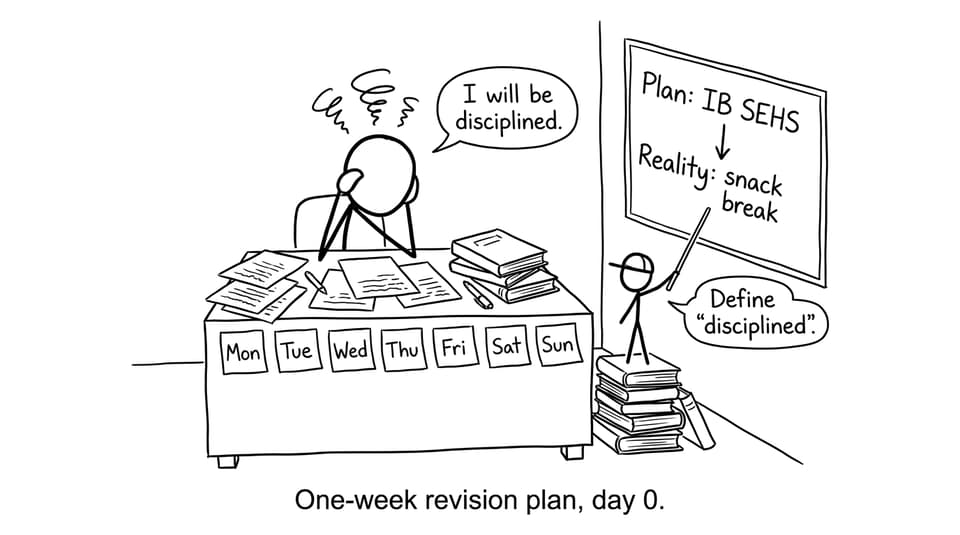
The one-week IB SEHS checklist (read this first)
Use this checklist to keep your IB SEHS revision focused and measurable.
-
Pick 3 core pillars to rotate daily: physiology/nutrition, biomechanics/injury, psychology/motor learning.
-
Do active recall every day (Flashcards or quick self-quizzes), even if only 10 minutes.
-
Do exam-style questions every day (Questionbank), then log mistakes.
-
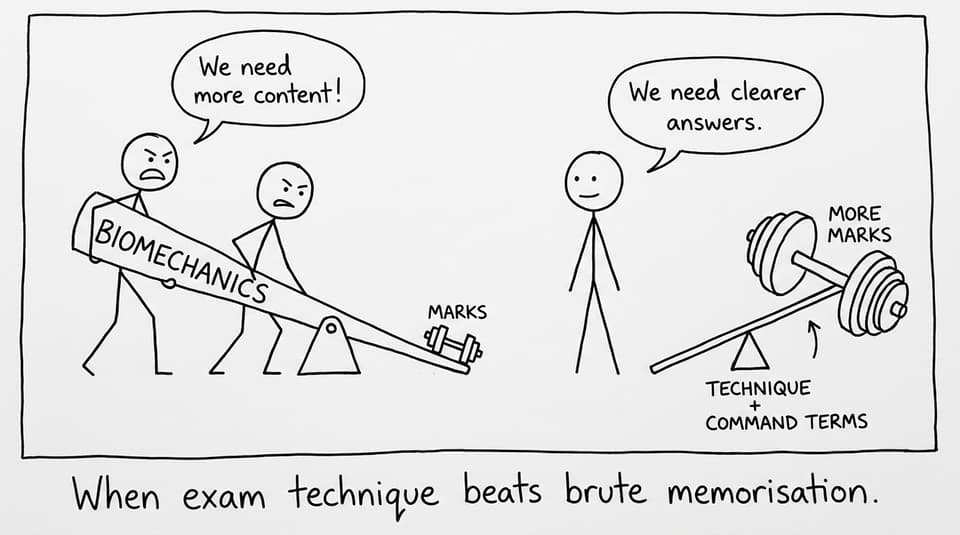
Spend at least 40% of your time on technique: command terms, structure, and application.
-
Sit two timed blocks in the week: one midweek, one near the end.
-
Keep the final day light: consolidate, do not panic-learn.
Helpful hubs to keep open in separate tabs:
What to prioritise in IB SEHS when time is short
A week forces you to think like a strategist. In IB SEHS, that means choosing content that (1) appears often, (2) links easily to real sport examples, and (3) can be explained clearly under pressure.
Prioritise these three areas:
Exercise physiology and nutrition
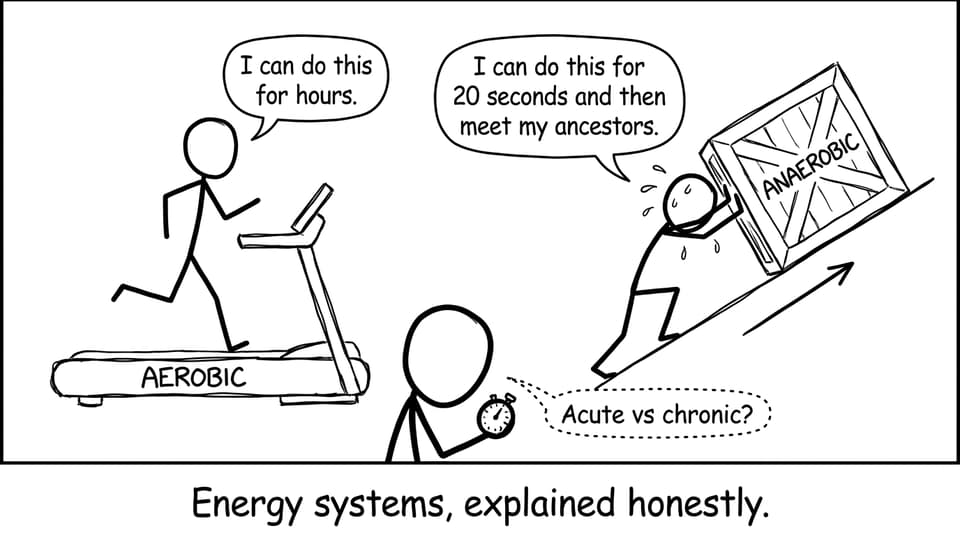
This is where definitions and mechanisms matter. You need the language of energy systems, acute vs chronic responses, and the ability to connect training to adaptation.
A strong starting point for quick, syllabus-aligned coverage:
Biomechanics and injury
These topics are high-yield because they reward clear application. If you can describe forces, motion, levers, and basic injury prevention in a sport scenario, you can score reliably.
Key pages to revise fast:
Sport psychology and motor learning
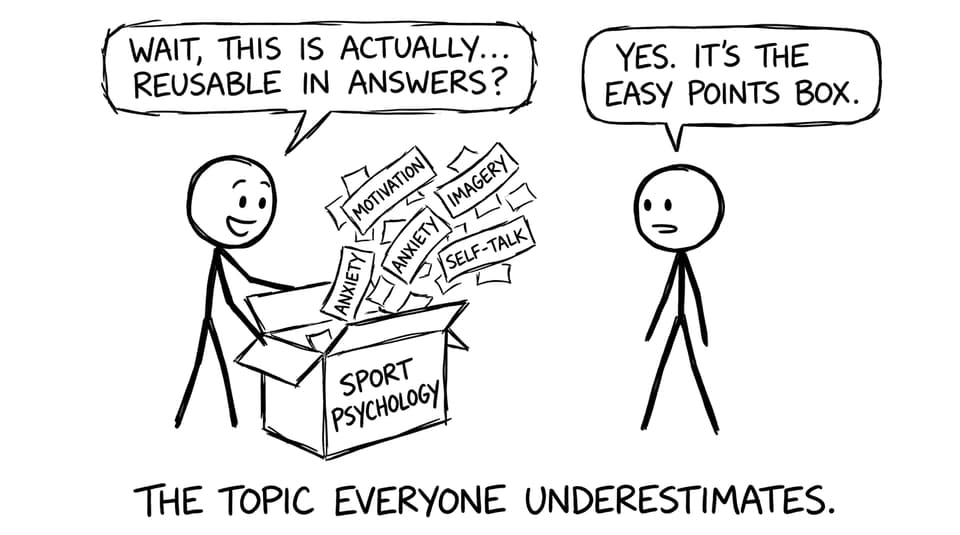
This is the quiet marks bank in IB SEHS because concepts are reusable across contexts. You can apply motivation, anxiety, and feedback principles to almost any performance scenario.
Use these for focused coverage:
Your 7-day IB SEHS cramming plan (survival mode, but smart)
This schedule assumes 2.5-4 hours per day. If you have less time, keep the same structure but cut the minutes.
Day 1: Build the base (communication, energy, nutrition)
In IB SEHS, day one is about removing fog. You want a simple mental map you can keep returning to.
-
Study Notes (60-90 min): energy systems, key terms, basic mechanisms.
-
Flashcards (10-15 min): definitions you keep mixing up.
-
Questionbank (45-60 min): short sets, mixed difficulty.
Do one focused Questionbank set here:
And anchor energy systems here:
Day 2: Acute vs chronic responses (make it exam-ready)
Most students can describe “heart rate goes up.” Fewer can explain why, and fewer still can write it like an examiner wants.
-
Notes (45-60 min): acute responses vs chronic adaptations.
-
Practice (60-90 min): write short responses using command terms like “outline” vs “explain.”
-
Fix (20 min): turn your top 10 errors into flashcards.
Comic break, because energy systems deserve honesty:
Day 3: Biomechanics essentials (movement, levers, technique)
Today is about clarity. In IB SEHS, biomechanics marks often go to students who label and sequence ideas cleanly.
-
Learn (60-75 min): joints, muscle actions, lever systems.
-
Apply (60-75 min): pick one sport skill (jump shot, sprint start, throw) and explain it using biomechanics language.
-
Drill (30-45 min): targeted questions.
Use:
Day 4: Forces + injury prevention (link topics for speed)
In a one-week plan, the biggest advantage is overlap. Forces and injury connect naturally: load, technique, tissue tolerance, and prevention strategies.
-
Review (45-60 min): Newton’s laws, force-time ideas, efficiency.
-
Injury block (45-60 min): risk factors, overuse vs acute, prevention interventions.
-
Questionbank (60 min): timed mini-set.
Practise here:
Day 5: Sport psychology + motor learning (easy points if you treat it seriously)
Many students “leave psychology for later” in IB SEHS because it feels intuitive. That is exactly why it becomes sloppy under exam timing.
-
Core concepts (60-75 min): motivation, anxiety, arousal, coping.
-
Motor learning (45-60 min): stages of learning, feedback types, practice methods.
-
Practice (45-60 min): write answers with specific sport examples.
Use:
Day 6: Timed mock block + ruthless review
This is where your IB SEHS grade changes: not from reading, but from performance plus feedback.
-
Timed block (60-120 min): sit a full section under strict timing.
-
Review (60-90 min): categorize every mistake into:
-
content gap
-
command term/structure
-
application/example weakness
-
time management
-
If you want a practical system for running timed practice across IB subjects:
And for realistic exam rehearsal (without guessing the future):
Day 7: Light consolidation + calm execution
The final day of IB SEHS cramming is not for heroic learning. It is for retrieval, confidence, and protecting sleep.
-
Flashcards (15-25 min): definitions, processes, key contrasts.
-
Error log (20-30 min): re-write your top 10 “rules” (what you will do differently).
-
One gentle mixed set (30-45 min): accuracy over speed.
If you have the urge to panic-revise, do this instead: open your flashcards and let the system carry you.
The IB SEHS answer structure that saves marks fast
Here is the simplest upgrade you can make in IB SEHS in one week: write like your marks depend on clarity (because they do).
Use this micro-structure for most short responses:
-
Define the key term in one precise sentence.
-
Explain the mechanism (causeandeffect).
-
Apply to a sport example (specific, not generic).
-
Link back to performance, recovery, or injury risk.
Technique matters more than brute memorisation:
Bring it home with RevisionDojo (the calm way)
A week from the exam is not the moment to juggle ten resources and hope they add up. The fastest way to stabilise IB SEHS revision is to run one connected system: learn, recall, practise, get feedback, repeat.
RevisionDojo is built for that loop. You can move from Study Notes to Flashcards, drill the Questionbank, ask AI Chat when you get stuck, and use Grading tools to understand how marks are awarded. When you are ready to rehearse exam pressure, use Mock Exams and Predicted Papers to simulate the real thing. And if coursework stress is leaking into exam week, the Coursework Library and Tutors help you stop carrying everything alone.
If you do one thing today: open the IB SEHS hub, pick your weakest topic, and do a short Questionbank set. One clean hour beats seven messy ones.
Start here: IB Sports, exercise and health science (SEHS) Resources