


The fastest way to lose marks in TOK isn’t weak writing. It’s choosing a title that forces you to pretend you have something to say.
Most IB students pick a TOK prescribed title the way people pick a gym membership: based on aspiration, not reality. “This one sounds deep.” “This one seems philosophical.” Then two weeks later, you’re stuck with vague claims, shaky examples, and a conclusion that quietly apologizes.
A TOK title should feel like a door you can actually walk through. Not a wall you admire.
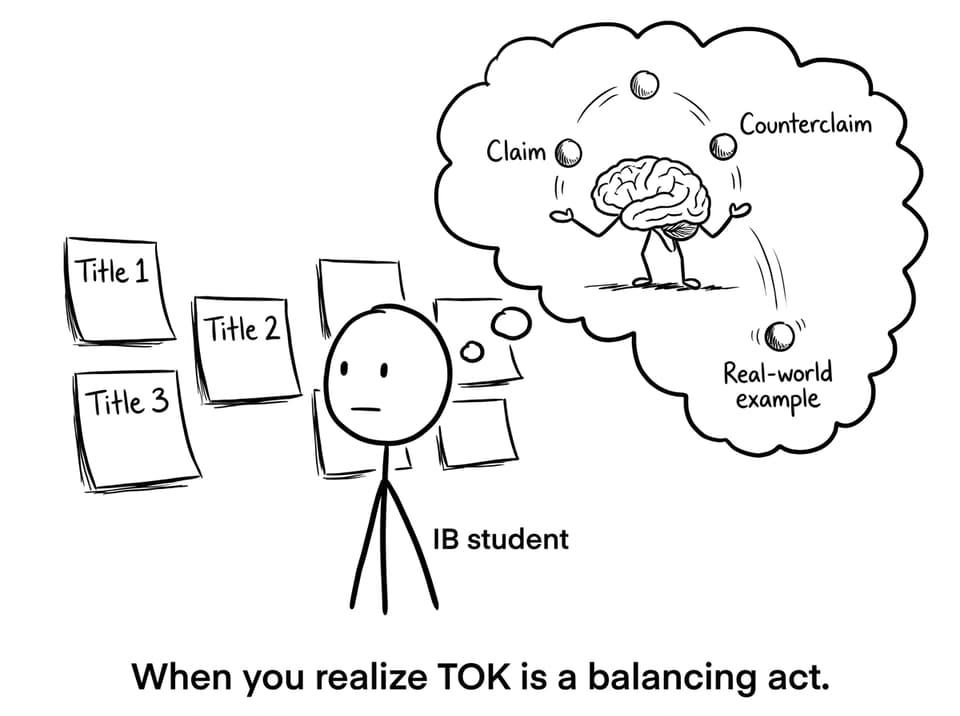
A quick TOK checklist before you commit
Use this mini-filter on every TOK prompt you’re considering:
-
Can you explain the key terms in your own words (without sounding like a dictionary)?
-
Can you generate two real-world examples in 60 seconds?
-
Can you see a claim and counterclaim that are both reasonable?
-
Can you link it to two Areas of Knowledge (AOKs) with real contrast?
-
Can you imagine what your conclusion’s implications could be?
If you answered “no” more than twice, keep browsing.
Start wide: read all TOK prescribed titles first
Before you “fall in love” with a prompt, scan the full list of released TOK titles for your session. Your brain needs comparison. A title that feels impossible in isolation can feel manageable once you see the alternatives.
If you’re working with a current session list, use a breakdown guide to understand what each prompt is really asking. For example, RevisionDojo posts like TOK May 2026 Essay Prescribed Titles: Complete Guide and IB TOK Essay Prescribed Titles: November 2026 help you spot the hidden “core tension” inside each title.
Choose a TOK title you can translate into a knowledge question
A strong TOK essay begins when the title turns into a workable Knowledge Question (KQ). That’s the moment the prompt stops being a sentence and becomes a tool.
Try this test: write your title at the top of a page, then underneath, create a single KQ starting with:
-
To what extent…
-
Under what conditions…
-
How far…
If you can’t make a clear KQ, you probably don’t understand the title well enough yet.
RevisionDojo’s guide TOK Essay Titles: What Are Knowledge Questions? is ideal for this step, and Using Knowledge Questions in Your TOK May 2026 Essay shows how KQs drive your structure.
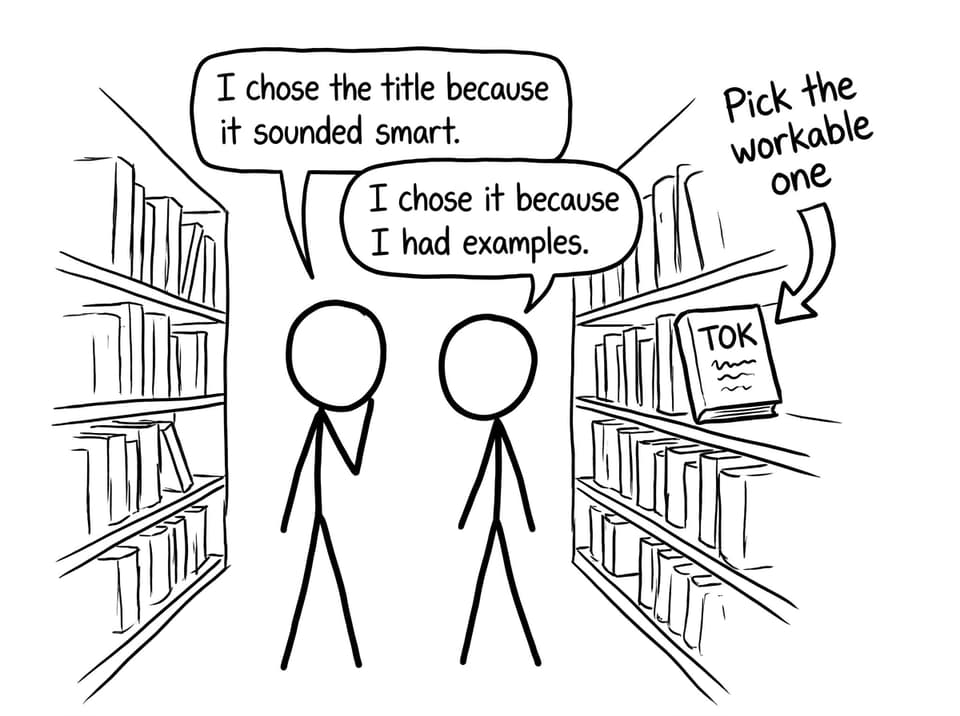
Pick the TOK title with the richest example-bank
In TOK, examples aren’t decoration. They are the engine that lets your analysis move.
A good title is one where you can quickly find:
-
A recent news event you genuinely understand
-
A classroom connection (an experiment, a text, a case study)
-
A personal micro-example (something you noticed about bias, language, or interpretation)
If you need help converting examples into analysis, use Examples and Tips for Writing IB TOK Knowledge Questions and The Art of Linking Examples to Knowledge Questions. These stop your TOK essay from becoming “here’s a thing that happened” instead of “here’s what it shows about knowledge.”
Make sure your TOK title allows balanced argumentation
If a title only lets you argue one side, your TOK essay becomes a speech. The rubric rewards evaluation, not certainty.
Ask:
-
What would an intelligent person disagree with in my claim?
-
What are the limits of my example?
-
Does the other AOK change the story?
For counterclaim ideas that aren’t generic, Best Counterclaims for the May 2026 TOK Essay Titles is a useful spark.
Choose a TOK title that lets you be a knower (not a narrator)
Examiners can tell when you’re performing depth. The best TOK titles invite genuine reflection: how your perspective, language, and assumptions shape what you accept as knowledge.
If you want prompts that help you write that kind of reflection without becoming informal, read How to Reflect on Yourself as a Knower in TOK and How the TOK Curriculum Connects Knowledge and the Knower.
Conclusion: pick the TOK title that gives you leverage
A good TOK essay title doesn’t just sound impressive. It gives you leverage: clear concepts, balanced arguments, and examples that naturally lead to implications.
When you’re ready to lock in your choice, use RevisionDojo as your basecamp. The Questionbank, Study Notes, Flashcards, and AI Chat help you pressure-test your claims. The Grading tools and Mock Exams help you practice writing under constraints. And if you need more guided support, RevisionDojo’s Tutors can help you refine your KQ and structure before your draft hardens.
Choose the TOK title that works for you, then build the essay that proves it.