


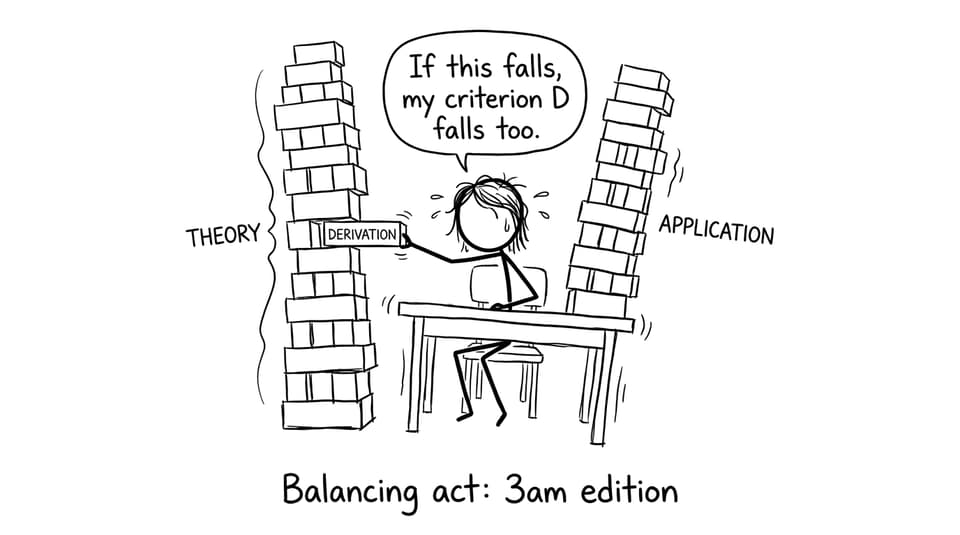
The night before you show your draft to your teacher, you notice a strange pattern.
Your pages are full. Your graphs look professional. Your calculator history is heroic.
And yet something feels off.
In many IB Math IAs, the problem isn’t effort. It’s imbalance. The exploration leans too hard into theory (beautiful math that never lands anywhere) or too hard into application (interesting context with math that stays shallow). A strong IB Math IA feels like a conversation between the two: the theory explains the world, and the world tests the theory.
The IB balance test (a quick checklist)
Use this fast check before you write, and again before you submit your final IB draft:
-
Can you name one central mathematical idea in one sentence (calculus, regression, probability, matrices, modeling)?
-
In the first page, do you clearly introduce a real context (even if it’s conceptual rather than “real-world” data)?
-
After each major piece of math, do you interpret what it means for your scenario?
-
Do you justify formulas or methods rather than only using them?
-
Do your graphs and tables carry both math and meaning (not just decoration)?
If you want a reliable structure baseline, borrow the flow from How to Structure Your IB Math IA Logically and refine it as your topic evolves.
Start with a single mathematical “engine” (not a theme)
A common IB trap is choosing a theme instead of an engine.
“Basketball,” “music,” or “social media” are themes. They can be great. But they are not mathematical engines. Your engine is the method that does the heavy lifting: optimization, hypothesis testing, correlation vs causation checks, differential equations, or a model comparison.
A practical way to sanity-check your engine is to ask: If I removed the context, would there still be a coherent mathematical exploration? If the answer is no, your IB Math IA may become a data commentary.
RevisionDojo helps here in a very non-magical way: clarity. Use the IB IA Guides hub to align your engine to what examiners actually reward, then ground your approach with the course-specific guide for IB Math AA or IB Math AI.
Bring application forward (within the first page)
Your reader shouldn’t wait five pages to learn why your math matters. In a high-scoring IB Math IA, the context shows up early, because it gives your decisions a reason.
That doesn’t mean you need a dramatic story. It means you should answer three questions quickly:
-
What is the situation or phenomenon?
-
What measurable variables will you use (or simulate)?
-
What is the exact aim or research question?
If introductions are where your balance falls apart, model a clean opening using How to Structure an IB Math IA Introduction That Captures Examiner Interest. In IB marking, a focused introduction often prevents a messy middle.
Derive or justify before you apply
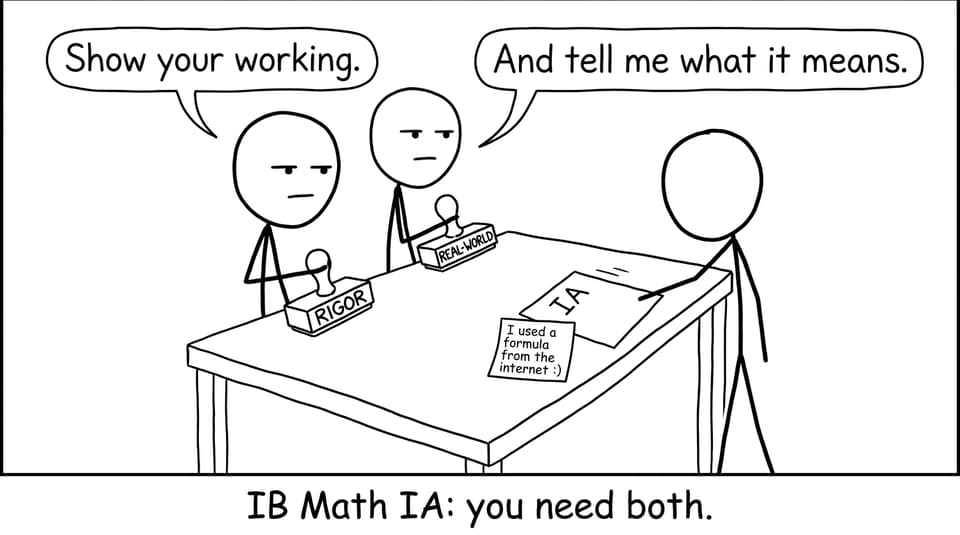
Application without justification is fragile. A formula can be correct and still feel borrowed.
In an IB Math IA, you don’t need to re-prove the universe. But you should show ownership. That usually means one of these:
-
a short derivation from known principles
-
a justification of why a model form fits (with residuals, assumptions, or parameter meaning)
-
a comparison of two methods, explaining trade-offs
If you’re working with modeling, this becomes easier when you treat the math like a tool you assembled yourself. The guide How to Build Mathematical Models for the IB Math IA gives a useful framework for that “assemble then test” mindset.
Alternate in small loops: theory -> apply -> reflect
Many students write theory in one long block, then add application later like an appendix. Examiners experience this as two separate documents stapled together.
A smoother IB approach is to work in loops:
Micro-loop you can repeat
-
Theory: define/derive the relationship or method
-
Apply: use your data or simulation immediately
-
Reflect: 1-3 sentences on what changed, what surprised you, and what limitation appeared
These short reflections are not fluff. They are how your IB IA signals that you understand both the technique and its consequences.
To see what that rhythm looks like in a full piece, study a few examples in Using IA/EE Exemplars to Improve Your IB Math IA. If you need more, browse the dedicated collections for IB Maths AI IA Examples.
Use graphs as bridges, not trophies
A graph earns marks when it does two jobs at once:
-
it reveals a mathematical relationship (shape, parameters, trends, residuals)
-
it answers a contextual question (what does this mean in the scenario?)
So caption and discuss graphs like you’re teaching a curious classmate: what the reader should notice, and why it matters.
If you’re doing heavy data work, build your analysis workflow around How to Use RevisionDojo to Prepare for IB Math IA Data Analysis. It nudges you toward interpretation, not just plotting.
Don’t confuse “hard” with “good”
In IB Math, sophistication is not a substitute for clarity.
A simpler model, clearly justified, tested, and evaluated, often outperforms an advanced method that appears suddenly and is never explained. When you feel tempted to escalate complexity, ask:
-
Can I explain this method without hiding behind jargon?
-
Does this extra math answer a question the reader actually has?
-
Did I create a new insight, or just a longer calculation?
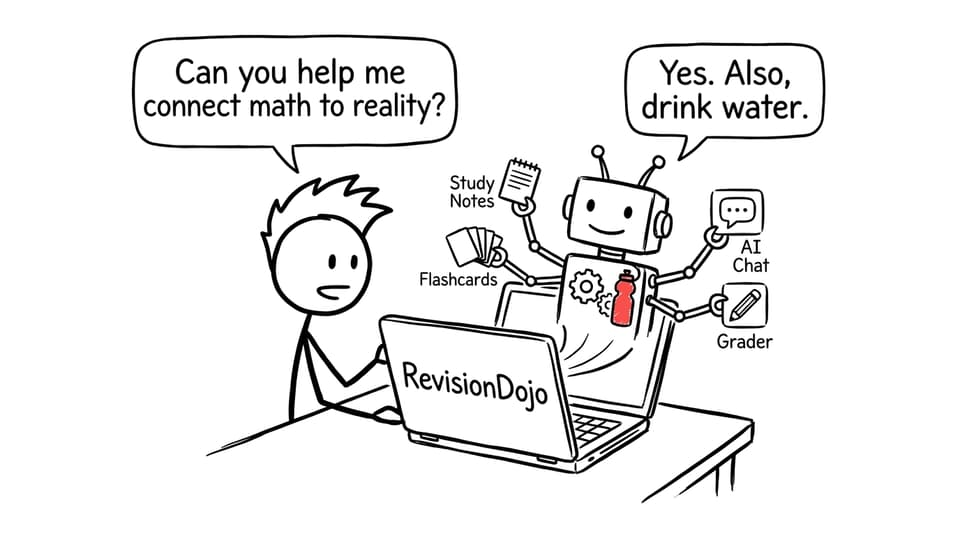
RevisionDojo’s tools are useful here because they force articulation. Use AI Chat to rehearse explanations in plain language, then tighten them with Study Notes and Flashcards so key definitions and conditions stay accurate. When your draft is ready, use the Grading tools (like the rubric graders) to see if your balance shows up in the criteria, not just in your word count.
A simple template you can steal for your IB Math IA
Here’s a structure that keeps theory and application close enough to support each other:
-
Introduction: context + aim + math engine
-
Background theory (tight): only what you will actually use
-
Method loop 1: derive/justify -> apply -> reflect
-
Method loop 2: extend or compare models -> apply -> reflect
-
Evaluation: limitations, assumptions, improvements, what the math can’t capture
-
Conclusion: what your theory revealed about the application (and vice versa)
For formatting and presentation polish (which helps the examiner follow your logic), use How to Format and Present Your IB Math IA Professionally.
Closing: the IB Math IA is a conversation, not a split screen
A memorable IB Math IA doesn’t feel like theory on the left and application on the right. It feels like each one keeps the other honest. Theory stops your IA from becoming a spreadsheet report. Application stops your IA from becoming a textbook summary.
If you want that balance to show up on the page (and in the marks), build with RevisionDojo: start in the IA Guides, check structure with exemplars, tighten understanding with Study Notes and Flashcards, pressure-test ideas with AI Chat, and validate your draft using the Grading tools. Then use Mock Exams and Predicted Papers to keep exam prep moving alongside coursework, so your IB momentum never stalls.