

Careless mistakes in IB Math rarely come from “not understanding.” They come from something quieter: a rushed first read, a skipped line of working, a minus sign that disappears when your brain is already thinking about the next part.
And what makes these errors so painful is that they don’t feel like learning problems. They feel like bad luck.
But in IB exams, luck is usually just untrained process.
This article gives you a practical system to avoid careless mistakes in IB Math exams, built around small habits you can actually repeat when you’re tired, stressed, and watching the clock. Along the way, you’ll see how RevisionDojo helps you turn accuracy into a measurable skill using Study Notes, Flashcards, AI Chat, Grading tools, Predicted Papers, Mock Exams, and targeted Questionbank practice.
A quick IB accuracy checklist (use this before every timed set)
Keep this short on purpose. The goal is to reduce careless mistakes in IB Math by controlling the moments where they tend to happen.
-
Read the question twice and underline command words (state, hence, exact, justify).
-
Write a one-line plan before you calculate.
-
Show at least one “boring” intermediate step you’d normally skip.
-
Do a reasonableness check (units, sign, size, domain).
-
Reserve 10% of your time to review finished answers.
-
Log the mistake type after marking so it doesn’t repeat.
If you want a structured practice loop, pair this with targeted drills from the IB Mathematics Analysis and Approaches hub and your next practice session will feel less random and more like training.
Why careless mistakes happen to strong IB students
Most IB students who score highly don’t “make fewer mistakes” by talent alone. They make fewer mistakes because they reduce cognitive load.
Careless mistakes in IB Math usually come from:
-
Rushing the setup: starting calculations before deciding what the question is asking.
-
Working memory overload: holding too many steps in your head instead of writing them.
-
Notation drift: changing symbols mid-solution, mixing degrees/radians, or losing brackets.
-
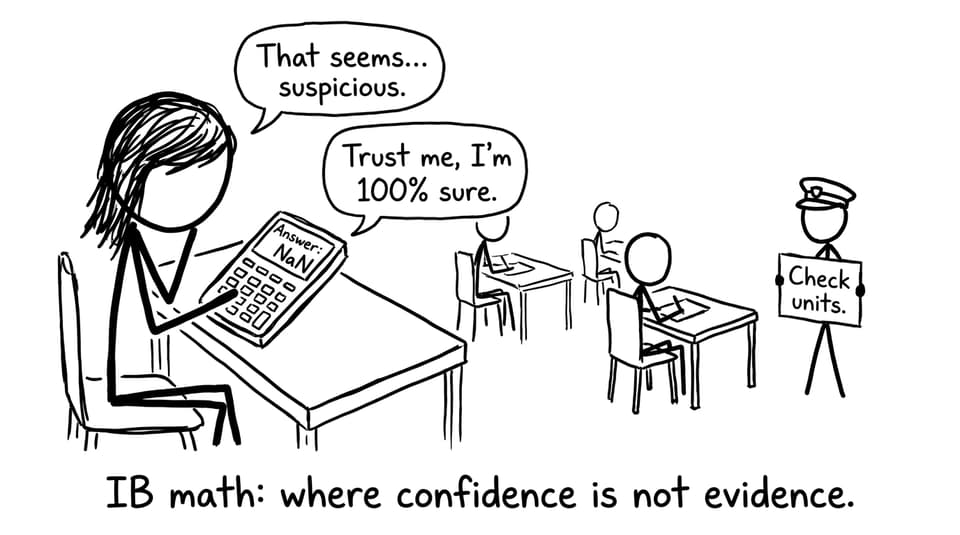
Calculator over-trust: copying the display without sanity-checking.
-
Late-paper fatigue: accuracy drops when you try to sprint the last questions.
RevisionDojo is helpful here because it turns “accuracy” into data. With Questionbank feedback and analytics, you stop guessing which topics cause careless mistakes and start seeing patterns.
For deeper reflection after you mark, read How to Analyze Your IB Math Mistakes Like a Top Scorer.
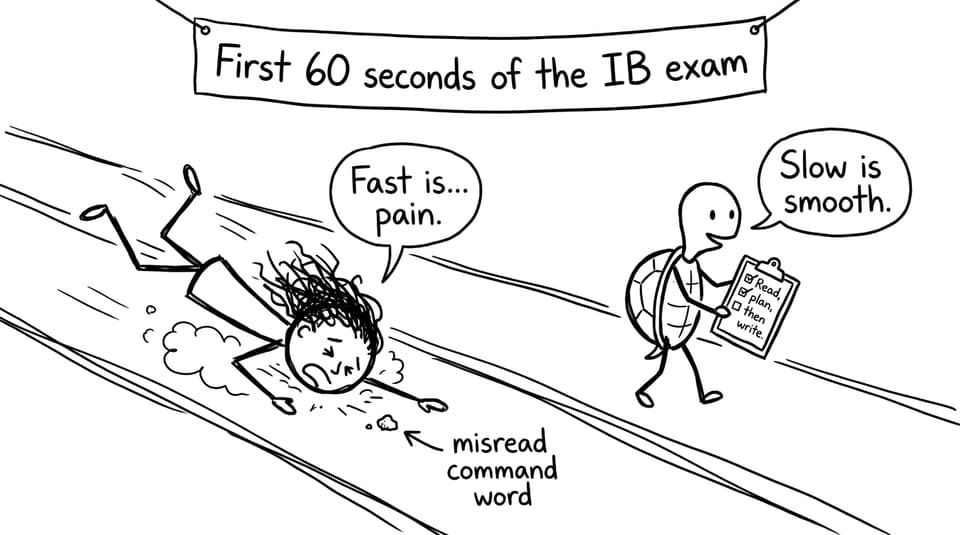
The first 60 seconds: slow down to go faster (IB timing paradox)
The most expensive moment in an IB Math exam is the beginning of a question. One misread condition can make five minutes of perfect math irrelevant.
Try this repeatable routine:
-
Scan for command words: “hence,” “show,” “exact,” “to 3 s.f.”
-
Circle constraints: domain restrictions, units, “in terms of,” “in radians.”
-
Write your target: one line such as “Find k using condition f(2)=0, then substitute.”
That tiny pause creates momentum that actually lasts, because you stop paying the “restart cost” of realizing you solved the wrong thing.
Show one more line than you think you need
In IB Math, skipping steps is tempting because it feels efficient. But it also hides the exact point where careless mistakes are born.
A useful rule: if the step includes a sign change, a substitution, a trig identity, or an exponent/log transformation, write it.
This helps in three ways:
-
You catch errors earlier (before they infect the whole answer).
-
You can earn method marks even if the final result is off.
-
You make checking faster, because your logic is visible.
If you notice that your errors cluster around specific techniques (chain rule, algebraic manipulation, domain restrictions), use a focused read like Why Does the Chain Rule Cause So Many Mistakes in IB Maths? and then immediately drill that exact skill in the Questionbank.
To practise with real exam-style structure, jump into a topic set such as IB Math AA Calculus Questionbank.
The two-check system that fits inside IB time pressure
Checking is not “doing the question again.” That takes too long.
Instead, use two fast checks:
Step check (10-20 seconds)
Look for mechanical slips:
-
Did you copy the expression correctly?
-
Did you distribute the negative sign?
-
Did you apply the exponent to the entire bracket?
-
Did you differentiate/integrate the inside function too?
Answer check (20-40 seconds)
Use a reality test:
-
Does a probability lie between 0 and 1?
-
Does an area/variance come out negative?
-
Does your answer match the required form (exact vs decimal)?
-
Does your graph or model behave sensibly for a simple input?
The IB doesn’t punish you for taking 40 seconds to be sure. It punishes you for being confidently wrong.
Use micro-estimation to catch “impossible” results
This is a skill you can train.
Before you move on, ask: “What rough size should this be?” Even a crude estimate catches the biggest careless mistakes.
Examples:
-
If
sin(θ)is involved, your output usually shouldn’t exceed the scale you started with. -
If you’re using logs, check whether the input is positive in a real-valued context.
-
If you’re modeling, check units: seconds vs minutes, degrees vs radians.
This is also where RevisionDojo’s AI Chat can help during revision: you can paste a step and ask, “Does this magnitude make sense?” That kind of quick feedback trains your internal alarm system for the real IB exam.
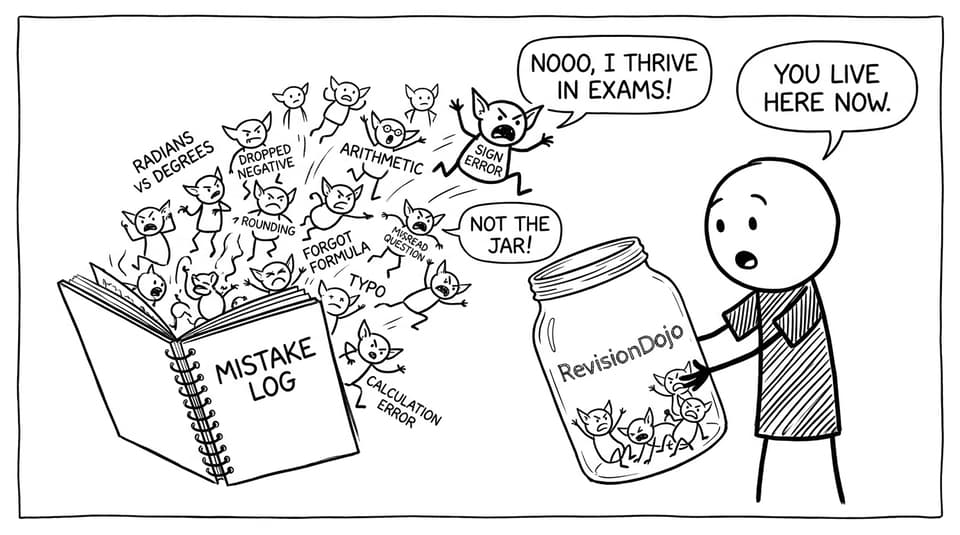
Build a mistake log you’ll actually use (IB Error Prevention Toolkit)
Most students “review mistakes” by feeling bad for two minutes and then doing another question. That’s not a system.
A system is a small record that answers one question: What should I do differently next time?
In your log, record:
-
Mistake type (sign, algebra, rounding, misread, calculator input, units).
-
Topic (functions, calculus, probability, vectors).
-
Trigger (rushing, fatigue, messy working, skipped step).
-
Prevention rule (“Always write bracket expansion line,” “Underline ‘exact’”).
RevisionDojo makes this loop smoother because your practice is already organized: you can do a focused Questionbank set, use the built-in feedback and Grading tools, then convert recurring errors into Flashcards.
If you want a full mindset shift, read How to Turn Math Mistakes Into Learning Opportunities.
Train accuracy under pressure with realistic IB practice
Many careless mistakes don’t appear in calm homework conditions. They appear when you’re timed.
So your training needs at least one weekly session that feels like the IB.
A simple plan:
-
3x per week: targeted Questionbank sets on weak topics.
-
1x per week: a timed section using Mock Exams or a full paper-style practice using Predicted Papers.
-
After every timed set: 10 minutes of review + mistake log + 3 Flashcards.
To build structure around exam simulations, explore IB Predicted Papers by IB Examiners (Free) and combine them with RevisionDojo’s Mock Exams workflow.
If you’re not sure what to prioritize first, this pairs well with How to Identify Your Weakest Math Areas Quickly.
Common careless mistakes to watch for in IB Math
You don’t need a list to feel worried. You need a list to feel prepared.
-
Dropping a negative sign during rearrangement.
-
Switching between degrees and radians.
-
Rounding too early, then compounding error.
-
Forgetting units, labels, or required form.
-
Copying calculator results incorrectly.
-
Misreading “show that” or “hence” and giving the wrong form.
For more examples, see Common Mistakes in IB Math HL exams and compare them to your own error patterns.
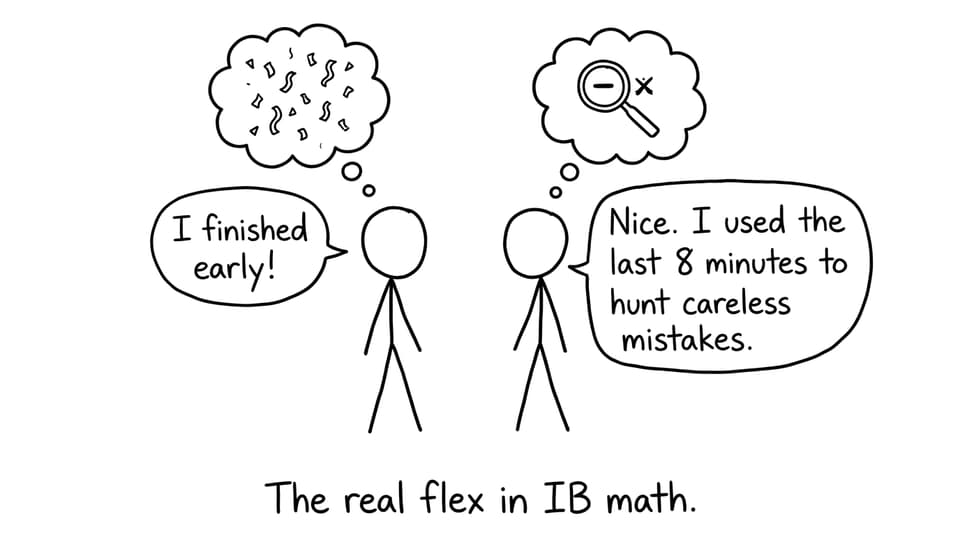
Conclusion: make IB accuracy a skill, not a hope
The goal isn’t to become the kind of IB student who never makes mistakes. The goal is to become the kind of IB student who catches them.
When you slow down at the start, write one extra line, run a two-check system, and track patterns, careless mistakes stop feeling random. They become familiar. And then they shrink.
If you want to train this systematically, build your weekly loop in RevisionDojo: Study Notes for clarity, Flashcards for detail retention, Questionbank for targeted repetition, AI Chat for fast fixes, Grading tools for feedback, and timed practice with Mock Exams and Predicted Papers. That’s how you protect marks you already earned, and turn your real ability into real IB exam results.