


You can tell who’s going to score well in IB Math by what they do after they get a question wrong.
Most students treat a mistake like a bruise: touch it once, wince, move on. Top scorers treat it like a map: it shows exactly where their understanding breaks, where their exam technique leaks marks, and which habits will quietly cost them on exam day.
If you want a higher IB grade, don’t just practice more. Analyze smarter. The goal is simple: turn every wrong answer into a reusable lesson that makes the next question easier.
The IB mistake-analysis loop (fast checklist)
Use this mini-system after any IB Math session (homework, Questionbank set, timed paper section):
-
Circle every lost mark (not just “wrong answers”).
-
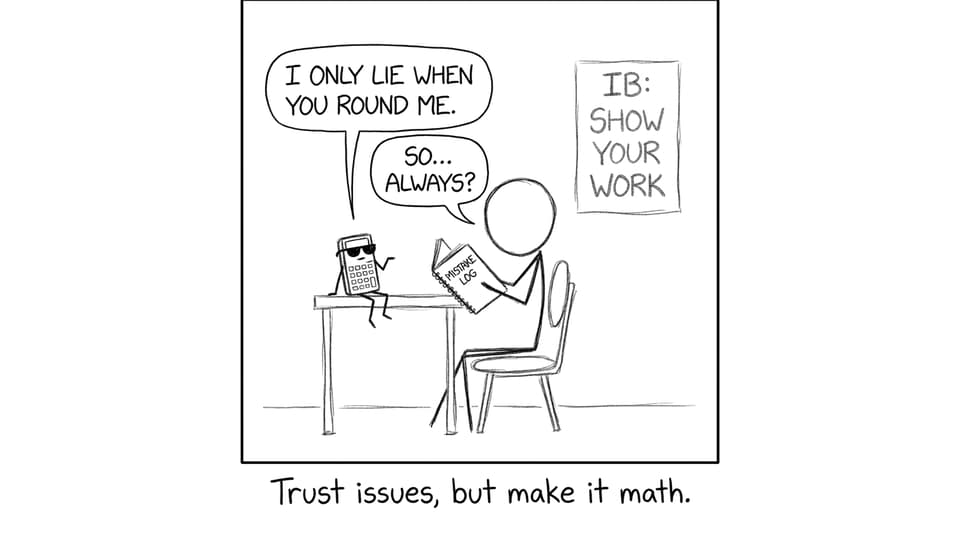
Label the mistake type: concept, careless, strategy, or timing.
-
Read the markscheme like an examiner: where are the method marks?
-
Write a one-line “error rule” (what you’ll do next time).
-
Re-solve the question from scratch 48-72 hours later.
If you want one place to run this loop, build it into your RevisionDojo routine: practice in the Questionbank, fill gaps with Study Notes, lock recall with Flashcards, and use AI Chat when you’re stuck (then immediately retest).
Why top scorers don’t fear mistakes in IB Math
In IB Math, a mistake is rarely random. It’s usually one of three things:
-
A concept you only half-own.
-
A process you can do slowly, but not under pressure.
-
A communication gap where you did the math, but didn’t earn the marks.
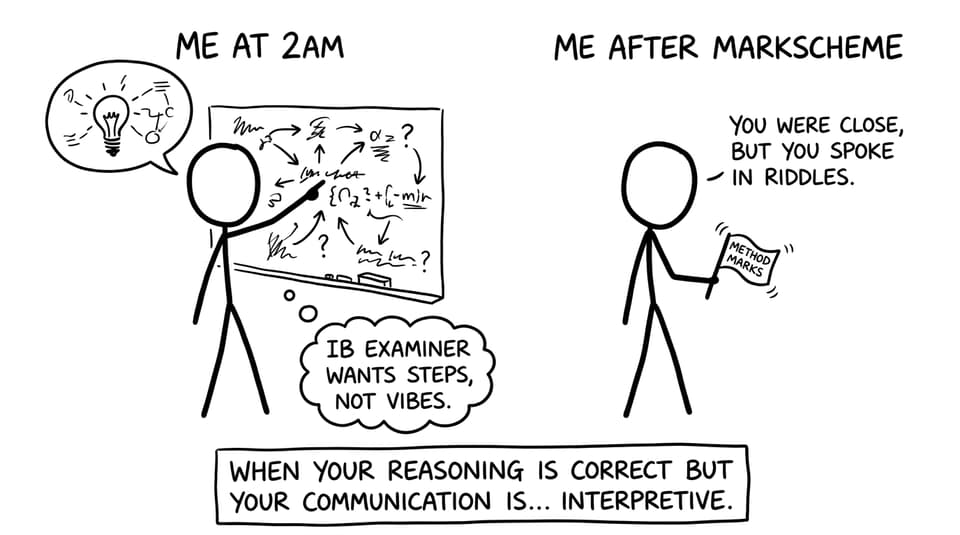
That last one surprises people. In IB exams, correct thinking that isn’t clearly shown can still lose marks. That’s why top students don’t just ask, “What’s the answer?” They ask, “What would an examiner reward here?”
RevisionDojo is built around that mindset: exam-shaped practice plus feedback loops that make your next attempt cleaner.
Step 1: Classify your IB Math mistakes like an examiner
Before you fix anything, sort the error. This is where most IB students skip ahead, and where top scorers quietly separate themselves.
Concept mistakes (you didn’t truly understand)
Signs:
-
You couldn’t start without looking at notes.
-
You used the right topic but the wrong idea.
-
Your steps don’t connect logically.
Fix:
-
Go straight to a targeted explanation, not a full chapter reread.
-
Use RevisionDojo’s IB Mathematics AA hub to find the exact topic area.
-
Then do a short focused set in the Questionbank.
Careless mistakes (you knew it, but lost marks)
Signs:
-
Sign errors, dropped brackets, wrong substitution.
-
You stop writing steps when the algebra gets “obvious.”
Fix:
-
Create an “error rule” you can execute under time.
Example: “After expanding, I will underline the sign in front of the second term.” -
Train it in short timed bursts so it becomes automatic.
Strategy mistakes (you chose an inefficient method)
Signs:
-
You got stuck mid-solution.
-
You used a method that works, but takes too long.
-
You ignored a hint in the question wording.
Fix:
-
Ask: “What was the fastest clean path?”
-
Use AI Chat to compare two approaches, then re-solve using the better one.
Timing mistakes (pressure changed your thinking)
Signs:
-
You make mistakes late in the paper.
-
You rush the last steps.
-
You freeze on multi-part questions.
Fix:
-
Practice whole-question pacing, not just topic drills.
-
Add Mock Exams and Predicted Papers so your brain learns what speed feels like.
If you’re revising for AA calculus in particular, a good place to drill efficiently is the Math AA Calculus Questionbank, because it keeps your practice close to how IB questions actually behave.
Step 2: Read the markscheme like it’s a scoring recipe
Markschemes aren’t just solutions. In IB, they’re a blueprint for where marks are hiding.
When you review a mistake, don’t ask, “How do I get the final answer?” Ask:
-
Where were the method marks awarded?
-
Which line proved I understood the concept?
-
What notation or justification did the examiner expect?
Here’s a powerful habit: highlight the first line in the markscheme that guarantees you get at least one method mark. Then make that line a non-negotiable part of your own solutions.
This is also where RevisionDojo’s Grading tools and feedback-first workflow matter: you’re not guessing what a good solution looks like. You’re training your writing to match what IB rewards.
Step 3: Build a “mistake database” that actually changes outcomes
A mistake log only works if it’s searchable and actionable.
Instead of writing paragraphs, log each IB Math mistake in this format:
-
Topic: (e.g., functions, calculus, probability)
-
Mistake type: concept / careless / strategy / timing
-
Trigger: what caused it (rushing? forgetting condition? misreading command term?)
-
Error rule: one sentence you can execute next time
-
Retest date: 48-72 hours
Over time, your database becomes your personal syllabus of weak points.
To keep it efficient:
-
Use Flashcards to turn recurring “error rules” into quick daily retrieval.
-
Use AI Chat to generate two new questions that target the same weakness.
-
Use the Coursework Library and Tutors when the pattern isn’t technical but strategic (for example, you keep misinterpreting modelling prompts).
Step 4: Re-solve from memory (this is where IB gains happen)
Reading solutions feels productive because it’s smooth. But IB grades are built on what you can produce when it’s not smooth.
Two days after you log a mistake:
-
Re-attempt the same question from a blank page.
-
If you get stuck, write what you know is true (definitions, conditions, transformations).
-
Only then check the solution.
-
Update your error rule to be simpler.
If you can solve it cleanly from memory, you didn’t just “fix” the mistake. You converted it into a skill.
Step 5: Train timing separately (accuracy is not enough)
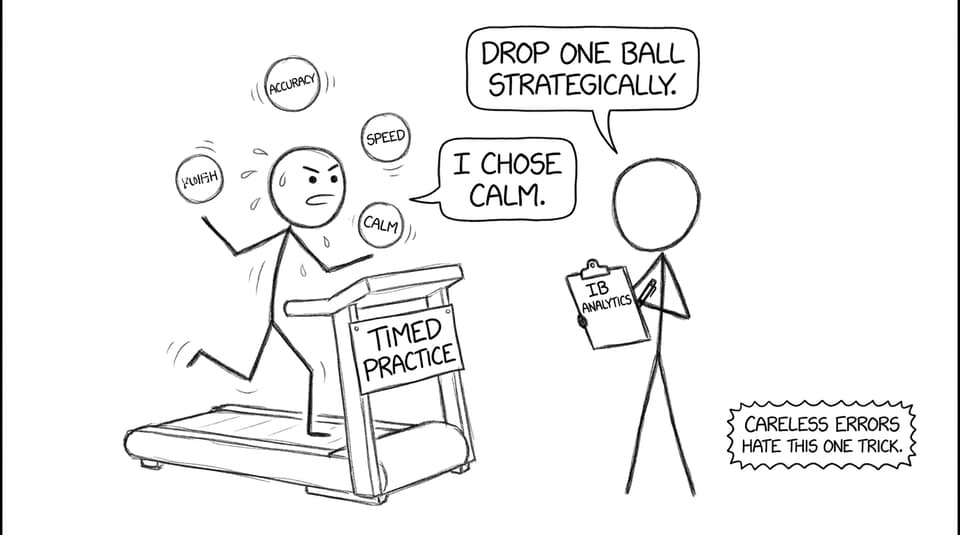
A lot of IB students are accurate in slow practice and shocked in timed conditions.
Timing is its own skill. Treat it that way:
-
Do 20-25 minute timed sets.
-
Review immediately.
-
Identify where time disappeared: setup, algebra, calculator steps, or writing.
Then choose one lever to pull next time: simplify notation, write fewer but clearer lines, or skip earlier and return. The point is not speed for its own sake. It’s staying precise while the clock is loud.
For broader exam strategy, this pairs well with 10 Quick Revision Hacks Before Your IB Math Exams and the bigger-picture approach in IB: I Study All Day but Remember Nothing.
How RevisionDojo turns IB mistakes into a system
A good IB student practices. A top scorer closes loops.
RevisionDojo is designed to make those loops easy to repeat:
-
Questionbank for exam-style targeting and repetition
-
Study Notes for fast clarification (no wandering)
-
Flashcards for daily retrieval of definitions, conditions, and error rules
-
AI Chat for precision diagnosis, not vague reassurance
-
Grading tools to learn what earns marks in written solutions
-
Predicted Papers for full-paper realism and stamina
-
Mock Exams for timing and pressure rehearsal
-
Coursework Library to reduce background stress during exam season
-
Tutors when you want a human to spot patterns you’re missing
Explore the broader IB resource hub here: International Baccalaureate (IB).
Closing: make mistakes pay you back
The quiet secret of top IB scorers is that they don’t do dramatically more work. They get more value from the same work because they treat mistakes as data, not drama.
Run the loop: classify, markscheme-think, log an error rule, reattempt from memory, then pressure-test with timed practice. If you want a platform that supports that entire process end to end, RevisionDojo brings it together in one place: Questionbank, Study Notes, Flashcards, AI Chat, Grading tools, Predicted Papers, Mock Exams, the Coursework Library, and Tutors.
Your next IB grade jump is probably already sitting inside your last five mistakes. Go collect it.