
Surface tension is the kind of quiet force you only notice when it fails. One second the pond looks like glass; the next, one drop of detergent turns the surface into a trapdoor. For IB Biology students, that moment is more than a party trick. It’s a perfect reminder that microscopic forces (hydrogen bonds) can shape macroscopic ecosystems (who can live, feed, and reproduce at the water’s surface).
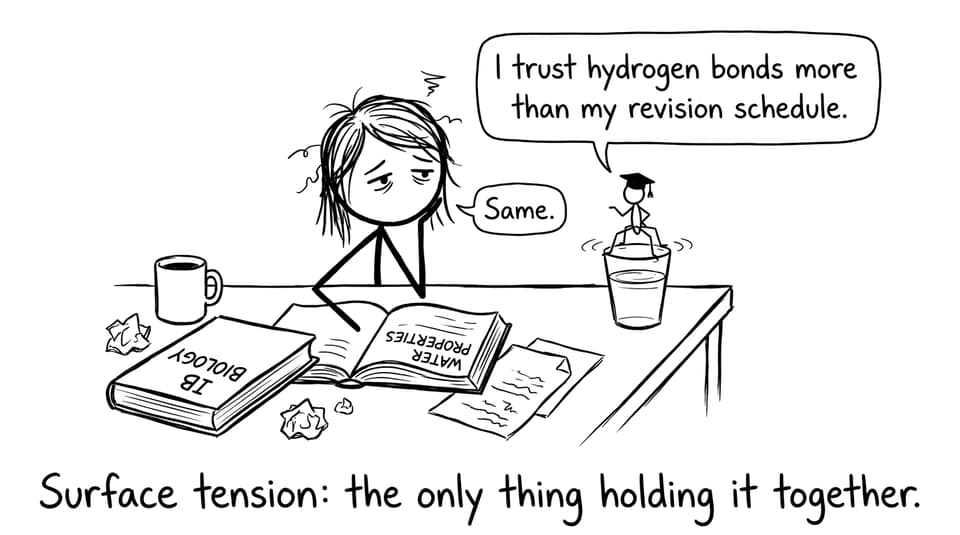
The IB Biology checklist for surface tension
Use this as a rapid revision frame before you dive into detail (or before you answer a 6-mark explain question in IB Biology):
-
Define surface tension as a “skin-like” surface caused by cohesion
-
Link cohesion to hydrogen bonding between polar water molecules
-
Explain why surface molecules experience a net inward pull
-
Apply to organisms (water striders, insects laying eggs, surface-dwelling microbes)
-
Extend to ecosystems and food chains (surface layer as a habitat and feeding zone)
-
Evaluate environmental impacts (surfactants, oils, temperature)
For the syllabus-aligned foundations, start with IB Biology Topic A1.1: Water Notes and then reinforce with exam practice in the A1.1 Water Questionbank.
What surface tension really is (and why IB Biology loves it)
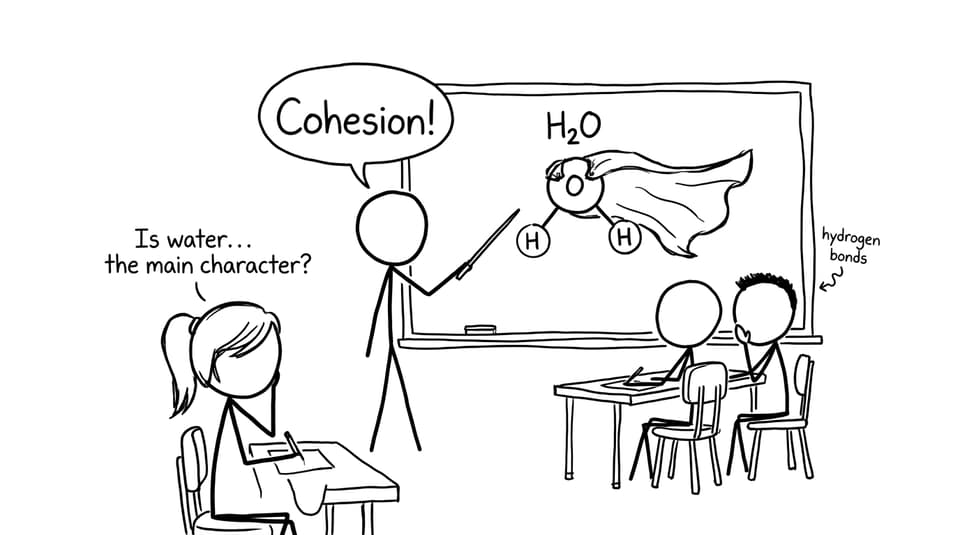
In IB Biology, water is never “just water.” It’s a network. Each molecule is polar, and that polarity lets water molecules form hydrogen bonds with each other. Inside the liquid, every molecule is tugged in all directions. But at the surface, there’s no water above to pull upward. The result is a net inward force, producing a tight surface layer that behaves like a stretched membrane.
If you want a clean, exam-ready explanation, pair this article with What Causes Water's High Surface Tension? and How Hydrogen Bonds Form in Water. Those two links give you the phrasing and causal chain IB examiners tend to reward.
How surface tension supports life on water
Surface tension matters because it creates an actual living space: a boundary layer where organisms can stand, hunt, hide, and reproduce.
Movement and survival: insects that “walk” on water
Water striders and other surface-walking insects exploit surface tension by spreading their mass across long legs. That lowers pressure at any single point, so the surface film doesn’t break. Many species also have hydrophobic hairs or waxy coatings, which help repel water and maintain the air-water interface around the leg.
In IB Biology, this is a classic structure-function story: adaptation makes sense only because the physical property exists. If surface tension drops, the same adaptation becomes less effective, and the niche collapses.
Feeding and ecosystems: the surface as a resource hotspot
The top layer of water often collects nutrients, organic molecules, and microorganisms. That makes it attractive to protists, bacteria, and small invertebrates, which then become food for larger organisms. The surface becomes a kind of ecological stage where interactions happen faster than you’d guess from looking at a “calm” pond.
To connect this to broader ecosystem thinking, revise food chains and relationships using Construction of food chains and food webs Notes. In exam terms, you’re showing how an abiotic factor (water’s properties) shapes biotic interactions (feeding and population dynamics).
Reproduction and signaling: eggs, vibrations, and boundaries
Some insects lay eggs on or near the surface. Others rely on the surface as a vibration-transmission layer: ripples can signal prey, predators, or mates. This is a subtle but powerful IB Biology theme: information transfer doesn’t always require nerves or hormones. Sometimes it’s physics.
When surface tension breaks: pollution, surfactants, and temperature
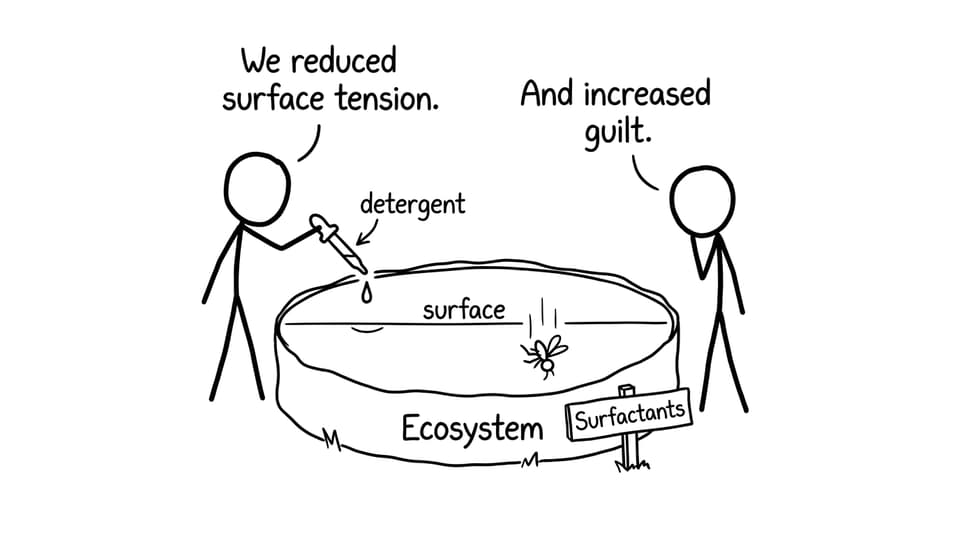
Surface tension is sensitive. Surfactants (like detergents) disrupt hydrogen bonding networks at the surface and lower the cohesive “film.” Oils can also alter surface properties and interfere with organisms that depend on the interface.
Temperature matters too. Higher temperatures increase molecular motion, weakening the effective cohesion and reducing surface tension. For a species finely tuned to the surface layer, that change can be the difference between skimming and sinking.
How to turn this into marks in IB Biology
Most IB Biology questions reward a tight chain: polarity -> hydrogen bonds -> cohesion -> surface tension -> biological consequence. If you drift into vague words like “stickiness,” you lose precision.
A strong revision path is:
-
Learn definitions via the IB Biology Key Definitions
-
Lock mechanisms with How Hydrogen Bonding Shapes Water's Properties
-
Practice application using A1.1.6 Physical properties of water Questionbank and recap quickly with A1.1.6 Flashcards
Bring it home: surface tension as an IB Biology advantage
Surface tension is small-scale physics with big ecological consequences. Once you can explain how hydrogen bonding creates a surface film, you can also explain why certain organisms can exist, how they feed, and why pollution can knock out an entire micro-habitat. That kind of multi-level thinking is exactly what IB Biology exams reward.
If you want to revise this the efficient way, RevisionDojo ties it together in one place: crystal-clear Study Notes, exam-style Questionbank practice, Flashcards for definitions, AI Chat for quick clarification, and Grading tools so you can see what “examiner language” looks like. Add Predicted Papers and Mock Exams when you’re close to test day, and use the Coursework Library and Tutors when you need deeper support. Surface tension may be the film holding a pond together, but IB Biology success is the system holding your revision together, and RevisionDojo is built for that.