


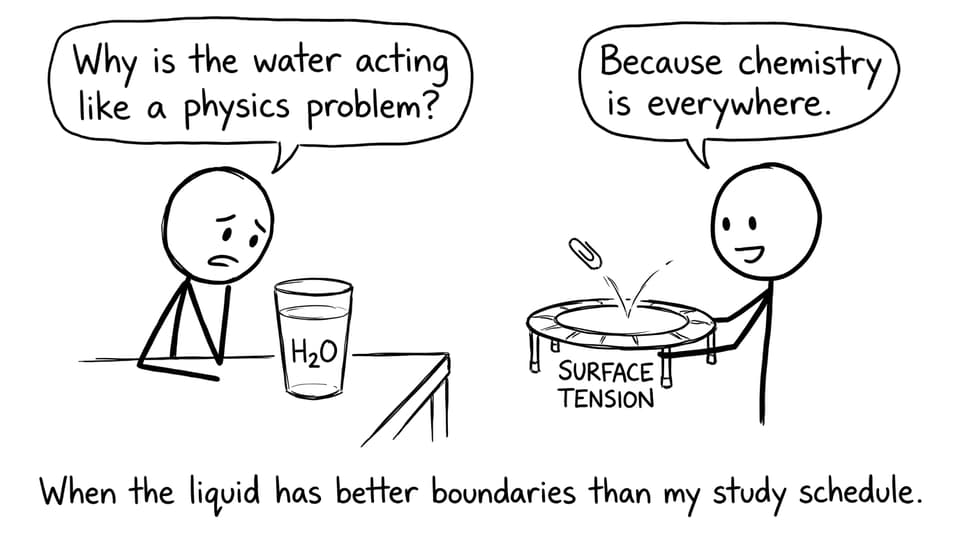
Water can hold itself together in a way that feels almost stubborn. A droplet beads up like it has a plan. A paperclip can float if you place it gently. And if you have ever watched a water strider skate across a pond, you have seen a quiet flex of physics powered by chemistry.
In IB Chemistry, this “invisible skin” is not a magic trick. It is a predictable consequence of molecular structure, polarity, and hydrogen bonding. The best part is that once you can explain it cleanly, you can reuse the same logic across questions on boiling point, viscosity, solubility, and intermolecular forces.
Quick checklist for an exam-ready explanation (IB Chemistry)
If you want a reliable 4-6 mark “Explain” response in IB Chemistry, make sure you can hit these points:
-
Define surface tension as a surface behaving like a stretched membrane due to cohesion.
-
State that water is polar because of electronegativity differences and bent shape.
-
Link polarity to hydrogen bonding between molecules.
-
Explain why surface molecules feel a net inward force (unequal attractions).
-
Conclude: strong hydrogen bonding network == unusually high surface tension.
To tighten your foundations fast, keep the relevant notes open while you practise: IB Chemistry Notes 2025 and the syllabus-aligned IB Chemistry Revision Notes (SL/HL).
What surface tension actually means
Surface tension is the tendency of a liquid surface to resist being stretched or broken. The key idea is unequal intermolecular attractions.
Inside the liquid, a molecule is pulled in all directions by neighbouring molecules, so the forces balance out. At the surface, there are fewer neighbours above. That means the attractions do not cancel. The surface molecules experience a resultant inward pull, and the surface minimizes its area, acting like a tight film.
This shows up in IB Chemistry questions when you are asked to interpret why droplets are spherical, why some liquids wet surfaces better than others, or why temperature changes the value of surface tension.
If you want the wider “toolkit view” of forces that drive these properties, revise from Intermolecular Forces Explained and the syllabus point notes: 4.4 Intermolecular forces (SL/HL).
Why water is polar (and why that matters in IB Chemistry)
Water’s polarity is the first domino.
-
Oxygen is more electronegative than hydrogen, so each O-H bond is polar.
-
The molecule is bent, so the bond dipoles do not cancel.
-
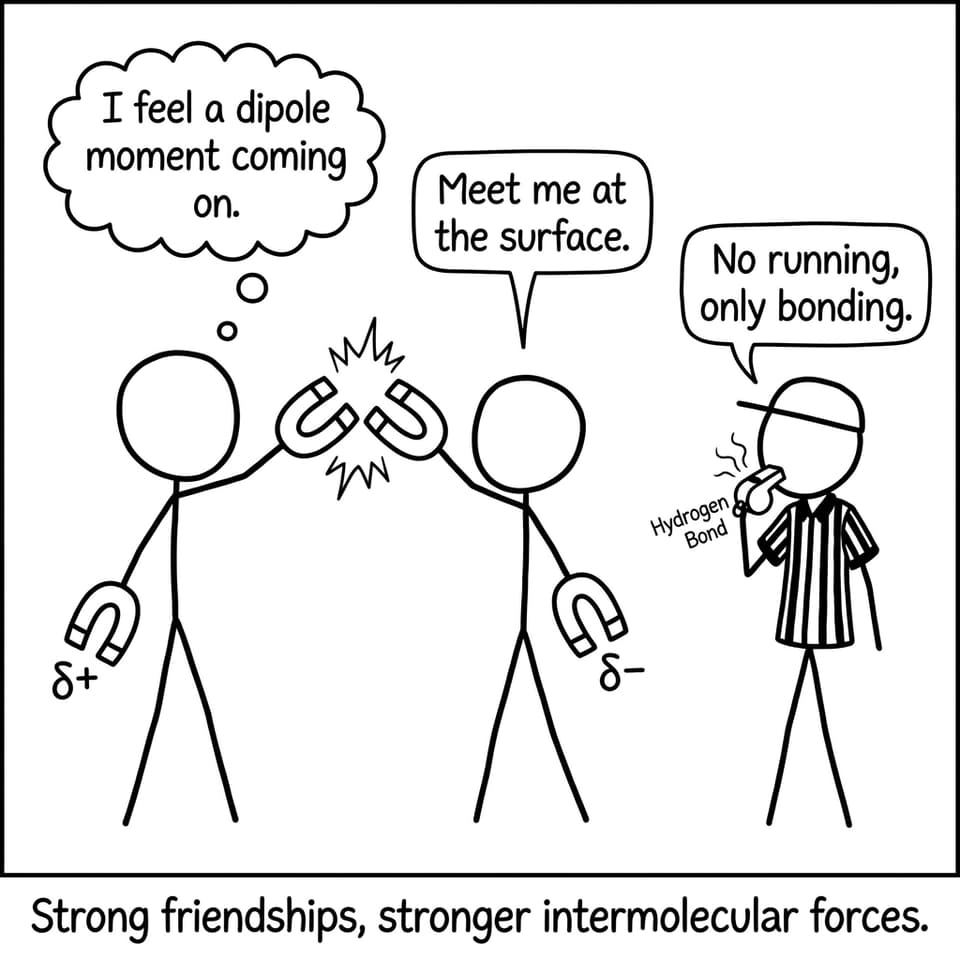
The oxygen end is δ- and the hydrogen end is δ+.
In other words, water molecules are “built” to attract each other strongly. In IB Chemistry, you are rarely rewarded for simply stating “water is polar.” You are rewarded for connecting polarity to a specific intermolecular force, and then connecting that force to a macroscopic property.
Hydrogen bonding: the real reason water’s surface tension is so high
Hydrogen bonding is the headline mechanism.
A hydrogen bond forms when hydrogen is covalently bonded to O, N, or F and is attracted to a lone pair on a neighbouring O, N, or F. In liquid water, each molecule can participate in multiple hydrogen bonds, producing a shifting but extensive network.
Here is the exam-friendly chain:
-
Water is polar (strong partial charges).
-
Those partial charges allow hydrogen bonds between molecules.
-
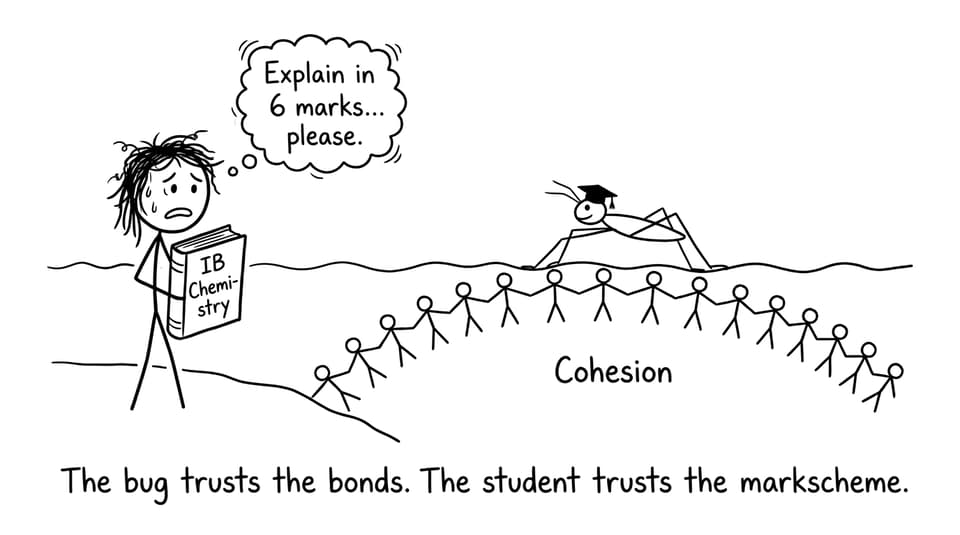
Hydrogen bonds increase cohesion (molecules stick to each other).
-
At the surface, cohesion creates a net inward pull, giving high surface tension.
To sharpen your wording and avoid common mistakes, it helps to read one clean definition and then drill it through questions: What Is Hydrogen Bonding? and 4.4 Intermolecular forces Questionbank.
What you can observe because of high surface tension
High surface tension is not just a definition. It has signatures:
-
Beading: water forms rounded droplets because the surface minimizes area.
-
Floating small objects: a carefully placed paperclip can sit on the surface without breaking the “film.”
-
Biology crossover: small organisms can exploit the surface layer as a habitat.
If you like seeing the same idea travel across subjects, you will enjoy: How Surface Tension Supports Life on Water.
Comparing water to other liquids (a common IB Chemistry angle)
A frequent IB Chemistry move is to compare water with ethanol, acetone, or non-polar liquids.
-
Many liquids rely mostly on London dispersion forces and (if polar) dipole-dipole attractions.
-
Water has especially strong intermolecular attraction because hydrogen bonding is stronger and more extensive.
So when a question asks why water has higher surface tension than, say, a non-polar liquid of similar size, your core justification is: stronger intermolecular forces lead to a larger net inward pull at the surface.
How to revise surface tension efficiently with RevisionDojo
This topic improves fastest when you practise explanations, not when you reread them.
A simple loop inside RevisionDojo:
-
Patch understanding with the IB Chemistry Resources hub and topic notes.
-
Use Flashcards for definitions like hydrogen bonding, cohesion, adhesion, and surface tension.
-
Drill exam-style prompts in the Questionbank, then use AI Chat to rewrite weak explanations into top-band language.
-
Once a week, run a timed set using Mock Exams or Predicted Papers to build calm under pressure.
If you need a broader plan for keeping this consistent, use: How to Study for IB Exams When You Feel Behind and How to Organize Your IB Notes Throughout the Year.
Closing: the calm way to earn marks on surface tension
Water’s high surface tension is not a random fact to memorise. In IB Chemistry, it is a story of structure creating forces, and forces creating properties: polar molecules form hydrogen bonds, hydrogen bonds create cohesion, and cohesion pulls the surface inward until it behaves like a stretched membrane.
If you want this to feel automatic by exam day, build the habit loop: Study Notes for clarity, Flashcards for definitions, Questionbank practice for explanations, and quick corrections using AI Chat and Grading tools. RevisionDojo brings that whole workflow together so your next IB Chemistry answer sounds less like guesswork and more like understanding.


