


The IB moment nobody prepares you for
It usually happens halfway through a tough IB paper.
You understand the question. You know the topic. You even know what the examiner wants.
Then your brain hits the smallest speed bump: the exact formula. Not the idea, but the exact version, notation, constants, and the little details that decide whether you earn method marks or lose them.
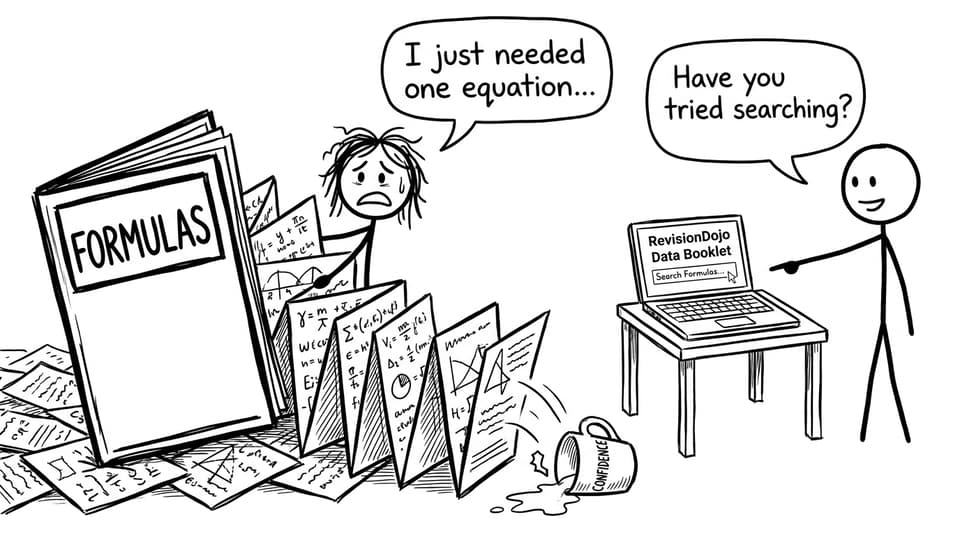
That’s why the Data Booklet is quietly one of the most powerful tools in IB exams. And it’s also why RevisionDojo’s Data Booklet feature matters: it takes something students treat like background noise and turns it into a practical, searchable, trainable skill.
RevisionDojo isn’t just a place to store formulas. It’s an entire IB ecosystem: Questionbank practice, Study Notes, Flashcards, AI Chat, Grading tools, Predicted Papers, Mock Exams, a Coursework Library, and Tutors, all designed to make your exam decisions simpler.
Quick checklist: how to use the IB Data Booklet like a tool (not a decoration)
If you want RevisionDojo’s Data Booklet to simplify calculations fast, start here:
-
Open the relevant Data Booklet for your course (Math AA or Math AI, SL or HL).
-
Pick two sections you keep revisiting (for most IB students: Calculus + Statistics).
-
Do one short Questionbank set with the Data Booklet open.
-
Write down one “navigation note” (example: “normal distribution formulas live in stats section; look for μ and σ”).
-
Finish by turning one recurring mistake into a flashcard.
For the most common Math routes, begin at the IB Mathematics Analysis and Approaches hub and build outward.
What’s actually inside the IB Data Booklet (and why it matters)
Most IB students treat the Data Booklet like a list. But it’s better to see it as a boundary line.
It tells you:
-
what the exam is willing to give you,
-
what you’re expected to recognise quickly,
-
and what you still must carry in your head.
RevisionDojo’s version keeps the official structure, but makes it easier to work with under pressure. That matters because “knowing a formula exists” is not the same as “finding it in 12 seconds while your timer is ticking.”
If you’re studying math, use the right booklet from the start:
And if you take sciences, the same principle applies:
How RevisionDojo’s Data Booklet simplifies complex calculations
Complex calculations in IB exams rarely fail because you can’t do algebra. They fail because of friction:
-
you waste time locating the right relationship,
-
you copy it incorrectly,
-
you mismatch symbols,
-
or you apply it in the wrong context.
RevisionDojo’s Data Booklet is built to reduce that friction in a few practical ways.
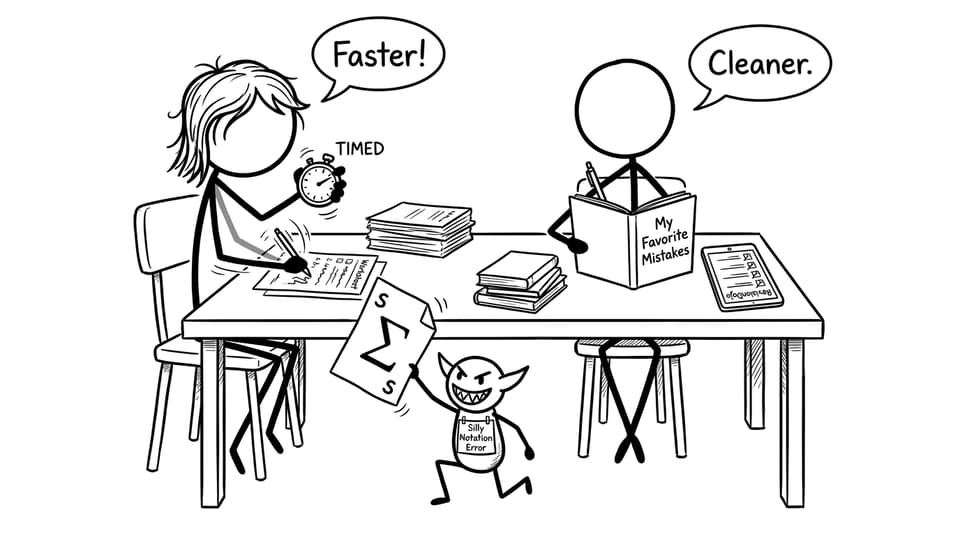
Faster retrieval means more marks under time pressure
In an IB paper, your real enemy isn’t difficulty; it’s delay. Every extra minute spent hunting a formula is a minute you don’t spend explaining working clearly.
RevisionDojo makes the Data Booklet feel like something you can navigate deliberately, especially when paired with timed practice from the Questionbank.
To train that retrieval skill, combine the booklet with targeted sets in the Questionbank feature. The goal is to make “find formula, substitute, interpret” feel automatic.
Cleaner notation reduces avoidable mistakes
A surprising number of IB errors are not concept errors. They’re notation errors.
Statistics is a classic example: mixing up parameters, misreading subscripts, or swapping population vs sample symbols. When you’re stressed, your eyes see what they expect.
RevisionDojo helps by keeping your reference consistent, and by letting you immediately reinforce meaning with linked learning tools. If you’re revising Math AA, you can anchor your notation practice inside topic pages like Statistics and Probability for IB Math AA, then test it right away.
Context turns formulas into decisions (not memory tests)
In IB Math, it’s rarely enough to quote a formula. Examiners reward the ability to decide:
-
Is this a modelling situation or a pure manipulation question?
-
Do I need a general result or a special case?
-
Is this asking for an exact form or an approximation?
That’s why RevisionDojo pairs the Data Booklet mindset with structured learning: use Study Notes to understand the “when,” then use practice to harden the “how.” If you need a reliable framework, follow a guide like How to Revise IB Math AA and AI Effectively.
A simple IB workflow: Data Booklet + practice loop
If you want the Data Booklet to simplify calculations, you need a repeatable loop that turns reference into reflex.
Learn the idea
Start with topic clarity. For calculus-heavy students, the IB Math AA Calculus topic page is a good hub because it connects notes, practice, and recall resources.
Practice with the booklet open
Do a short, specific set (10-15 questions). The point is not volume. It’s building a habit of using the Data Booklet correctly.
A useful companion strategy is explained in IB Math: Targeted Revision Using the Questionbank.
Turn mistakes into recall
Formulas become reliable when you can recall the meaning even if you don’t recall the layout. That’s where Flashcards come in.
Use IB Flashcards with Spaced Repetition (SRS) to lock in your most common “I always forget which one is which” moments.
Rehearse under pressure
When you’re closer to exams, you want the full IB feeling: timing, fatigue, and decision-making. That’s where RevisionDojo’s Predicted Papers and Mock Exams become the bridge.
Start exploring at IB Predicted Papers, then use your results to choose which Data Booklet sections deserve attention.
Common IB Data Booklet mistakes (and how to avoid them)
Most students don’t lose marks because they didn’t have the formula. They lose marks because the formula didn’t protect them from rushed thinking.
Here are mistakes worth training out:
-
Copying errors: missing brackets, wrong sign, wrong power.
-
Units drift: substituting values without checking units.
-
Symbol confusion: treating similar symbols as interchangeable.
-
Over-trusting the booklet: quoting a formula but not showing method.
A surprisingly effective habit is to build a tiny “error log” and update it after each session. Pair that with Flashcards so your errors become spaced repetition, not repeated pain.
FAQ
Is the Data Booklet allowed in IB exams, and does it guarantee marks?
Yes, the Data Booklet is provided for relevant IB exams, and you are allowed to use it during the paper. But it doesn’t guarantee marks on its own, because marks are awarded for method, reasoning, and clear communication. A formula written without correct substitution, working, and interpretation is usually not enough to secure full credit. This is why it’s worth practising with the Data Booklet during revision, not discovering it during the exam. RevisionDojo’s approach helps you build the habit: locate the relationship, apply it correctly, and present the steps the examiner expects. When you practise that loop in the Questionbank, the booklet becomes a tool for speed and accuracy, not a last-minute rescue.
Should I memorise formulas that are already in the IB Data Booklet?
Not all of them, and trying to memorise everything can waste time and increase stress. What matters is knowing what is provided, recognising it instantly, and understanding what each piece of notation means. Many strong IB students memorise only high-frequency items that save time to recall (even if they’re provided), while still relying on the booklet for verification. The more important “memorisation” is actually navigation: knowing where to find what you need quickly. RevisionDojo helps because the Data Booklet connects naturally to study resources, so your memory becomes conceptual rather than just symbolic. If you want to strengthen recall efficiently, build a small flashcard deck for your personal weak points rather than the entire booklet.
How do I get faster at using the Data Booklet during IB Math exams?
Speed comes from repetition under realistic constraints, not from reading the booklet more times. Start by doing short timed sets where you force yourself to use the Data Booklet for any formula you might normally try to recall. Then track which sections you open most, and write one-line navigation notes for them. After that, increase pressure: sit a longer mixed-topic set so you practise switching sections without losing time. RevisionDojo makes this easier because you can move from Study Notes to Questionbank to timed practice without changing platforms or hunting resources. If you want a clean structure for building speed, combine Data Booklet work with the broader IB routine in RevisionDojo: targeted practice, fast feedback, and spaced review.
Bring it home: make the IB Data Booklet your calm advantage
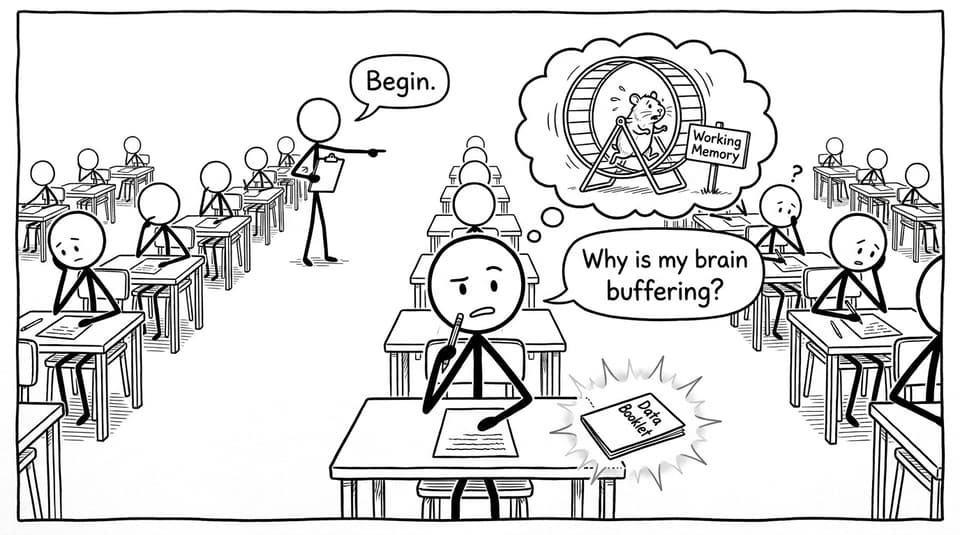
The best IB students don’t “know more” in the exam hall. They carry less in working memory, and they make fewer avoidable mistakes.
That’s the real promise of RevisionDojo’s Data Booklet: it simplifies complex calculations by reducing friction, finding formulas faster, applying them more cleanly, and reinforcing meaning through practice.
If you want the easiest next step, open the correct booklet, then run one focused Questionbank set and write down your two most frequent formula moments. Do that for a week.
Your IB calculations won’t just get faster. They’ll get calmer. And that calm is where marks tend to appear.