


A school can display flags from 40 countries and still feel surprisingly narrow. Another may serve mostly local families, teach in the national language, and create genuinely international conversations every day.
That tension explains how international IB schools worldwide really are. The International Baccalaureate is global in scale, curriculum, assessment, and institutional reach. Yet the experience inside any IB World School is shaped by local families, national regulations, languages, funding, admissions, and school culture.
For prospective families, the IB label is a useful starting point, not a complete description. Understanding a school means examining both halves of its identity: the shared IB framework and the particular community delivering it.
The global IB community at a glance
The IB's consolidated facts page reports that, as of October 2024, more than 8,000 IB programmes were offered across over 5,900 schools in more than 160 countries. Together, the four programmes served more than 1.95 million students aged 3-19.
Three distinctions help explain those figures:
- One school can offer several programmes, so programme and school totals differ.
- Schools are authorized separately for the Primary Years Programme, Middle Years Programme, Diploma Programme, and Career-related Programme.
- An IB World School may be public, private, national, bilingual, international, selective, urban, or rural.
Families new to these distinctions can start with this guide to the International Baccalaureate and overview of the four IB programme levels.
The May 2025 Diploma Programme and Career-related Programme assessment session further illustrates the network's reach. The IB recorded 202,102 students across 3,400 participating schools in 153 countries, representing 213 reported first nationalities. This is not a census of every IB student, but it shows that the senior IB community crosses borders meaningfully.
A checklist for prospective families
When deciding whether a school feels genuinely international, ask:
- Is the campus authorized for your child's specific programme?
- Is the student body internationally mixed, locally rooted, or both?
- Which languages are used for teaching, assessment, and family communication?
- How are local and global perspectives represented in lessons?
- Do students collaborate across cultural or linguistic differences?
- Are local and internationally mobile students equally included?
- Does the school offer suitable subjects, wellbeing support, and university guidance?
- Can students provide specific examples of international-mindedness?
A prospectus may answer the first question. A school visit, policy review, and conversation with students will reveal more. RevisionDojo's guide to choosing an IB school offers a fuller comparison framework.
Global does not always mean expatriate
The familiar image of an international school is a private campus filled with children whose families move regularly between countries. Some IB schools fit that image. Many do not.
Students attend state-funded schools, independent national schools, bilingual institutions, specialist academies, and traditional international schools. In some countries, IB programmes have a substantial public education presence. Elsewhere, provision may be concentrated in fee-charging schools.
The word international can therefore describe several qualities:
| Form of internationalism | What it may look like |
|---|---|
| Demographic | Students and teachers hold many nationalities |
| Curricular | Lessons consider multiple cultural perspectives |
| Linguistic | Several languages are taught or supported |
| Institutional | The school follows an internationally authorized framework |
| Aspirational | Students prepare for opportunities across borders |
| Relational | Students collaborate and disagree constructively across differences |
A school can be strong in one category and weak in another. A largely local student body may engage deeply with global questions. Conversely, a multinational campus can remain socially divided if students rarely move beyond familiar cultural or language groups.
What internationalism feels like to students
Students rarely experience internationalism as a statistic. They encounter it in ordinary moments: a discussion in which classmates interpret the same event differently, a literature lesson that asks whose voice is missing, or a science project connecting a global issue with local evidence.
These moments should be visible in normal school life, not manufactured for a tour. Families can ask current students whether different groups mix naturally, home languages are respected, unfamiliar viewpoints appear in lessons, and classroom disagreement is handled thoughtfully.
Listen for examples rather than slogans. A student who can explain how a discussion changed their assumptions reveals more than a wall covered in flags.
Language reveals the local reality
Language is one of the clearest tests of how international education works in practice. The IB's external working languages are English, French, and Spanish. Schools may implement programmes in other languages within IB requirements, although support and assessment availability vary by programme and language.
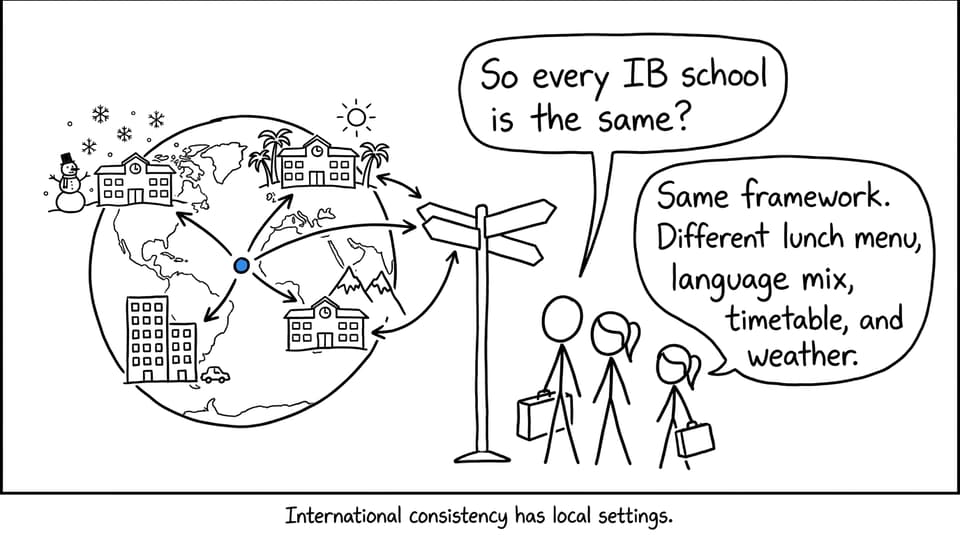
Two IB World Schools in the same city can therefore have different linguistic environments. One may teach mainly in English while supporting several home languages. Another may deliver much of the curriculum in the national language and offer selected subjects in English or French.
Families should confirm the classroom language for each subject, available assessment response languages, support for developing academic fluency, home-language provision, and communication options for parents. Multilingualism is not the number of languages in a brochure. It is whether students can participate fully while developing the language required for complex academic work.
A common framework, not an identical education
The IB creates continuity through programme standards, authorization, evaluation, teacher development, and common assessment structures. A student changing countries may recognize familiar concepts, terminology, and approaches to learning.
However, schools make local decisions about subjects, timetables, texts, projects, staffing, and support. A Middle Years Programme student may encounter a different unit sequence after moving. A Diploma Programme student may discover that a desired Higher Level subject is unavailable.
This balance between shared structure and local interpretation allows the framework to remain relevant in different societies. Families should investigate the specific campus rather than assuming every authorized school is interchangeable. Those considering the middle years can explore why international schools choose the MYP. Mobile families should compare course pathways, language options, and assignment progress before relocating.
International reach does not guarantee access
Geographic spread should not be confused with universal accessibility. Fees, admissions criteria, transport, language expectations, and limited regional provision can restrict participation.
The pattern varies by country. Some public systems offer IB programmes broadly, while elsewhere they remain concentrated in independent schools. Additional learning support, technology, optional travel, and assessment-related charges may also affect the total cost.
Families should request a complete fee schedule, ask about scholarships or bursaries, and review support for learning or language needs. An international community is meaningful only when belonging extends beyond students who already find such environments easy to navigate.
Recognition matters, but school fit matters more
One attraction of the IB is portability. Universities around the world recognize the Diploma Programme, although requirements vary by institution, course, country, subjects, and Higher Level results. Families can learn more through this guide to international IB recognition.
Recognition should not distract from implementation. A famous name or high average score cannot reveal whether teachers give useful feedback, deadlines are coordinated, or students feel comfortable asking for help. There is no official worldwide IB school ranking, and third-party lists use different methods. RevisionDojo's explanation of global IB school rankings helps families interpret them cautiously.
The strongest choice is usually the school where subjects, teaching, support, and culture fit the individual student.
Turning a global curriculum into daily progress
Wherever a student studies, academic challenges eventually become personal. Global scale does not plan tomorrow's essay or resolve today's misunderstanding.
RevisionDojo turns the shared framework into practical support. Students can clarify concepts with Study Notes and Flashcards, practise through the Questionbank, ask focused questions using AI Chat, and use Grading tools to identify where marks are being lost. Predicted Papers and Mock Exams support timed preparation, while the Coursework Library and Tutors provide structure for larger assignments.
A student in Singapore, São Paulo, Nairobi, or Toronto may learn in a very different community. Shared assessment expectations nevertheless create enough common ground for a focused IB resource to travel with them.
The international school students experience
IB schools worldwide form a genuine global network, but internationalism is not guaranteed by geography, branding, or nationality counts. It is built through inclusive relationships, language support, thoughtful teaching, and a willingness to consider other perspectives.
Families should verify authorization, investigate the local reality, and speak with the students living it each day. Once the right school is chosen, RevisionDojo can remain the consistent academic companion within an education that is global in framework, local in character, and personal in experience.