

The first time you get serious IA comments, it can feel like opening a suitcase you didn’t pack.
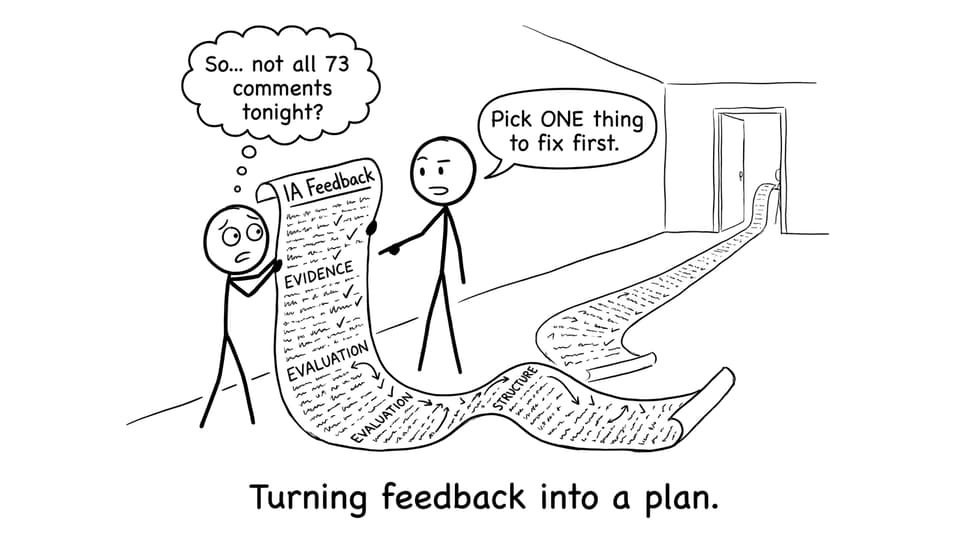
A few neat notes. A few confusing ones. And a couple that land like, “Please rewrite your entire brain.” For many IB students, the instinct is either to panic-fix everything at once or to quietly close the document and pretend the feedback will mature into marks on its own.
But there’s a calmer truth hiding inside the red highlights: IB IA feedback is not just about improving one assignment. When used well, it becomes exam preparation in disguise. It trains the same muscles you need for Paper responses: interpreting criteria, making evidence do real work, and explaining your thinking under pressure.
This guide shows how IB teachers can turn IA feedback into real learning opportunities and, more importantly, how you as an IB student can use that system to score more reliably in exams.
Quick checklist: what “useful IB IA feedback” looks like
If your teacher is doing IA feedback well, you should be able to do these things within 10 minutes of reading it:
-
Identify which IB criterion each comment is really about (not just what line it points to)
-
Turn comments into 1--2 priorities for the next draft (not 15)
-
Write one sentence describing the skill you’re improving (analysis, evaluation, structure, academic honesty)
-
Plan the next revision as a short cycle (edit, re-check, ask one question)
-
Store your feedback somewhere you can revisit during exam revision
When this is hard, tools help. Many students use RevisionDojo’s ecosystem to make the feedback loop faster: Study Notes, Flashcards, AI Chat, and Grading tools all turn vague advice into a plan you can actually execute.
A good starting point for organizing coursework feedback across a cohort is RevisionDojo for Schools.
Why IB IA feedback matters for exams (even if you’re “done” with the IA)
In the IB, the IA is one of the few places you see your thinking evaluated in slow motion. Exams happen fast. IAs happen with pauses, drafts, and reflection. That means teachers can coach the skills that exams later demand.
Here’s the exam connection most students miss:
-
If feedback says your analysis is thin, you’ll likely lose marks in data-based questions too
-
If feedback says your evaluation is generic, your essay conclusions will drift into vague summaries
-
If feedback says your structure is unclear, your Paper arguments will become hard to follow under time pressure
That’s why students who learn to “speak criteria” during the IA often feel calmer later. They’re not guessing what quality looks like. They’ve practiced it.
If you want a student-friendly way to decode confusing comments, pair this article with Why IA Feedback Feels Confusing for IB Students.
IB teachers: anchor every comment to criteria (students: demand this clarity)
The biggest upgrade a teacher can make is simple: stop giving feedback that sounds like personality, and start giving feedback that sounds like a skill.
Instead of:
- “This is unclear.”
Try:
- “In IB terms, this hurts communication because the reader can’t follow your chain of reasoning. Add one signpost sentence that explains what the paragraph will prove.”
Instead of:
- “Needs more evaluation.”
Try:
- “Your evaluation names a limitation but doesn’t explain impact on results and how you’d improve the method. That’s the difference between mid-band and top-band evaluation.”
As a student, you can also prompt better feedback by asking for it in criterion language. A practical template is explained in How IB Teachers Can Deliver Better IA Feedback in Less Time.
Turn IB IA feedback into a dialogue (not a verdict)
The most motivating feedback feels like a conversation. The least motivating feedback feels like a sealed envelope.
Teachers can create dialogue by requiring a short student response, even if it’s just three lines:
-
What I think the main issue is (in IB criterion terms)
-
What I will change in the next draft
-
One question I still have
Students: this is where you win time. A two-sentence reply can prevent hours of revising the wrong thing.
When you get stuck on what a teacher comment means, RevisionDojo’s AI Chat is useful as a translator: paste the comment and ask, “What action would raise this criterion band?” Then confirm the plan with your teacher.
Use phased feedback: plan, draft, polish
One reason IB students hate IA feedback is volume. When every issue appears at once, it all feels equally urgent. It isn’t.
A better approach is staged feedback cycles:
Early phase: research question and structure
This is where teachers should challenge the foundation: focus, feasibility, method logic, and whether the IA is actually answering its own question.
Middle phase: analysis and reasoning
This is where the marks often live. Teachers should push for explanations that connect evidence to claims and show the “why,” not just the “what.”
Late phase: communication and exam-readiness
This is where clarity, formatting, citations, and evaluation polish matter. It’s also the best time to connect IA skills to exam writing.
To make those phases less guessy, many students use the IB Internal Assessment Feedback: Detailed Comments and Suggestions guide as a reference point while revising.
Feedforward: write feedback in “next time” language
Some feedback is backward-looking: what went wrong.
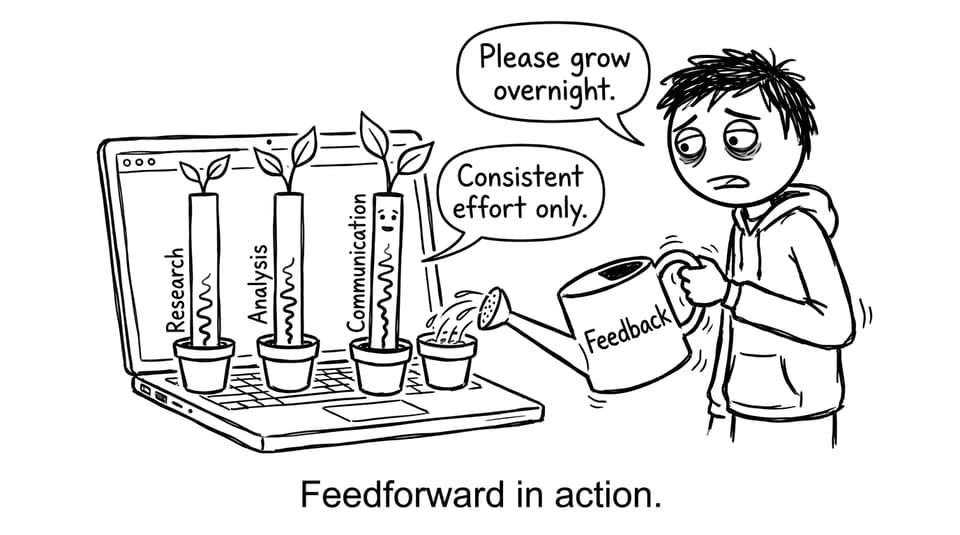
The feedback that changes outcomes is forward-looking: what you’ll do differently next time.
Teachers can convert comments into feedforward by adding one line to every major point:
-
“Next time, do X earlier.”
-
“Next time, link your conclusion to Y evidence explicitly.”
-
“Next time, evaluate impact not just existence of limitations.”
Students can do the same conversion as a habit: rewrite each major comment as a “next time” instruction. This is how IA feedback becomes exam technique.
If you want a structured loop that mirrors how you improve in timed papers, the RevisionDojo workflow described in RevisionDojo App: The Smarter Way to Prep for IB Exams is a clean model: learn, drill, simulate, review.
Peer review that actually helps (and doesn’t turn into compliments)
Peer review fails when it becomes emotional support.
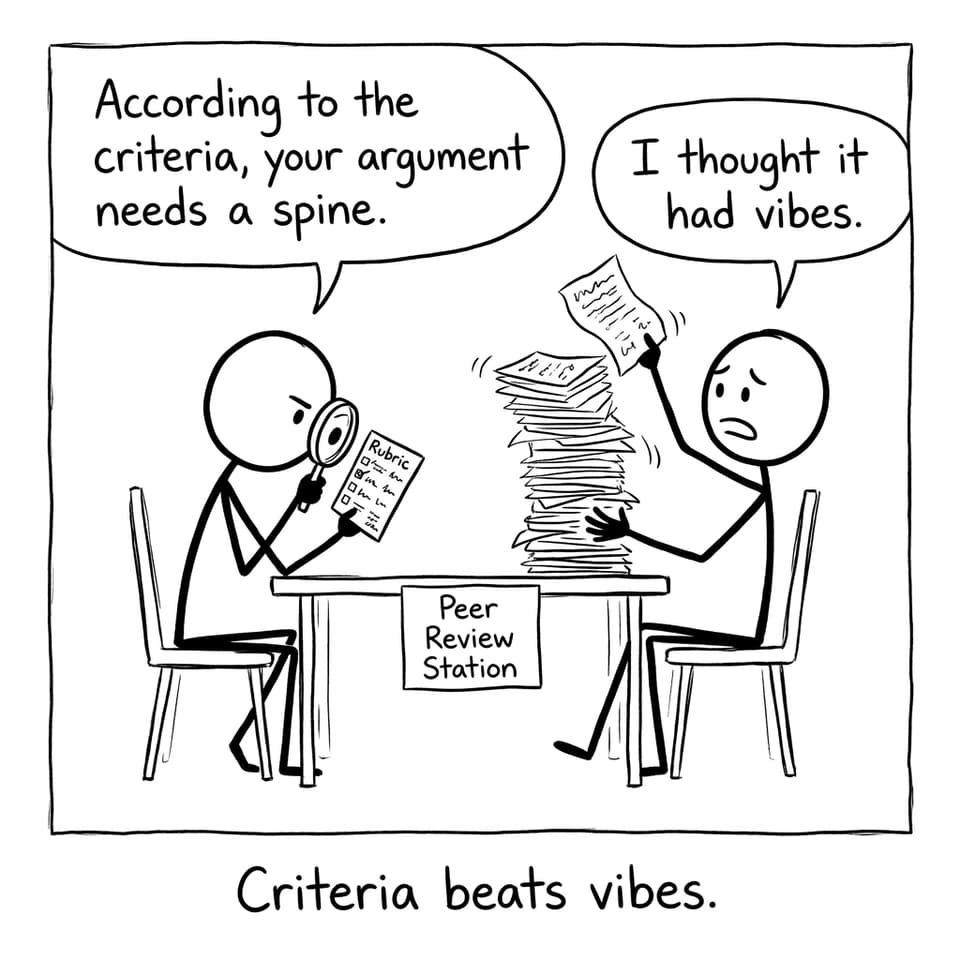
It succeeds when it becomes criteria practice.
A simple teacher move: give students a mini-rubric with only 3 checks:
-
Where is the claim?
-
What evidence supports it?
-
Where is the explanation that earns marks?
Students: doing this for someone else trains your own exam instincts. You learn what a high-scoring response looks like before you have to write one under time pressure.
Use exemplars to stop guessing what “good” means
Teachers often assume students can imagine the difference between an okay IA and a strong one. Most can’t.
Exemplars solve that. Not as “copy this,” but as calibration:
-
What does strong analysis sound like?
-
How explicit is the evaluation?
-
How is the structure signposted?
RevisionDojo’s Coursework Library is built for exactly this moment: when you need models to compare against, not just more advice.
Connect IA feedback to the last weeks of IB exam prep
Here’s the move that makes IA feedback pay off in exams: turn your top 3 recurring IA issues into your revision themes.
For example:
-
If feedback says “explain your reasoning,” do exam practice that forces explanation (then check with Grading tools)
-
If feedback says “evaluation is generic,” practice building conclusions that discuss impact and limitations
-
If feedback says “structure is unclear,” rehearse paragraph frames and signposting
RevisionDojo makes this loop practical:
-
Use the Questionbank for targeted drilling (see Questionbank)
-
Use Study Notes to patch the concept behind the mistake (start at RevisionDojo for IB)
-
Use Flashcards to keep the fix alive after 48 hours
-
Use Mock Exams and Predicted Papers when you’re ready to rehearse timing (browse IB Predicted Papers)
This is how IB feedback becomes an engine: comment, action, practice, proof.
FAQ
How much IA feedback is actually helpful for an IB student?
Helpful IB IA feedback is specific enough to act on and small enough to finish. When feedback turns into a wall of comments, students either freeze or “patch edit” without learning. A better standard is: a few high-impact points tied to the criterion plus one clear next step per point. Students should be able to identify what matters most within a single reread. Teachers can still leave minor notes, but they should be clearly labeled as “polish” rather than “priority.” The goal is improvement you can measure, not commentary you can admire.
How can I make sure I’m using IB IA feedback instead of just feeling bad about it?
Start by rewriting each comment into an action, using IB criterion language. Then sort actions into Major (changes the markband), Medium (improves clarity), and Minor (formatting and tidy-up). Pick one Major action and complete it before touching anything else. After that, do a short proof step: ask, “What would an examiner now award that they couldn’t before?” If you want faster clarity, run your draft through RevisionDojo’s Grading tools and ask AI Chat to explain what a top-band version would include. The feeling fades when the plan becomes concrete.
How should teachers handle IB IA feedback when the class is large?
Large cohorts require systems, not heroics. Teachers can build a shared comment bank mapped to IB criteria so common issues are addressed consistently and quickly. Phased deadlines also reduce overload: feedback on research question first, then analysis, then evaluation and communication. Short conferences can replace long written explanations when the misunderstanding is conceptual. Schools can centralize patterns using How RevisionDojo Enhances IB Internal Assessment (IA) Feedback and Moderation, which supports rubric-based workflows and consistency across subjects. When students see the same language across classes, they learn faster.
Conclusion: let IB IA feedback become your exam advantage
The most successful IB students aren’t the ones who receive less feedback. They’re the ones who turn feedback into a repeatable loop: identify the criterion, choose one priority, revise, then practice the same skill under pressure.
If you want that loop to feel simpler, build it inside RevisionDojo. Use the Coursework Library to calibrate quality, AI Chat to translate confusing comments, Flashcards to keep improvements from disappearing, the Questionbank to drill weak skills, and Mock Exams plus Predicted Papers to make exam day feel familiar.
Your IA might be submitted. But your learning from it doesn’t have to be.