


In an IB classroom, the most expensive currency isn’t content. It’s time.
You can watch it disappear in a familiar loop: a smart student writes quickly, the argument wanders, the evidence lands without meaning, and the conclusion sounds confident but proves nothing. The teacher marks it, explains structure again, and hopes it sticks. Then the next essay arrives and the cycle repeats.
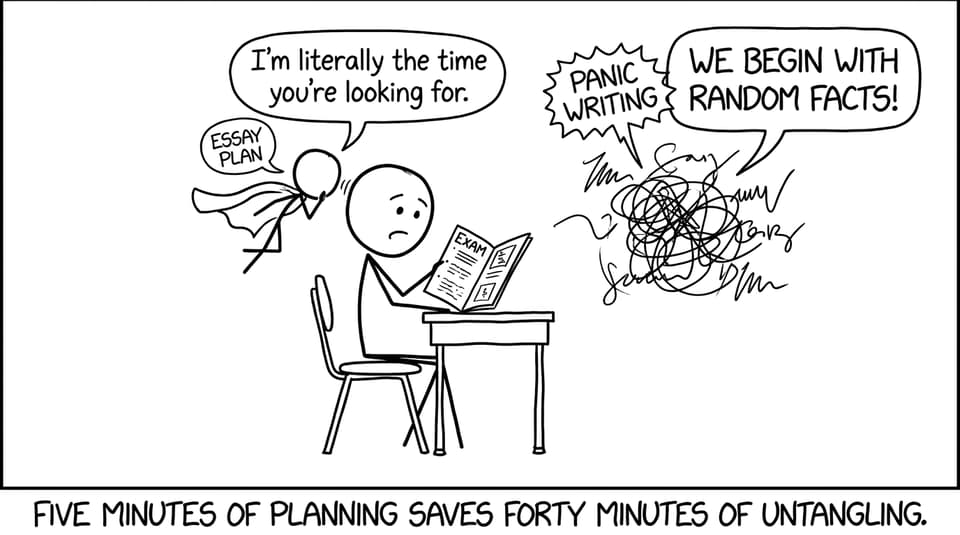
But in IB exams, structure is not decoration. It’s how clarity survives time pressure. And the good news is that essay planning and structure can be taught efficiently, not by adding more rules, but by making planning feel like the shortest path to a better grade.
Quick checklist: the efficient IB essay structure routine
If you only remember one approach for IB essay planning, make it this:
-
Deconstruct the question (command term + scope + concept)
-
Write a one-sentence thesis (a judgement, not a topic)
-
Choose 2-3 arguments max (depth beats coverage in IB)
-
Attach evidence to each argument before drafting
-
Plan links back to the question for every paragraph
-
Use a consistent paragraph framework across tasks
-
Practice timed planning weekly (short, repeatable, low-friction)
To make this routine easier to rehearse at home, students can pair it with RevisionDojo’s Questionbank practice and track which prompts cause structure to break down.
Why IB essay planning and structure matter more than “good writing”
IB essays reward visible thinking. Examiners can’t award marks for insight that never becomes clear on the page. A strong IB essay structure makes your argument easy to follow, your evidence easy to credit, and your evaluation easy to trust.
When students skip planning, they usually don’t save time. They borrow it, with interest. They spend the middle of the essay fixing direction, the end of the essay rushing evaluation, and the final minutes praying the conclusion will solve a problem it didn’t create.
Efficient teaching means students stop treating structure as something teachers want and start treating it as something the clock demands.
Teach the “thinking step” first: question deconstruction
Most IB structure problems begin before the first sentence.
Students often read an essay question like it’s a theme (“globalization,” “power,” “identity”) instead of a task. Efficient IB teachers make question deconstruction non-negotiable and fast:
-
Underline the command term (evaluate, discuss, to what extent)
-
Circle the scope (time period, region, text type, stakeholders)
-
Name the key concept in student-friendly words
-
Translate the question into a simple “I must judge X by weighing Y and Z” sentence
This is where structure quietly appears. Once the student has a judgement, their introduction writes itself and their paragraphs have a job.
If you want subject-specific examples of what this looks like, RevisionDojo has targeted guides like IB History Essay Structure: Plan Fast, Write Better and TOK Essay Structure: A Comprehensive Guide.
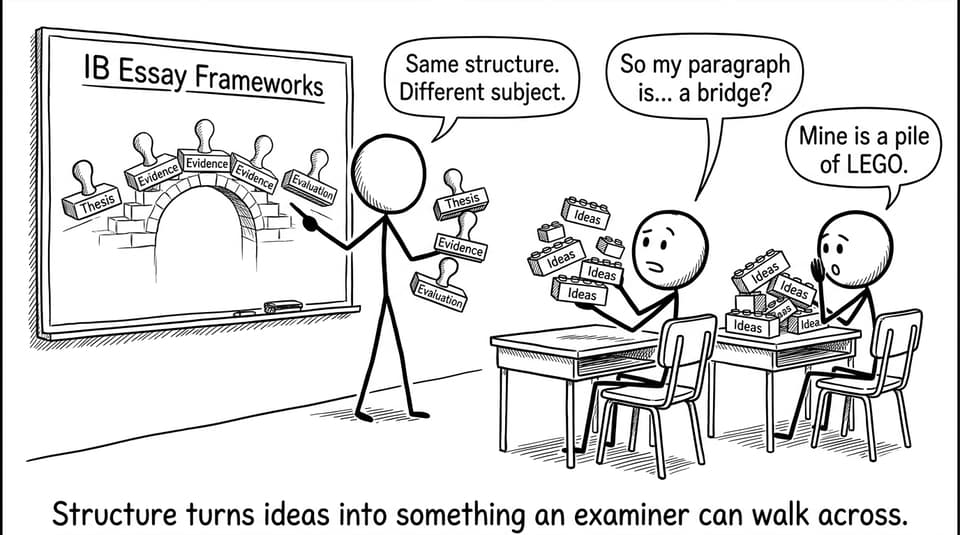
Use one “IB essay DNA” across subjects
Efficiency comes from consistency. Students don’t struggle because they’re incapable. They struggle because every class sometimes feels like a new set of unwritten rules.
A practical approach is to teach one portable structure that adapts across IB subjects:
A reliable IB paragraph structure (portable across subjects)
Use a simple sequence students can repeat under pressure:
-
Claim (argument that answers the question)
-
Evidence (example, quote, data, case study)
-
Analysis (how evidence proves the claim)
-
Evaluation (limitations, counterpoint, nuance)
-
Link (explicit return to the question)
You can call it PEEL, CLAIM, EVIDENCE, LINK, or something your department agrees on. The label matters less than the habit.
For students in English courses, it helps to see how this “DNA” becomes a full essay blueprint in Structuring Your IB English Paper 2 Essay and IB English: How to Write a Good Literature Essay.
Model planning live (and narrate the invisible parts)
Students copy what they can see. Unfortunately, most of planning is invisible.
Efficient IB teachers make planning visible by doing it live:
-
Put an IB-style prompt on the board
-
Set a 4-6 minute timer
-
Plan in real time: thesis first, then 2-3 arguments, then evidence, then a counterpoint
-
Narrate decisions: “I’m choosing this example because it lets me evaluate, not just describe.”
This matters because it teaches students the difference between knowing content and using content. IB rewards the second.
A good extension is to assign “plan-only homework”: students submit a thesis + three bullet paragraphs. It’s fast to check, and it trains the part that collapses in timed conditions.
Teach timed planning like it’s a skill, not advice
Many IB students “believe” in planning the way people believe in flossing. They agree it’s good. They skip it when life gets loud.
So teach timing as a routine:
-
5-minute plan rule: no writing sentences until the plan exists
-
One line per paragraph: claim + evidence placeholder + evaluation angle
-
Thesis in 12 words: forces clarity and prevents “topic introductions”
The point isn’t to make planning longer. It’s to make planning automatic.
Students can rehearse this at home by using RevisionDojo’s Flashcards feature to drill command terms and evaluation phrases, then applying them in short bursts.
Scaffold hard, then remove it on purpose
The fastest route to independence is not “less help.” It’s the right help, withdrawn at the right time.
A simple IB structure ladder looks like this:
-
Stage 1: paragraph frames (sentence starters for claim, analysis, evaluation)
-
Stage 2: skeleton outlines (headings only: thesis, P1, P2, P3, counter)
-
Stage 3: blank plan (students generate the structure from the prompt)
If you don’t remove scaffolds deliberately, students will keep asking for them. If you remove them too early, students will panic-write. The efficient middle path is planned withdrawal.
Use peer review to outsource the “structure spotting”
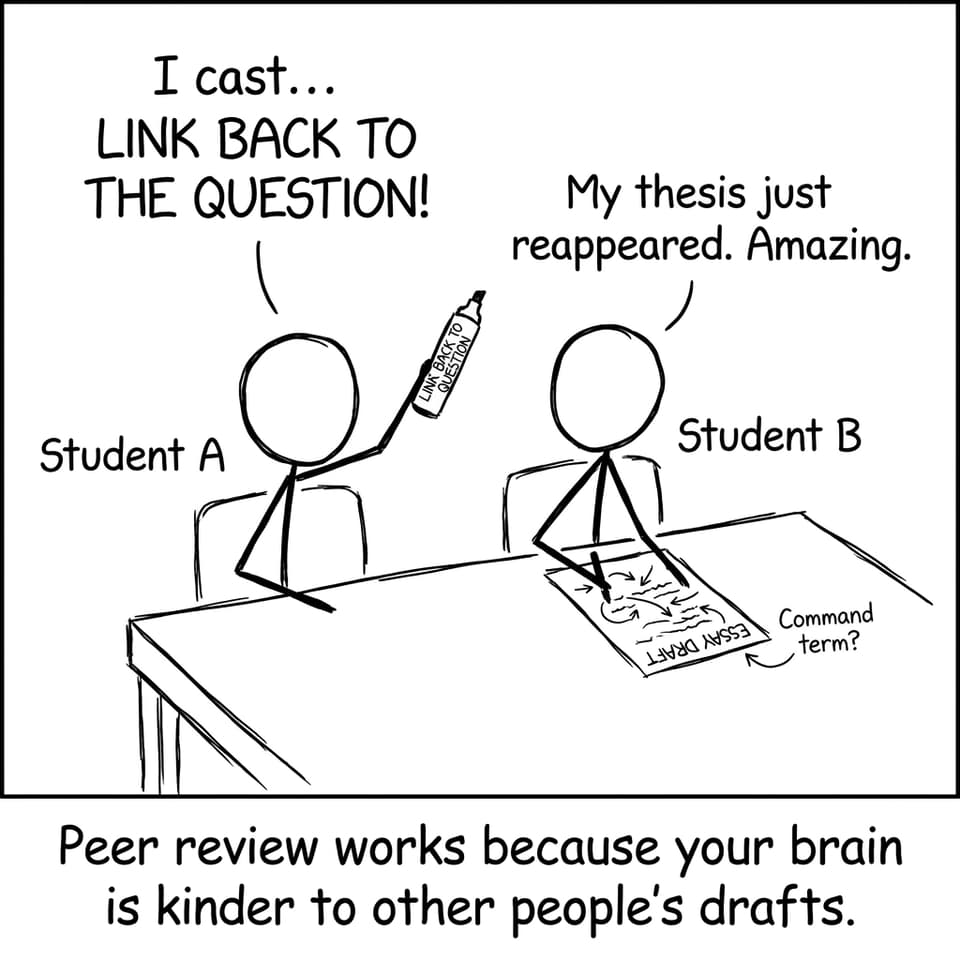
Peer review saves time because it turns structure into something students can detect, not just receive.
A fast IB peer review protocol:
-
Swap plans, not full drafts
-
Partner highlights the thesis and labels each paragraph’s job
-
Partner checks: “Does every paragraph link back to the question?”
-
Partner adds one missing evaluation angle (“What would someone disagree with here?”)
This teaches a key IB skill: seeing the difference between a point and an argument.
Leverage RevisionDojo to make structure practice cheaper
For IB students preparing for exams, structure improves fastest when feedback is frequent and specific. That’s hard to scale with teacher marking alone.
RevisionDojo is built to lighten that load while keeping the focus on IB criteria and exam performance:
-
Questionbank for steady, exam-style practice loops
-
Study Notes to keep content accurate and organized (Study Notes feature)
-
Flashcards for command terms, thesis stems, and evaluation language
-
AI Chat to clarify misunderstandings quickly (without waiting for the next lesson)
-
Grading tools for written feedback that targets structure and criteria (IB Coursework Grader)
-
Predicted Papers and Mock Exams to rehearse planning under realistic pressure
-
Coursework Library to see what strong structure looks like in real student work
-
Tutors when a student needs a human to diagnose habits and rebuild them
For teachers coordinating whole cohorts, RevisionDojo for Schools adds class-level workflows that make it easier to spot patterns (like weak evaluation or repetitive paragraphing) before they become exam-day problems.
FAQ
How can IB teachers teach essay planning without sacrificing content coverage?
In IB, essay planning is not separate from content. It’s how content becomes marks. The efficient move is to teach planning during content lessons, not after them. For example, after finishing a unit, spend 8 minutes planning a question instead of re-explaining notes. Students still use the same knowledge, but they practice turning it into a thesis and arguments. Over time, this reduces reteaching because students stop writing content dumps and start writing focused answers. If you want a student-friendly way to reinforce this at home, pair classroom planning with RevisionDojo’s Study Notes and a short Questionbank set so the content-to-argument pathway becomes normal.
What essay structure works best across different IB subjects?
The best IB essay structure is the one students can repeat under pressure. Most subjects reward a clear thesis, logical paragraphs, accurate evidence, and explicit evaluation. A portable framework like Claim, Evidence, Analysis, Evaluation, Link works well because it forces students to explain significance, not just list facts. Subject differences still matter: History might demand balance and causation, Economics might demand diagram-linked analysis, and English might demand technique-driven interpretation. But the core structure stays steady: answer the question, prove it, evaluate it, and keep returning to the prompt. Students can see how that portability works by comparing guides like TOK structure and IB English Paper 2 structure on RevisionDojo.
How do IB students actually learn to plan quickly for exams?
They learn it the same way musicians learn scales: short repetitions, often. Planning quickly isn’t a personality trait; it’s a trained routine. Start with “plan-only” drills where the goal is a thesis plus three paragraph bullets, not a full essay. Then add a single body paragraph written from the plan, so planning feels useful immediately. Finally, put the routine under time pressure in Mock Exams and timed practice sessions. Tools like Flashcards can help students automate command terms and evaluation stems, and Questionbank practice keeps the prompts close to real IB phrasing. The key is consistency: a five-minute plan done weekly beats a perfect plan done rarely.
Closing: make IB structure feel like the shortcut, not the chore
The secret about IB essay planning is that it isn’t extra work. It’s the work that prevents wasted work.
When teachers make structure consistent, model planning live, and rehearse timing like a skill, students stop treating essays like emergencies. They start treating them like problems with repeatable solutions.
If you want a system that supports that habit outside the classroom, RevisionDojo brings it together: Study Notes for understanding, Flashcards for recall, Questionbank for application, AI Chat and Grading tools for feedback, plus Predicted Papers, Mock Exams, Coursework Library support, and Tutors when you need the human edge. That’s how IB essay structure becomes automatic, and how exam writing becomes calmer, faster, and clearer.