


Formative assessment in IB can feel like the quiet part of learning no one applauds.
It’s the unglamorous middle: the messy drafts, the half-right answers, the moments you realise you thought you understood command terms until the mark scheme politely disagreed. But that’s also where your score is actually built.
The problem is timing. In IB, feedback that arrives a week late often lands like weather: interesting, but not actionable. What you need is feedback that shows up while the memory is still warm, and then a system that turns that feedback into your next set of practice.
That’s why RevisionDojo’s feedback tools matter. They’re not just “nice features.” They’re the machinery of formative assessment: fast responses, clear criteria, and a loop that keeps you improving without burning out.
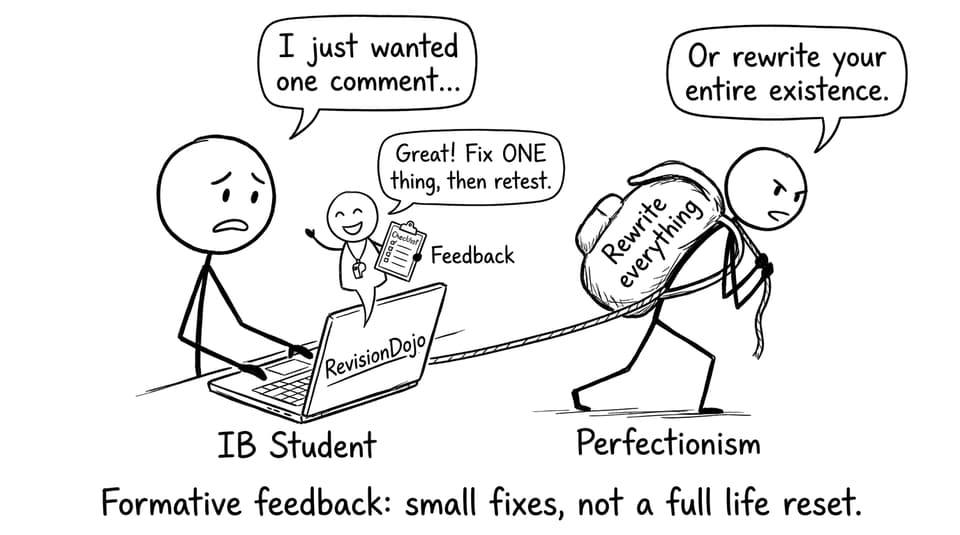
A quick checklist for stronger IB formative assessment
Use this as your simple, repeatable routine for IB exam prep:
-
Practice something small (one skill, one topic slice, one command term).
-
Get feedback quickly (mark-scheme language, not vague praise).
-
Name the error type (concept gap, technique, or timing).
-
Write one “next action” you can complete in 20-40 minutes.
-
Retest within 48 hours so the loop closes.
RevisionDojo supports this loop end-to-end with its Questionbank, Study Notes, Flashcards, AI Chat, Grading tools, Predicted Papers, Mock Exams, Coursework Library, and Tutors.
Why formative assessment matters in IB (and why it’s often wasted)
In IB, formative assessment isn’t meant to be a stream of mini-grades. It’s supposed to be information you can use.
The best feedback has three qualities:
-
Specific: tied to criteria, command terms, or a measurable skill.
-
Timely: delivered soon enough that you can still change your approach.
-
Repeatable: it tells you what to do next, and lets you try again.
When formative assessment fails, it’s rarely because students don’t care. It fails because the feedback is too general (“add more evaluation”), too slow, or disconnected from the next practice opportunity.
RevisionDojo’s design pushes against that drift. It keeps feedback close to practice, and practice close to retesting.
To understand the mindset behind this, it helps to read Making Formative Assessment Meaningful in IB Contexts and IB Formative Assessment Culture: Not a Task.
How RevisionDojo feedback tools strengthen IB formative assessment
Real-time analytics that show what to fix next
In IB, your results often hide patterns.
You might feel like you’re “bad at Biology,” when the real issue is: you miss marks on data-based questions, or you struggle when asked to “evaluate,” or your timing collapses halfway through longer responses.
RevisionDojo analytics make those patterns visible quickly. Instead of guessing what to revise, you can see what topics and question types are costing you marks, then respond with targeted practice.
If your teachers are using the Schools dashboard, the same visibility exists at class and cohort level, which means misconceptions can be addressed before they harden.
For a broader view of how this works across a department, see Empowering Teachers with RevisionDojo's Analytics and Insights and Using RevisionDojo Analytics to Improve Year-on-Year IB Results.
Feedback that saves time without becoming generic
Fast feedback is only useful if it still feels personal.
RevisionDojo helps teachers and students keep feedback consistent and criteria-aware without writing the same paragraph fifty times. That matters in IB, where the difference between “good explanation” and “full marks” often lives in one missing step.
For students, the benefit is simple: you receive feedback while you still remember what you were thinking. That makes it easier to correct the logic, not just the final sentence.
This time-saving side of feedback also reduces teacher overload, which quietly improves consistency across the year. Related reading: How IB Teachers Can Reduce Their Marking Workload.
Reflection tools that turn feedback into ownership
A weird truth about IB is that students often collect feedback like souvenirs.
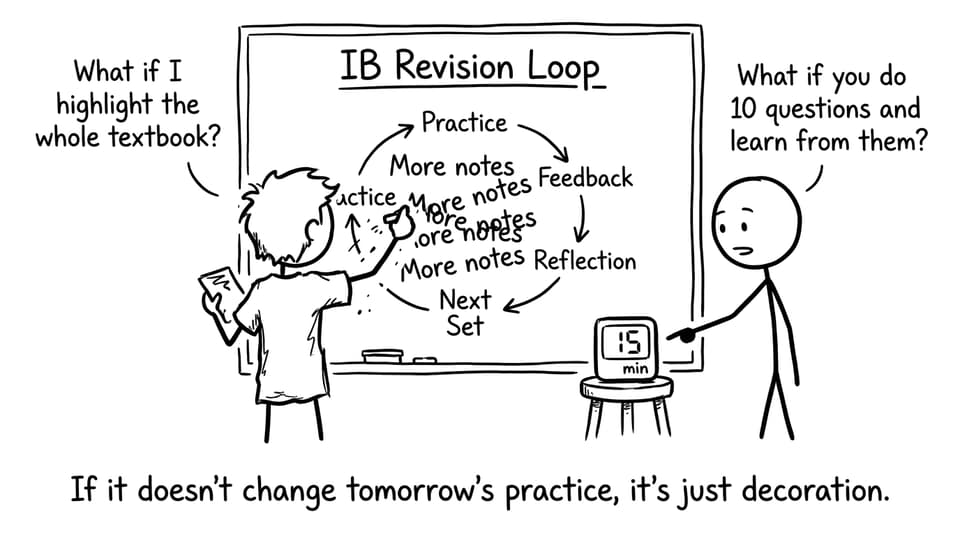
You receive comments, you nod, you feel motivated for twenty minutes, and then the note disappears into a folder called “stuff.” The fix isn’t more motivation. The fix is a built-in step that asks: what will you do next?
RevisionDojo supports that reflection loop so feedback becomes a decision, not a document. Reflection doesn’t need to be long to be powerful. A good reflection is six lines:
-
What did I do well?
-
What did I misunderstand?
-
What pattern keeps repeating?
-
What will I practice next?
-
When will I retest?
-
What will “better” look like?
If you like structured reflection for exam preparation, IB Unit Planners as Living Reflection Tools for Exams is a practical companion.
Visual progress tracking that makes growth believable
Progress in IB is often delayed. You can work hard for two weeks and still feel stuck, because your improvements are subtle: fewer dropped method marks, cleaner evaluation, faster planning.
RevisionDojo makes those gains easier to see, which matters psychologically. When progress becomes visible, you’re more likely to keep practicing the right way, instead of switching strategies every time anxiety spikes.
This is where Flashcards (small daily wins), Questionbank practice (measurable accuracy), and Mock Exams (stamina and timing) combine into a feedback system you can trust.
To build that study loop without exhaustion, see How to Study for IB Exams Without Burning Out and IB: I Study All Day but Remember Nothing.
Department-wide consistency (the underrated advantage)
Students feel it immediately when feedback standards vary wildly between classes. In IB, inconsistency is costly because criteria and expectations are already complex.
RevisionDojo for Schools helps departments align on shared language: command terms, criteria expectations, and what “good” looks like. That creates fairness, and fairness creates focus. You stop trying to decode each teacher’s personal style and start improving the same underlying skills.
You can explore the Schools platform here: RevisionDojo for Schools.
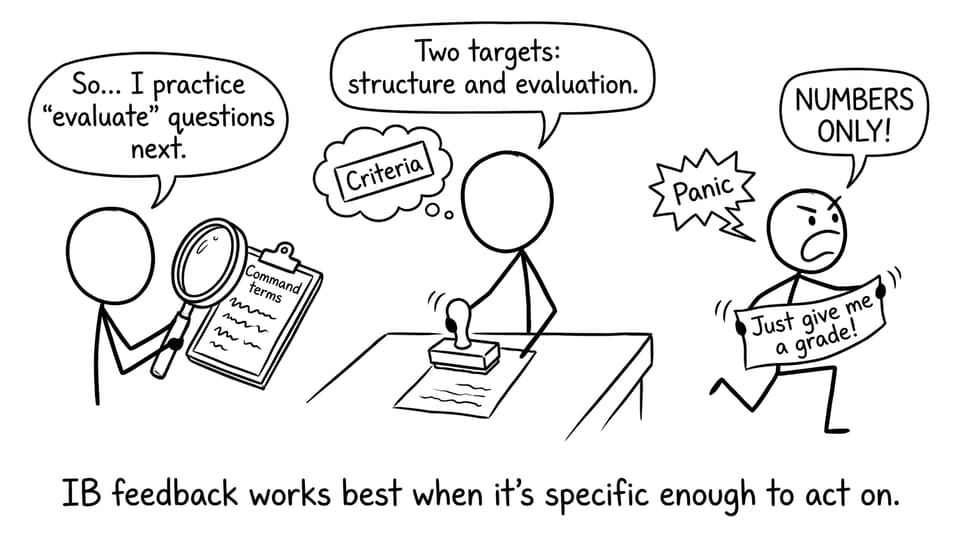
Turning IB feedback into action (a simple weekly rhythm)
Here’s a student-friendly weekly structure that makes formative assessment actually form your results:
Two short loops during the week
-
Study Notes: patch one precise gap (not a whole chapter).
-
Questionbank: 15-30 exam-style questions on that exact gap.
-
AI Chat: ask one targeted question about why you lost marks.
-
Flashcards: turn your mistake into a card (or two).
One pressure loop on the weekend
-
Sit one timed block using Mock Exams or Predicted Papers.
-
Review mistakes longer than you wrote.
-
Write 3 “error rules” (one sentence each) you will follow next time.
This is how formative assessment becomes your personal coaching system for IB: small practice, fast feedback, reflection, and retesting.
If you need a bigger strategy reset, these two posts help frame the final stretch: Why Hard Work Alone Won't Get You a 7 in IB and IB: The Last 2 Weeks Before Exams (What Matters).
Conclusion: Make IB feedback the engine, not the paperwork
The students who improve fastest in IB aren’t always the ones who “study the most.” They’re the ones who close the loop.
They practice, get feedback, reflect briefly, then retest while it still matters. They keep feedback small enough to act on, and consistent enough to compound.
RevisionDojo is built for that kind of formative assessment: Questionbank practice, AI Chat explanations, Grading tools for criteria-driven guidance, Flashcards for retention, Mock Exams and Predicted Papers for pressure rehearsal, plus a Coursework Library and Tutors when you need examples or human clarity.
If you want your next round of IB feedback to lead to visible score gains, start by exploring RevisionDojo for Schools or build your own loop with the platform’s study and feedback tools today.