Suddenly, every lesson feels like a race against the clock: more content, more markschemes, more timed answers. In that squeeze, IB Approaches to Learning (ATL) skills can start to feel like a “nice extra” you’ll return to after exams.
But here’s the quiet truth students discover too late: in the IB, revision doesn’t break down because they forgot a fact. It breaks down because they didn’t have a system for thinking, planning, checking sources, communicating under pressure, and recovering from mistakes.
ATL skills are that system. When teachers integrate ATL skills into IB revision, students don’t just revise harder. They revise with less friction and more control.
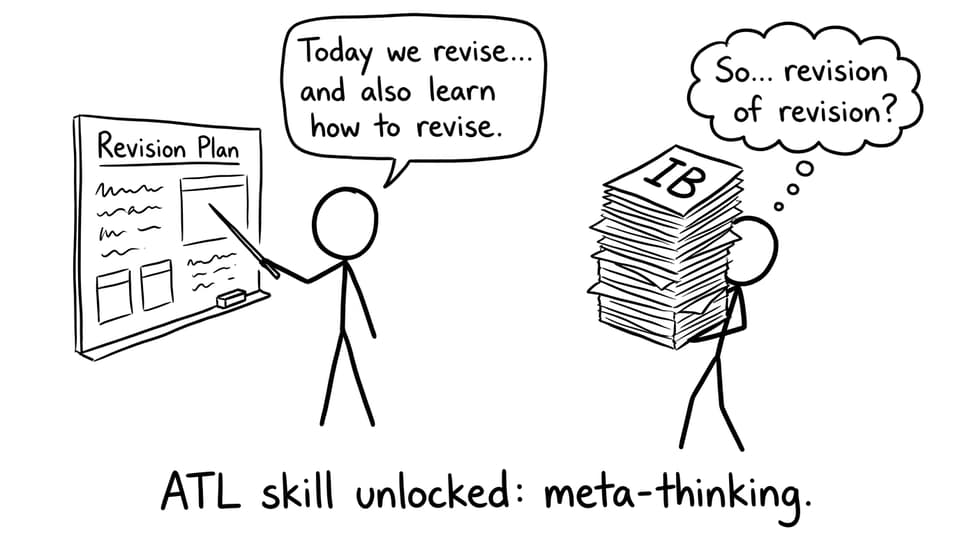
Teacher says revision of revision
Quick checklist for ATL-driven IB revision
Use this as a simple loop you can run in any IB subject (and students can repeat at home).
Choose one ATL focus for today: thinking, communication, self-management, research, or social.
Assign one exam-shaped task (questions, essay plan, data response, short timed section).
Add one visible skill behavior (a timer, question stems, source evaluation, peer feedback).
Give (self-mark, teacher comment, peer check, or tool-based feedback).
End with one reflection line: what worked and what changes next time.
If you want to make this routine effortless for students, point them to the RevisionDojo homepage so their notes, practice, and feedback sit in one place.
Why ATL skills matter in IB revision (even when time is tight)
The IB rewards students who can do more than remember. It rewards students who can choose the right method under pressure.
That’s what ATL skills train:
Thinking skills help students interpret unfamiliar prompts and command terms.
Communication skills help them structure answers so marks are actually accessible.
Self-management skills stop revision from becoming late-night chaos.
Research skills help them verify what’s true, useful, and examinable.
Social skills make feedback and collaboration productive, not vague.
When teachers make ATL visible during IB revision, students start seeing revision as a craft: repeatable, trainable, and surprisingly calm.
Integrating ATL skills into IB revision: the five categories
Thinking skills: train judgment, not just recall
In IB revision, students often confuse “I’ve seen this” with “I can do this.” Thinking ATL skills close that gap by forcing students to generate, compare, and evaluate.
Try these quick swaps:
From rereading notes to writing two “why” questions for each key idea.
From copying model answers to identifying the decision points (what makes an answer 7/7 rather than 5/7?).
From teacher-made questions only to student-made questions using command terms.
To support this, many students benefit from a clean content spine first, then hard practice. Send them to IB subject note collections so their thinking work is built on accurate, syllabus-aligned understanding.
Communication skills: make marks reachable under time pressure
In the IB, students can understand a topic and still lose marks because their explanation is unstructured, unreferenced, or unclear.
Build communication ATL into revision with routines like:
60-second teach-back: students explain one concept aloud with no notes, then refine.
Paragraph skeleton drills: claim, evidence, explanation, link (or equivalent structures by subject).
Peer marking with one rule: the marker can only comment using the rubric language.
For students who struggle to turn knowledge into exam performance, combine recall tools with application tools. The IB Flashcards with spaced repetition page is a good entry point for building quick, confident phrasing and definitions that support clearer writing.
Self-management skills: make revision boring (in the best way)
Self-management ATL is the difference between revision that feels dramatic and revision that feels inevitable.
Help students build a simple IB self-management system:
Time-box everything (even “review notes”): 15 minutes, then switch tasks.
Make goals observable: “Finish 12 questions on Topic X” beats “revise Topic X.”
Schedule recovery: sleep and short breaks become part of the plan, not a failure.
A practical extension is to teach students to use different tools for different cognitive jobs. The article IB Flashcards vs practice questions: score higher fast frames this choice in a way most IB students immediately understand.
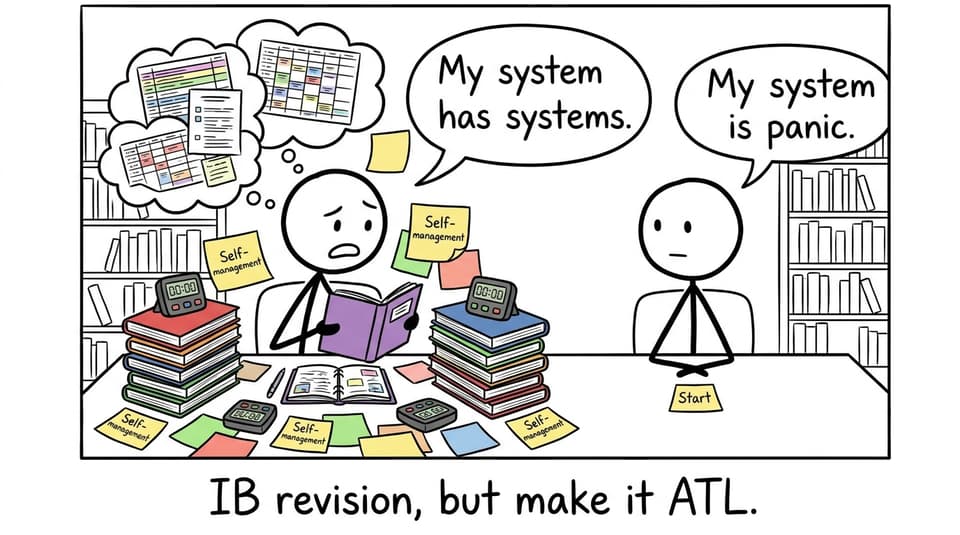
Two systems: panic vs planners
Social skills: collaboration with structure, not noise
Social ATL skills matter most when revision gets stressful. Students isolate, hide weaknesses, and compare themselves to the loudest person in the room.
Make collaboration useful by building structure:
Pairs with roles: explainer and skeptic (the skeptic must ask “how do you know?”).
Error-swaps: students exchange one mistake pattern and teach the fix.
Mini-debates: especially powerful in humanities, but even in sciences (methods, assumptions, interpretations).
This kind of revision also reduces the fear of being wrong. In the IB, that fear quietly destroys practice volume.
Research skills: verify, filter, and ask better questions
Research ATL skills aren’t only for coursework. During IB revision, they show up as:
Checking whether a definition is syllabus-accurate
Comparing explanations across sources and spotting contradictions
Turning confusion into a precise question instead of vague frustration
One of the simplest teacher moves is to model what a “good question” looks like. Then students can use support tools without becoming dependent.
RevisionDojo helps here because students can move from understanding to practice quickly: Study Notes to clarify, Questionbank to apply, and AI Chat to unblock when they’re stuck.
To make research-driven practice more systematic, share IB Question Bank: how to use it effectively and have students follow its mistake-pattern method for every IB revision set.
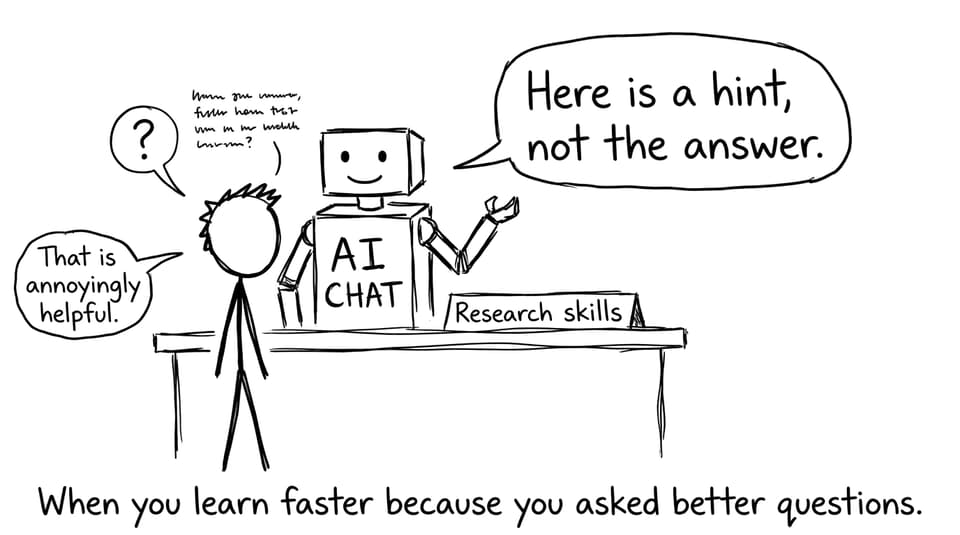
AI Chat gives a hint
Making ATL visible: the one-sentence reflection habit
The fastest way to integrate ATL into IB revision is to make it visible at the end of every task.
Ask students to complete one sentence:
“Today my biggest gain came from (ATL skill) because (reason).”
That’s it. No long journal. No performance. Just a small habit that trains metacognition.
Teachers can reinforce this by writing feedback in ATL language:
“Your thinking skills improved when you compared two explanations before choosing one.”
“Your self-management was strong because your timing matched the marks.”
“Your communication improved when you signposted the argument clearly.”
Digital routines that support ATL without adding workload
Students preparing for IB exams need a workflow that doesn’t rely on motivation.
RevisionDojo is built around that reality: students can practice with Questionbank, consolidate with Study Notes, retain with Flashcards, and improve written responses using Grading tools. When they want full rehearsal, Predicted Papers and Mock Exams turn revision into timed training. For coursework support, the Coursework Library and Tutors reduce guesswork, while AI Chat helps students refine questions and fix misunderstandings fast.
How can teachers integrate ATL skills into IB revision without losing syllabus time?
Treat ATL as a “how” layer, not a new unit. Keep the content task exactly the same (a timed response, a question set, an essay plan), and add one small ATL behavior that changes the process. For example, keep the same IB question set but require students to label each mistake as a thinking error (misread command term), communication error (unclear structure), or self-management error (ran out of time). Over a week, students start predicting their own failure modes, which is where improvement becomes fast. The key is consistency: one ATL focus per lesson is enough. Over time, the class builds a shared language for revision that feels practical, not theoretical.
What should IB students do if ATL skills feel like extra work during revision?
Start by noticing that “extra work” usually means “unclear payoff.” ATL skills have a payoff when they reduce wasted time: fewer rereads, fewer random resources, fewer repeated mistakes. A student can test this in one evening by doing two short IB sessions: one session with no structure, and one with a timer, immediate feedback, and a one-line reflection. The second session tends to feel calmer because it creates closure: you know what improved and what didn’t. If students still resist, anchor ATL to marks: show how better communication produces clearer evaluation, or how self-management prevents the final-question collapse. Once ATL is connected to results, it stops feeling optional.
How can schools track ATL growth during IB revision in a way that is actually useful?
Track behaviors that predict performance, not vague traits. Useful indicators include: how often students reattempt mistakes, whether timing improves across weeks, and whether reflections move from “I need to study more” to specific plans like “I will do 15 minutes of Topic X questions and then recheck command terms.” Schools can also track which ATL category is the most common bottleneck by subject: self-management often dominates in mathematics and sciences, while communication often dominates in humanities and languages. A platform approach helps because it makes progress visible without extra paperwork. This is why tools like RevisionDojo for Schools are valuable: they let teachers see practice volume, weak areas, and improvement loops in one place. When tracking feels light, it gets done, and students benefit.
Closing: ATL is the quiet advantage in IB revision
The best IB revision doesn’t look heroic. It looks repeatable.
When teachers integrate ATL skills into revision, students gain something bigger than a better plan for tonight: they gain a method they can trust when the exam clock starts. Thinking becomes sharper, communication becomes clearer, self-management becomes steadier, research becomes faster, and collaboration becomes genuinely supportive.
If you want that entire loop in one place, send students to RevisionDojo and build a routine that connects Study Notes, Flashcards, Questionbank, AI Chat, Grading tools, Predicted Papers, Mock Exams, and support from Tutors. In the IB, confidence is rarely a personality trait. It’s usually a system that finally works.