



RevisionDojo logoRevisionDojo logo
PricingSchools
  1. Home
  2. /Blog
  3. /IB Design Technology: Go From Grade 5 to a 7

IB Design Technology: Go From Grade 5 to a 7

IB Design Technology
RevisionDojo Team
•Last updated: 19 Jul 2026•8 min read
Jojo holding a cookie

This site uses cookie tracking technologies. Learn more in our Cookie Policy.

Share on
Share on
Share on
4.1/5 from students worldwide
Share
Share on X

If you are sitting on a Grade 5 in IB Design Technology, it can feel like you are running on a treadmill: effort goes in, the number barely moves.

But the Grade 5-to-7 jump is rarely about learning a mountain of new content. It is about changing what you do with the content you already have. Grade 7 answers are not longer. They are sharper. They make decisions, show trade-offs, and sound like someone who is designing for a real user rather than narrating a textbook.

This guide will show you the exact habits that lift IB Design Technology responses into the top markbands, and how to practise them without burning out.
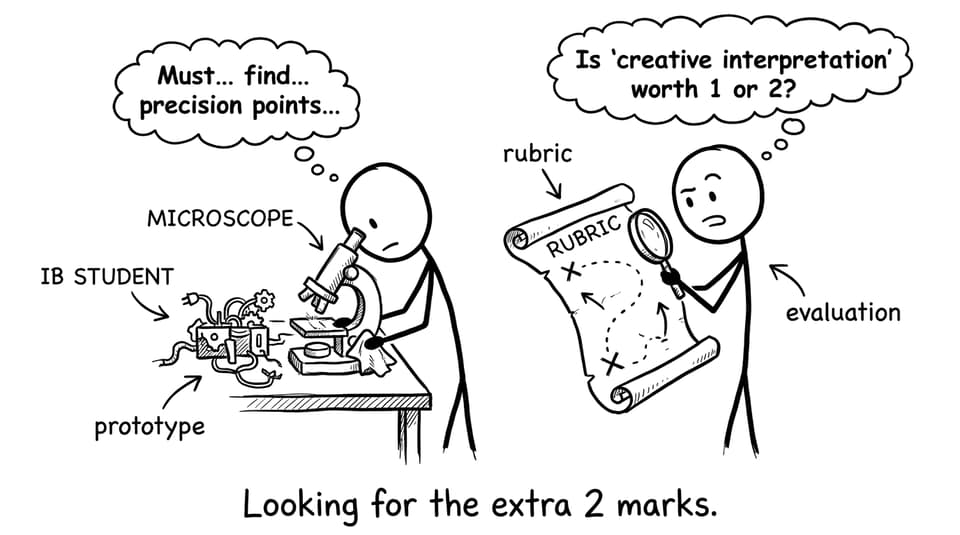
Stick figure polishing prototype while examiner holds rubric map

The 7-point checklist (save this before you revise)

Use this as your weekly loop for IB Design Technology:

  • Answer using the command term first, not the topic.

  • Apply every concept to the given product, user, or scenario.

  • Add at least one limitation or risk to any “benefit” point.

  • Use one strong example and explain it, instead of listing three.

  • Structure extended responses so evaluation is unavoidable.

  • Practise timed questions and stop when marks are “fully met.”

  • Fix your IA with evidence, iteration, and honest reflection.

For a central hub of aligned resources, start with IB Design Technology Resources.

Why you get stuck at Grade 5 in IB Design Technology

A Grade 5 answer often has correct ideas, but they sit on the surface. It will define ergonomics, mention sustainability, or name a manufacturing process. That is not wrong. It is just incomplete.

In IB Design Technology, marks rise when your writing starts doing three things at once:

  • Application: linking theory to the specific scenario.

  • Justification: showing cause and effect (why this choice works).

  • Evaluation: weighing benefits against limitations and constraints.

If your response could be copied into a different question with minimal changes, it is probably capped.

What Grade 7 answers in IB Design Technology do differently

Grade 7 work sounds like a designer thinking out loud.

A top response will usually:

  • Anchor points to a user need and a context constraint.

  • Use DT vocabulary precisely, then move beyond it.

  • Compare options and explain trade-offs.

  • Finish with a judgement that is justified, not dramatic.

When in doubt, borrow the rhythm of the design cycle. If you want to build that mindset, RevisionDojo’s DT lessons on process thinking help a lot: B2.1 The Design Process Lessons.

Master command terms (the fastest marks in IB Design Technology)

Many Grade 5 students lose marks because they answer a different question than the examiner asked.

Train yourself to translate command terms into a sentence starter:

  • Describe = “This is what it is like…”

  • Explain = “This happens because…”

  • Analyse = “This leads to these consequences…”

  • Evaluate = “Overall, the best option is X because…, however…”

A simple drill: do 10 mixed command term questions and underline the phrase where you actually deliver the command term. If you cannot underline it, you did not do it.

For targeted practice, use RevisionDojo’s exam-style sets like B2.2 Modelling and Prototyping Questionbank.
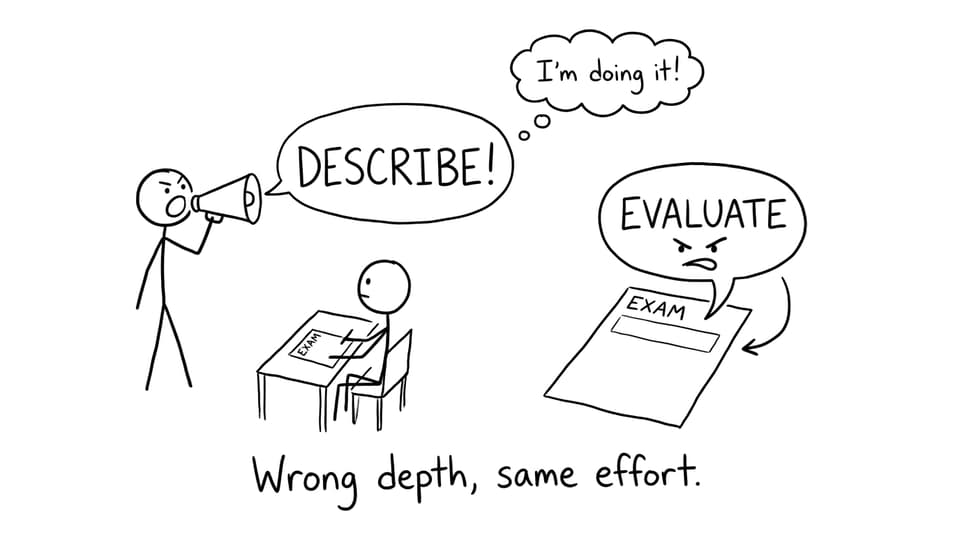
Student yells DESCRIBE while command term bubble says EVALUATE

Make your answers impossible to copy-paste

A reliable Grade 7 move in IB Design Technology is being specific.

Try this quick upgrade:

  • Replace “the product” with the actual product.

  • Replace “users” with a named user group.

  • Replace “better” with a performance measure (durability, safety, cost, aesthetics, carbon footprint).

Example shift:

  • Grade 5: “Injection moulding is good for mass production.”

  • Grade 7: “Injection moulding suits a high-volume run of identical phone cases because tooling cost is high but unit cost drops sharply; however, design changes become expensive once the mould is made.”

Want more context-rich prompts? RevisionDojo’s DT topic practice (for example, A3.1 Material Classification and Properties Questionbank) forces you to apply materials knowledge rather than recite it.

Add balanced evaluation (the Grade 7 separator)

Evaluation is not “being negative.” It is showing you understand constraints.

A simple pattern that works across IB Design Technology:

  • Claim: choose the best option for the context.

  • Evidence: one reason tied to performance/user.

  • Limit: one drawback or condition.

  • Judgement: why it is still best (or when it would not be).

Even two sentences of real evaluation can push a response up a markband.

If sustainability topics appear, practise evaluation with product lifecycle thinking: 5.5 Product Life Cycle Questionbank.

Structure extended responses so marks “show up”

Unstructured writing hides your best thinking. A Grade 7 structure makes it obvious.

Use this DT paragraph template:

  • Concept (1 line): define the relevant idea.

  • Application (1--2 lines): connect to the scenario.

  • Mechanism (1--2 lines): explain cause and effect.

  • Evaluation (2 lines): trade-off, limitation, condition.

  • Conclusion (1 line): justified judgement.

On RevisionDojo, you can build this habit by using Questionbank + AI feedback through the IB Design Technology Resources page, then tightening answers with AI Chat when your evaluation feels vague.
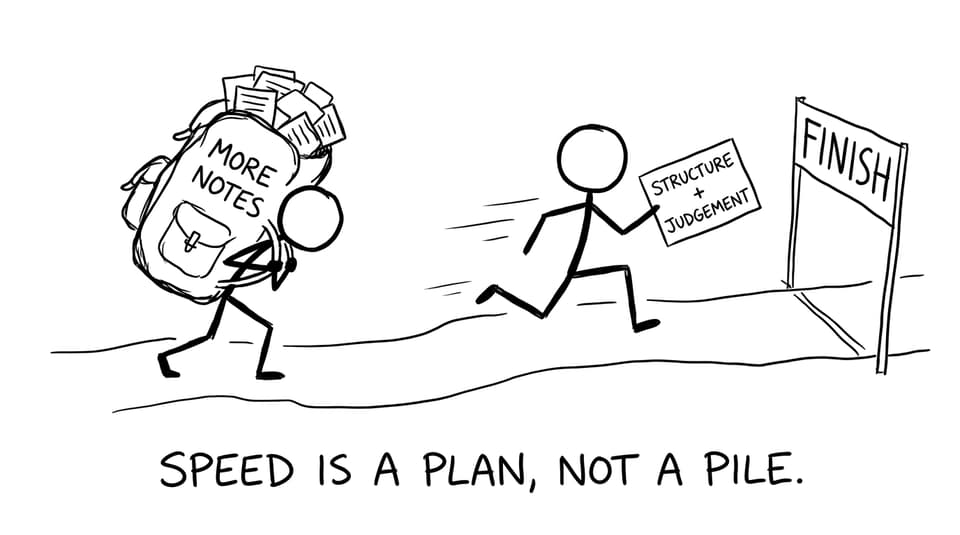
Two racers: one carrying “more notes”, one carrying “structure + judgement”

Do not ignore the IA: it trains the exact Grade 7 skills

If you want a 7 in IB Design Technology, your IA should make you better at:

  • Justifying decisions with evidence.

  • Iterating (and proving it).

  • Testing prototypes and interpreting results.

  • Writing honest, criteria-linked evaluation.

Use these supports to tighten your coursework:

  • Step-by-Step Guide to Writing a Winning IB Design Technology IA

  • How Do You Finalise and Submit the IB Design Technology IA

  • IB Design Technology HL IA Grader

  • IB Design Technology SL IA Grader

  • IB Design Technology Exemplars

A final push: turn RevisionDojo into your Grade 7 system

Getting a 7 in IB Design Technology is not about being “naturally creative.” It is about being consistently precise: command terms, context, evaluation, and structure.

If you want a clean workflow, use RevisionDojo as your basecamp: practise with the Questionbank, lock in knowledge with Study Notes and Flashcards, check your coursework with the Grading tools and Coursework Library, and sharpen weaknesses with AI Chat. Add Predicted Papers and Mock Exams when you need full exam pacing, and pull in Tutors when you want feedback that saves weeks.

Pick one habit from this article and start today. Your next IB Design Technology test should feel different for a simple reason: your answers will finally be doing the thinking the marks are rewarded for.

How helpful was this article?
Add as a preferred source on Google

Continue studying with RevisionDojo

  • IB Coursework GraderCheck an IA, EE, or TOK draft against IB assessment criteria.
  • IB Coursework ExamplesLearn from high-scoring coursework across IB subjects.
  • IB Grade CalculatorEstimate an IB grade using session-specific boundaries.
  • IB Grade BoundariesExplore historical grade boundaries by subject and session.

Join 650k+ students breezing through the IBReady to breeze through the IB?

Footer

General

  • For parents
  • For schools
  • Pricing
  • Gift RevisionDojo
  • Tutoring
  • IB syllabus
WhatsApp
LinkedIn
Facebook

Frequently Asked Questions

  • MYP syllabus
  • Blog
  • Research
  • Features

    • Jojo AI
    • Questionbank
    • Notes
    • Flashcards
    • Test builder
    • Exam mode
    • Coursework
    • Coursework grader
    • Coursework examples
    • Predicted papers
    • IB grade calculator
    • Grade boundaries

    Research

    • State of learning survey
    • IB Moderation Analysis
    • Jojo AI vs ChatGPT
    • Jojo AI vs Gemini
    • Jojo AI vs Perplexity
    • Jojo AI vs Claude
    • Jojo AI vs Poe

    Platform

    • RevisionDojo vs Others
    • Content philosophy
    • Trustpilot
    • Join usWe're hiring
    • Terms and conditions
    • Privacy policy
    • Cookie policy
    • Trust Center

    MYP Subjects

    • MYP Biology
    • MYP Chemistry
    • MYP English Lang & Lit
    • MYP Extended Mathematics
    • MYP History
    • MYP Individuals & Societies
    • MYP Physics
    • MYP Standard Mathematics
    • MYP Biology
    • MYP Chemistry
    • MYP English Lang & Lit
    • MYP Extended Mathematics
    • MYP History
    • MYP Individuals & Societies
    • MYP Physics
    • MYP Standard Mathematics

    IB Subjects

    • Arabic ab initio
    • Arabic B
    • Biology
    • Business Management
    • Chemistry
    • Chinese A Lang & Lit
    • Chinese B
    • Computer Science (CS)
    • Computer Science (First Exam 2027)
    • Design Technology (DT)
    • Design Technology (First Exam 2027)
    • Digital Society (DS)
    RevisionDojo logo

    © 2022 - 2026 RevisionDojo (MyDojo Inc)

    RevisionDojo was developed independently of the IBO and as such is not endorsed by it in any way.

    GDPR compliantDownload on the App Store

    Related Articles

    IB Design Technology · 4 min read

    What Extra Topics Are Covered in IB Design Technology HL?

    Learn what extra topics IB Design Technology HL students study, how HL content is deeper than SL, and what this means for exams and coursework.

    IB Design Technology · 7 min read

    IB Design Technology IA: How to Show Real Iteration

    IB Design Technology iteration made simple: learn what counts, where to show it in your IA, and how to document changes for higher marks.

    IB Design Technology · 8

    IB Design Technology Problem Statement: Write It Strong

    IB Design Technology problem statement guide: learn the user-first formula, avoid solution language, add evidence, and set up high-scoring IA work.

    IB Design Technology · 8

    IB Design Technology IA Referencing: A Simple Guide

    IB Design Technology IA referencing made simple: what to cite, how to format in-text citations, and how to avoid plagiarism with consistent sources.

    IB Design Technology · 7

    IB Design Technology Without Creativity: Can You Still Excel?

    IB Design Technology success isn’t about being artistic. Learn what examiners reward, how to score higher, and how RevisionDojo helps.

    IB Design Technology · 7

    Common IB Design Technology Exam Mistakes (and Fixes)

    IB Design Technology exam mistakes are predictable. Learn the most common errors and quick fixes for command terms, evaluation, timing, and structure.

  • Economics
  • English A Lang & Lit
  • English A Lit
  • English B
  • Environmental systems and societies (ESS)
  • French A
  • French ab initio
    • French B
    • Geography
    • German A
    • German ab initio
    • German B
    • Global Politics
    • History
    • Mathematics Analysis and Approaches (AA)
    • Mathematics Applications & Interpretation (AI)
    • Philosophy
    • Physics
    • Psychology
    • Psychology (First Exam 2027)
    • Spanish A
    • Spanish ab initio
    • Spanish B
    • Sports, exercise and health science (SEHS)
    • Theory of Knowledge (TOK)
    • Arabic ab initio
    • Arabic B
    • Biology
    • Business Management
    • Chemistry
    • Chinese A Lang & Lit
    • Chinese B
    • Computer Science (CS)
    • Computer Science (First Exam 2027)
    • Design Technology (DT)
    • Design Technology (First Exam 2027)
    • Digital Society (DS)
    • Economics
    • English A Lang & Lit
    • English A Lit
    • English B
    • Environmental systems and societies (ESS)
    • French A
    • French ab initio
    • French B
    • Geography
    • German A
    • German ab initio
    • German B
    • Global Politics
    • History
    • Mathematics Analysis and Approaches (AA)
    • Mathematics Applications & Interpretation (AI)
    • Philosophy
    • Physics
    • Psychology
    • Psychology (First Exam 2027)
    • Spanish A
    • Spanish ab initio
    • Spanish B
    • Sports, exercise and health science (SEHS)
    • Theory of Knowledge (TOK)
    min read
    min read
    min read
    min read